🇹🇷 Portrait of a European — Turkey
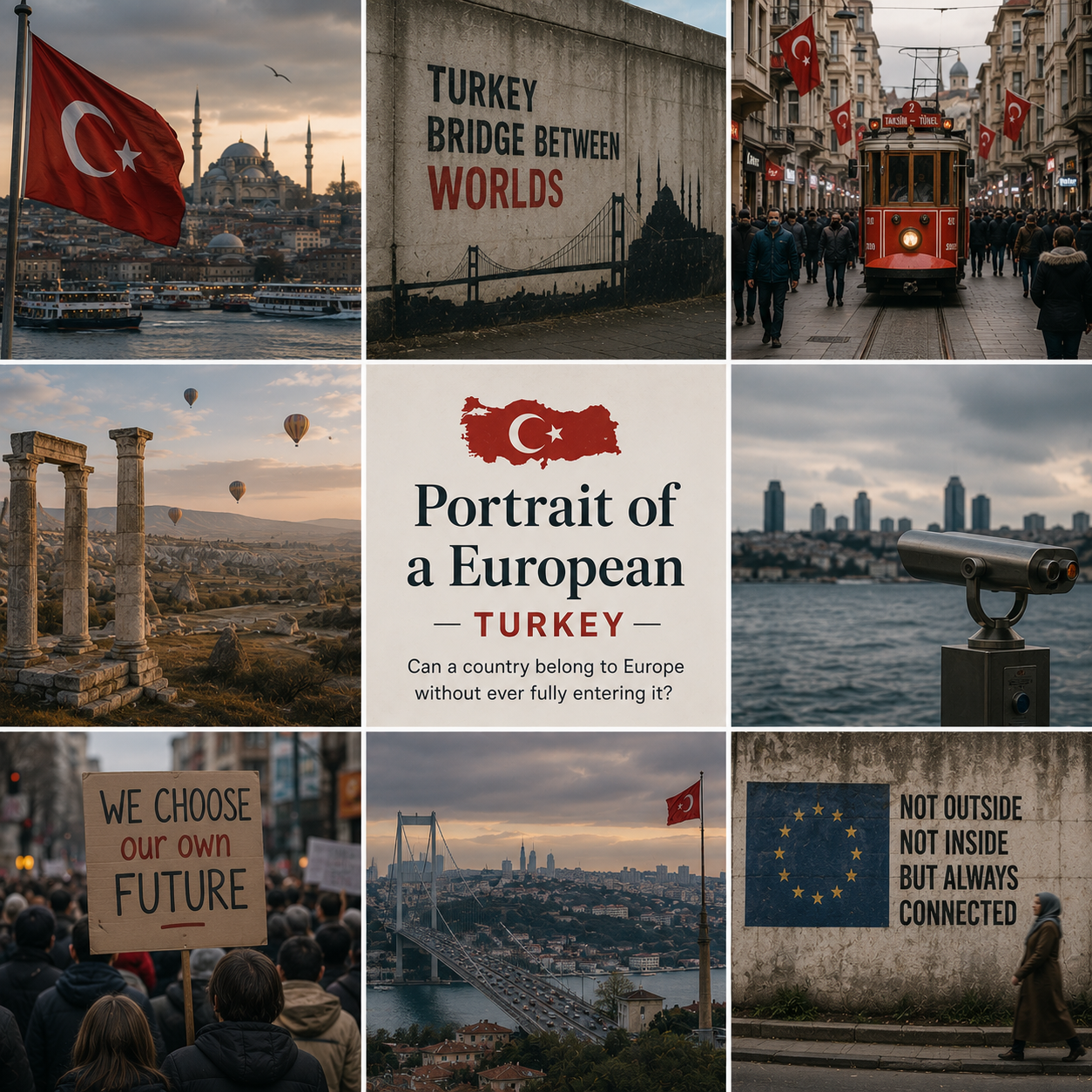
Can a country belong to Europe without ever fully entering it?
🇹🇷 Snapshot
- Capital: Ankara
- Population: ~85 million
- Economy: manufacturing, logistics, tourism, defence industry and regional trade
- Position: transcontinental NATO power balancing Europe, the Middle East and Asia simultaneously
Turkey feels impossible to place neatly inside a single category. European. Asian. Mediterranean. Middle Eastern. Secular. Religious. Western-aligned. Strategically autonomous. It is perhaps Europe’s most persistent question mark.
👤 The average Turk
Life in Turkey is shaped by intensity.
- rapid urbanisation
- economic volatility
- strong family structures
- political polarisation
- and constant geopolitical awareness
Common professions:
- manufacturing and trade
- tourism and services
- logistics and construction
- growing defence and technology sectors
Daily life often feels energetic and adaptive. But also politically charged.
🧬 Demography & society
Turkey is young compared to much of Europe.
Its large population creates:
- economic dynamism
- entrepreneurial energy
- urban growth
But also:
- pressure on housing
- inequality
- political tension
- and generational divides
In cities like Istanbul:
- hyper-modern business districts
- global connectivity
- secular lifestyles
Elsewhere:
- stronger conservatism
- traditional social structures
- more visible religious identity
Turkey contains multiple social realities simultaneously.
🧠 Self-image
The Turkish self-image is deeply shaped by historical continuity and strategic consciousness.
There is pride in:
- civilisation
- sovereignty
- resilience
- national independence
But also frustration.
Because Turkey spent decades positioned as:
- strategically necessary for Europe
- economically connected to Europe
- militarily tied to Europe through NATO
Yet never fully accepted politically as European. That ambiguity became psychologically significant. Turkey increasingly sees itself not as a future European member—but as an independent regional power.
🇪🇺 Relationship with Europe
The relationship with Europe remains emotionally complicated. Turkey is deeply intertwined with Europe through:
- trade
- migration
- security
- tourism
- and infrastructure corridors
Millions of Turks live across European societies. And yet Turkey often feels positioned outside Europe culturally and politically. That creates a paradox: Turkey is too connected to be external, but too contested to become fully internal.
⚖️ Tension
This is where Turkey becomes especially revealing.
It balances between:
- secularism and religion
- democracy and centralisation
- NATO alignment and strategic autonomy
- European integration and civilisational independence
Migration intensified this further. Turkey became one of Europe’s major geopolitical buffers: holding migration routes, managing regional instability and negotiating constantly with European institutions. At the same time, Ankara increasingly pursues an autonomous geopolitical course. That makes Turkey simultaneously: partner, neighbour, challenge and mirror.
🏡 Everyday life
Life feels fast, crowded and emotionally expressive.
In Istanbul:
- global commerce
- immense density
- visible inequality
- cultural overlap everywhere
Across the country:
- strong hospitality culture
- deep local identity
- visible political symbolism
- rapid social change
Turkey often feels like several centuries existing simultaneously inside one society.
✨ What makes Turkey unique
Turkey forces Europe to confront an uncomfortable question: Is Europe primarily: geographic, political, cultural, religious or civilisational? Because Turkey touches all of those boundaries simultaneously.
The country reveals that European identity has never been entirely clear or fixed. And perhaps that ambiguity matters more now than ever.
🪞 Closing
This is a portrait of a European. And perhaps not. Not shaped by simple belonging. But by permanent proximity. Not defined by entry. But by connection without full inclusion.
This is what Europe looks like—when its boundaries remain psychologically unresolved.
This article is part of Portrait of a European — a series exploring how people across Europe see themselves through work, identity and everyday life. Each edition offers a local perspective on a shared continent.
📷 Caption
A glimpse of everyday life in Turkey—where Europe, Asia, religion, secularism and geopolitical ambition intersect across one of the world’s most psychologically and strategically complex societies.
✍️ Credit
Altair Media — Portrait of a European series
