🇬🇧 Portrait of a European — United Kingdom
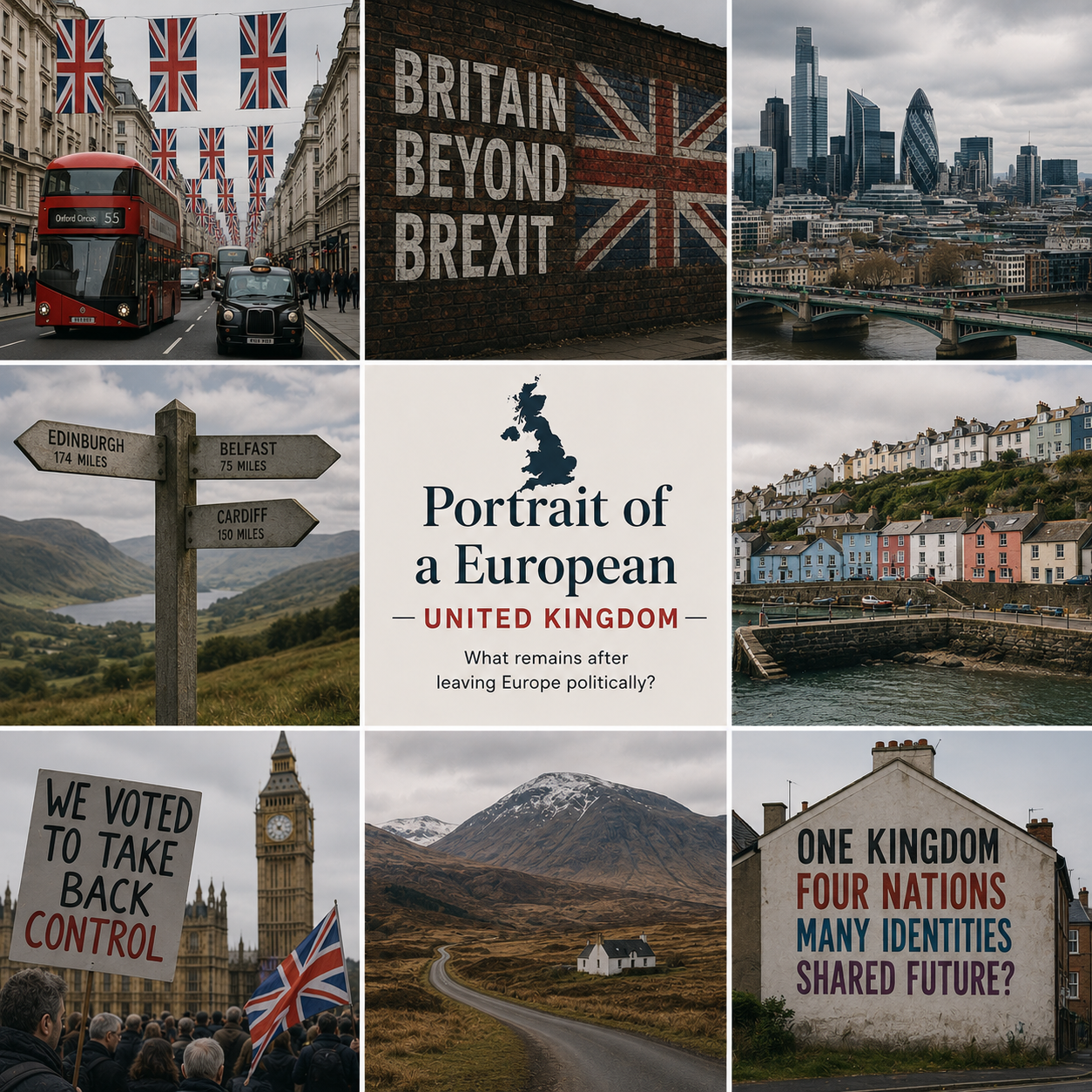
What remains after leaving Europe politically?
🇬🇧 Snapshot
- Capital: London
- Population: ~68 million
- Economy: finance, services, technology, higher education and global trade
- Position: former EU member balancing global ambition, internal fragmentation and post-Brexit identity
The United Kingdom feels familiar to Europe. But no longer fully inside it. Brexit did not simply change treaties or markets.
It exposed deeper questions about:
- sovereignty
- identity
- geography
- and belonging itself
Because leaving politically does not automatically mean leaving psychologically, economically or culturally.
👤 The average Briton
Life in the United Kingdom depends heavily on where you are.
In London:
- global finance
- international talent
- hyper-connectivity
- extreme economic concentration
Elsewhere:
- post-industrial regions
- economic frustration
- infrastructure inequality
- stronger local identities
Common professions:
- services and finance
- healthcare and education
- logistics and retail
- technology and creative sectors
The country feels globally connected. But internally uneven.
🧬 Demography & society
The United Kingdom contains multiple national identities simultaneously:
- English
- Scottish
- Welsh
- Northern Irish
That tension existed long before Brexit. But Brexit made it visible.
Especially because Europe was experienced differently across the union:
- economically
- culturally
- emotionally
London often felt European and global. Other regions often felt distant from both London and Brussels. That divide reshaped British politics permanently.
🧠 Self-image
The British self-image remains deeply tied to sovereignty and historical continuity.
There is pride in:
- parliamentary tradition
- institutional history
- global influence
- cultural impact
But Brexit also revealed uncertainty. Because the United Kingdom increasingly faces a difficult question: What is Britain after empire, after European integration and inside a fragmented global order? That question remains unresolved.
🇪🇺 Relationship with Europe
The relationship with Europe became psychologically complicated after Brexit. The UK left the European Union politically.
But Europe remains deeply present through:
- trade
- culture
- migration
- security
- geography
The country did not stop being European geographically. But politically, it chose distance. That creates an unusual condition: a country both inside and outside Europe simultaneously.
⚖️ Tension
This is where the United Kingdom becomes especially revealing.
It balances between:
- sovereignty and interdependence
- global ambition and regional fragmentation
- national identity and multinational reality
Brexit promised clarity. Instead, it exposed how layered British identity had become. Because “Britain” never existed as a single emotional experience everywhere. Scotland often feels more European than England. London often feels detached from large parts of the country itself. And younger generations frequently experience Europe differently than older generations.
🏡 Everyday life
Life differs dramatically across the UK.
In London:
- global capital
- immense diversity
- financial intensity
- high housing pressure
In former industrial regions:
- slower recovery
- economic frustration
- stronger attachment to locality and continuity
In Scotland and Wales:
- distinct cultural identity
- different political orientations
- stronger debate about the future of the union itself
The United Kingdom increasingly feels like multiple countries negotiating coexistence within one structure.
✨ What makes the United Kingdom unique
The UK reveals something profound about Europe. Leaving political integration does not automatically resolve questions of identity.
If anything, Brexit exposed how interconnected Europe had already become: economically, culturally and psychologically.
The United Kingdom became a mirror for a wider European tension: How much sovereignty is possible inside deeply interconnected systems? And can nations fully step back from structures they helped shape for decades?
🪞 Closing
This is a portrait of a European. Not shaped by departure alone. But by ambiguity. Not defined by leaving. But by what remains afterwards.
This is what Europe looks like—when separation reveals how connected everything already was.
This article is part of Portrait of a European — a series exploring how people across Europe see themselves through work, identity and everyday life. Each edition offers a local perspective on a shared continent.
📷 Caption
A glimpse of everyday life in the United Kingdom—where Brexit, regional identity and global ambition continue to shape how people understand sovereignty, belonging and Europe itself.
✍️ Credit
Altair Media — Portrait of a European series
