🇧🇦 Portrait of a European — Bosnia and Herzegovina
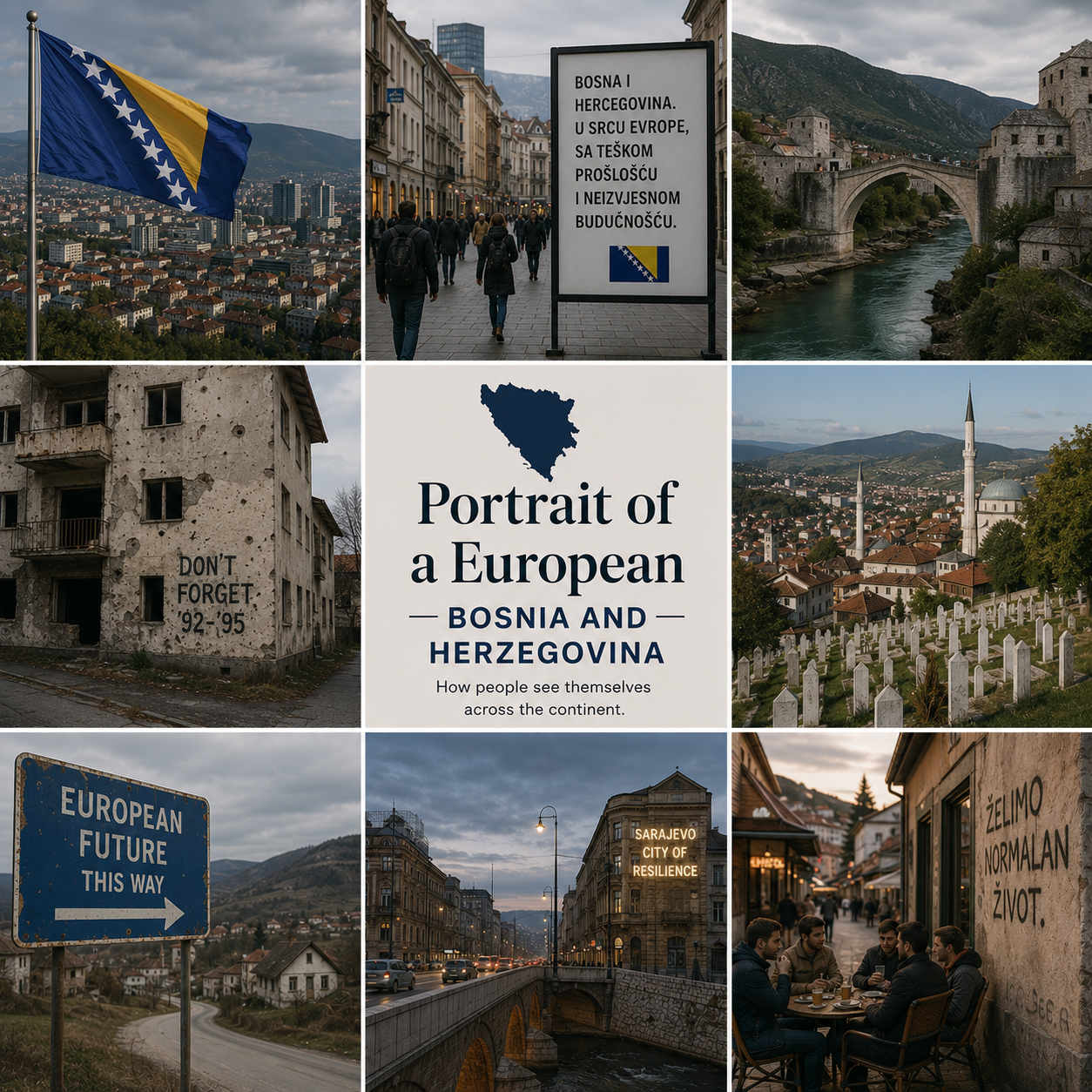
What if history never fully ends?
🇧🇦 Snapshot
- Capital: Sarajevo
- Population: ~3.2 million
- Economy: services, manufacturing, remittances and limited industrial growth
- Position: Western Balkan state shaped by post-war governance, ethnic fragmentation and unfinished European integration
Bosnia and Herzegovina feels suspended. Not entirely unstable. But not fully resolved. A country where history does not simply belong to the past. It remains present: in institutions, in memory and sometimes even in geography itself.
👤 The average Bosnian
Life is shaped by adaptation and endurance.
Many people navigate:
- economic uncertainty
- political stagnation
- fragmented governance systems
- and limited long-term confidence in institutions
Common professions:
- services and retail
- manufacturing
- tourism
- public administration
For younger generations especially, the future often feels uncertain. Not because there is no talent or ambition—but because the system itself often feels difficult to move.
🧬 Demography & society
Bosnia and Herzegovina is one of Europe’s most internally fragmented societies. The country operates through a highly complex political structure created after the Bosnian War:
- multiple governments
- overlapping institutions
- ethnic power-sharing arrangements
The result is peace. But also paralysis.
At the same time, many communities remain shaped by:
- wartime memory
- demographic separation
- unresolved historical narratives
Daily life can appear calm. Yet memory remains structurally embedded in society.
🧠 Self-image
The Bosnian self-image is layered and often emotionally complex.
There is pride in:
- cultural coexistence
- resilience
- survival
- local identity
But also fatigue. Because many people feel trapped between:
- historical trauma
- political fragmentation
- and an uncertain European future
Bosnia often feels like a country asked to remain functional without ever fully becoming whole again.
🇪🇺 Relationship with Europe
Europe represents hope for many Bosnians.
Associated with:
- stability
- mobility
- economic opportunity
- institutional normalisation
But there is also disappointment. Because the European promise often feels permanently delayed. Bosnia and Herzegovina exists physically inside Europe.
Yet psychologically and institutionally, many citizens still experience distance from the European project. That creates frustration—especially among younger generations.
⚖️ Tension
This is where Bosnia and Herzegovina becomes especially revealing.
It balances between:
- peace and paralysis
- coexistence and fragmentation
- European aspiration and structural stagnation
The country demonstrates something uncomfortable: Ending conflict is not the same as resolving history. Institutions can stop violence. But they cannot automatically rebuild trust, identity or shared direction. That process takes generations.
🏡 Everyday life
Life moves slowly.
In Sarajevo:
- cafés full of conversation
- visible Ottoman and Austro-Hungarian history
- strong cultural identity
Elsewhere:
- depopulating villages
- economic stagnation
- quiet social fragmentation
There is beauty everywhere in Bosnia and Herzegovina. But also visible exhaustion.
✨ What makes Bosnia and Herzegovina unique
Bosnia and Herzegovina reveals something profound about Europe itself. European stability is often discussed as if history naturally fades over time.
Bosnia shows that history can remain institutionally alive for decades. Not through active conflict alone. But through structures built around unresolved memory.
That makes the country deeply important to understand. Because it asks Europe a difficult question: What happens when peace arrives before reconciliation does?
🪞 Closing
This is a portrait of a European. Not shaped by forgetting. But by remembering. Not defined by resolution. But by continuation.
This is what Europe looks like—when history never fully disappears.
This article is part of Portrait of a European — a series exploring how people across Europe see themselves through work, identity and everyday life. Each edition offers a local perspective on a shared continent.
📷 Caption
A glimpse of everyday life in Bosnia and Herzegovina—where memory, fragmentation and resilience continue to shape how people navigate identity, coexistence and Europe’s unfinished promises.
✍️ Credit
Altair Media — Portrait of a European series
