What Is AskDiana?
Can Enterprise AI Be Built Differently?
EDITORIAL CASE STUDY · SIGNAL I
Artificial intelligence is becoming an integral part of organisational decision-making. Yet as enterprise AI expands, so do questions about trust, governance and control. AskDiana argues that the future depends not on larger language models, but on a different architectural approach to knowledge itself.
🟦 Is AskDiana just another enterprise AI platform?
Enterprise AI has become one of the fastest-growing segments of the technology industry. New platforms appear almost weekly, promising greater productivity, stronger security, enhanced privacy and more efficient decision-making. At first glance, AskDiana seems to enter this increasingly competitive landscape. Its positioning, however, is noticeably different.
Rather than presenting itself primarily as an AI assistant or productivity tool, AskDiana describes itself as a private Business AI platform built around organisational control, trusted reasoning and knowledge governance. In doing so, it shifts the conversation away from what AI can generate towards how organisations can manage, govern and rely upon the knowledge those systems produce.
The distinction immediately raises a broader question: is AskDiana simply another enterprise AI platform or does it represent a different architectural approach to enterprise intelligence?
🟦 Why was AskDiana developed?
According to its developer, 4Square Innovations, the greatest challenge facing enterprise AI is not access to increasingly powerful language models. It is the growing dependence of organisations on AI systems they neither control nor fully understand.
Public models, unpredictable costs, vendor dependency and opaque reasoning are presented not as isolated operational concerns, but as symptoms of a deeper architectural problem.
AskDiana therefore begins from a different premise. Enterprise AI should not merely automate work; it should strengthen organisational control over knowledge, reasoning and institutional decision-making.
🟦 Why build it in Europe?
The platform originates in Lithuania, one of Europe’s emerging technology ecosystems. While the global AI landscape continues to be shaped largely by American and Chinese technology companies, Europe is increasingly pursuing its own path—one that places greater emphasis on governance, transparency, digital sovereignty and institutional trust.
Within that broader context, AskDiana reflects more than the ambitions of a single company. It illustrates a wider European effort to explore how enterprise AI might evolve when long-term control and accountability become architectural priorities rather than optional features.
🟦 What makes its architectural vision different?
Many enterprise AI platforms compete by offering larger models, longer context windows and more advanced capabilities. AskDiana suggests that these improvements alone do not resolve the underlying challenge.
Its research focuses instead on how organisations preserve trustworthy knowledge over time. Concepts such as Conversation Intelligence, knowledge decay, context management and consensus reasoning point towards an alternative way of thinking about enterprise AI—not simply as language generation, but as the architecture through which organisational knowledge is organised, maintained and governed.
Whether these ideas ultimately translate into measurable advantages remains to be demonstrated. They do, however, expand the conversation beyond model performance alone.
🟦 Does AskDiana represent the future of enterprise AI?
It is far too early to answer that question.
AskDiana remains one of many competing approaches within a rapidly evolving market. Yet its significance lies less in the claims it makes than in the questions it raises. As enterprise AI becomes embedded within organisations, issues such as governance, trust, explainability and knowledge management are likely to become as important as the models themselves.
Regardless of its commercial trajectory, AskDiana invites a broader discussion about how organisations should design, govern and trust artificial intelligence in the years ahead.
■ Signify
AskDiana is not interesting simply because it introduces another enterprise AI platform. It is interesting because it challenges one of the dominant assumptions shaping today’s AI landscape: that larger models alone will solve the problems organisations face. Whether its architectural approach ultimately proves successful remains an open question. The questions it raises about knowledge, governance and institutional trust, however, are likely to remain central to the future of enterprise AI.
Next Signal
Who Is AskDiana Built For?
From SMEs to Governments
If AskDiana proposes a different architecture for enterprise AI, an equally important question follows. Which organisations stand to benefit most—and can a single platform realistically meet the needs of businesses, governments and public institutions alike?
Photo credit
Illustration: Altair Media / OpenAI (concept visualisation)
Caption
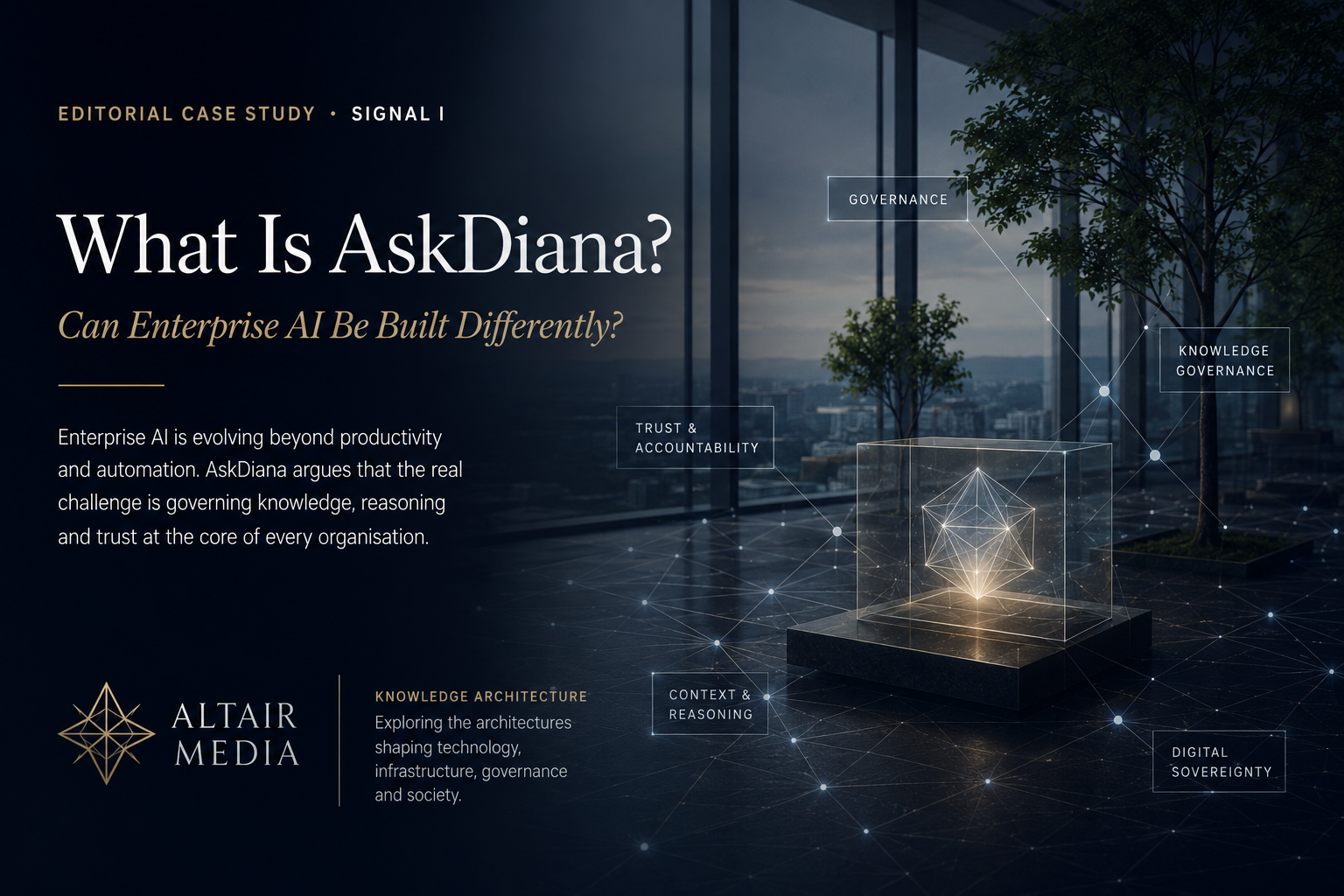
Concept illustration for Editorial Case Study – Signal I: “What Is AskDiana? Can Enterprise AI Be Built Differently?” The artwork visualises the shift from AI as a productivity tool towards AI as an architectural framework for knowledge governance, trusted reasoning and European digital sovereignty.
