The Sovereign Developer
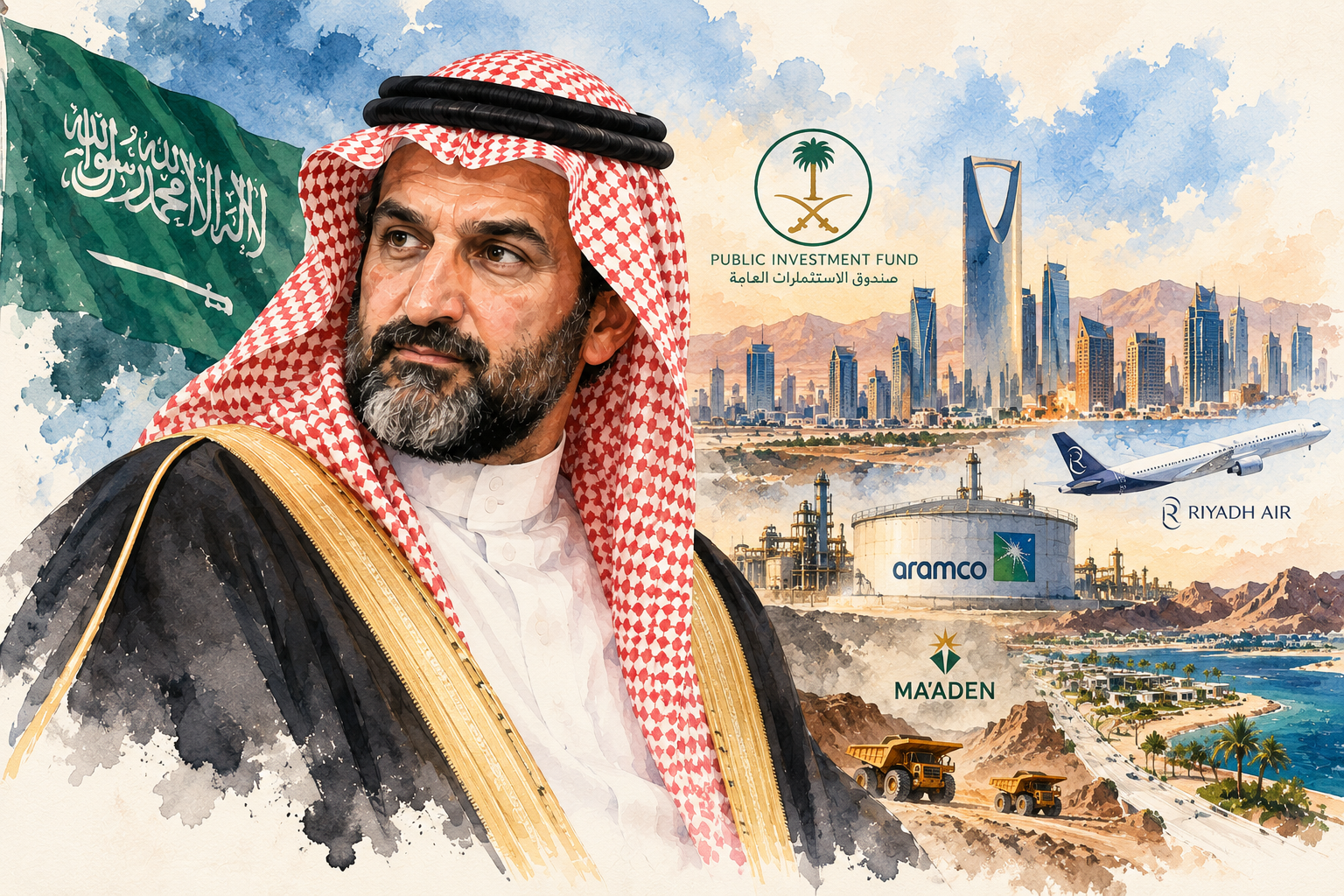
Yasir Al-Rumayyan and the fund trying to build an economy beyond oil
Yasir Al-Rumayyan does not simply manage one of the world’s largest investment portfolios. As Governor of Saudi Arabia’s Public Investment Fund (PIF), he helps turn the Kingdom’s economic ambitions into companies, infrastructure and entire new industries.
His position is powerful, but its institutional context matters. Crown Prince Mohammed bin Salman chairs PIF’s board and provides the overarching strategic direction. Al-Rumayyan is responsible for translating that mandate into investment decisions, partnerships and businesses capable of operating in the real economy. That makes him an important first figure in The New Architecture of Gulf Capital.
The sovereign investor is becoming a market developer.
PIF is not merely investing wealth accumulated from oil. It is attempting to create an economy in which new industries can eventually attract investment and grow without depending indefinitely on sovereign support.
From investor to developer
PIF now manages more than $900 billion, compared with around $150 billion in 2015. According to its latest annual report, the fund invested more than $199 billion in Saudi projects between 2021 and 2025. But the more revealing development is how its mission is changing.
Traditional sovereign wealth funds primarily invest national savings across financial markets. PIF also creates companies, finances infrastructure and supports industries that Saudi Arabia wants to develop domestically.
Its 2026–2030 strategy places greater emphasis on financial returns, investment efficiency and private-sector participation. Al-Rumayyan describes the objective as developing competitive domestic ecosystems capable of attracting global partners. That represents a significant evolution.
The first phase was about proving that sovereign capital could build at extraordinary speed. The next is about proving that what it built can stand.
The fund is moving beyond financing individual projects towards creating the businesses, infrastructure and commercial relationships that allow entire sectors to develop. The sovereign investor is becoming a market developer.
Where oil meets the next economy
Al-Rumayyan’s other responsibilities make that transition particularly interesting. He is Chairman of Saudi Aramco, mining group Ma’aden and Riyadh Air. These positions connect him to the Kingdom’s established sources of wealth and several industries intended to broaden its economic base. Aramco is central to that relationship.
The Saudi state has transferred portions of its Aramco shareholding to PIF and its subsidiaries, including an additional 8% in 2024. Those holdings give PIF-linked entities exposure to the company’s value and dividend distributions, strengthening the financial resources available for long-term investment.
Yet Aramco is also publicly listed, with obligations to shareholders beyond the state. Its investment needs, creditworthiness and dividend policy cannot simply be subordinated to every new national project.
That creates an important balancing act between maintaining the strength of the existing energy economy and financing its gradual diversification.
The logic resembles Mukesh Ambani’s Reliance model, but with a fundamental difference. Ambani uses established businesses to finance new industries within a conglomerate. Al-Rumayyan works within a sovereign investment system seeking to help develop the national market itself.
In both cases, the wealth generated by yesterday’s economy helps finance tomorrow’s industries.
Bringing private capital into the system
The next challenge is attracting other investors to participate.
PIF cannot remain the principal financier of every industry it helps establish. A successful economic transformation requires companies capable of attracting commercial investment, generating sustainable revenues and operating without permanent financial support. That explains the growing importance of partnerships.
The wealth generated by yesterday’s economy helps finance tomorrow’s industries.
In 2026, PIF announced an agreement with infrastructure investor I Squared Capital exploring up to $2 billion of investment in Saudi digital infrastructure and district cooling. A separate PIF-backed Brookfield initiative reached an initial close of approximately $2 billion.
These arrangements illustrate a changing approach. Rather than financing every asset independently, PIF can provide an initial investment, market access and local partnerships while international investors contribute capital and expertise.
For Al-Rumayyan, attracting investors therefore becomes as important as committing PIF’s own resources.
The ultimate objective is not simply to bring more money into Saudi Arabia. It is to create commercially viable opportunities that investors would eventually pursue without requiring PIF to lead every transaction.
From construction to performance
This model also concentrates considerable responsibility.
Sovereign capital can build infrastructure before private demand has fully developed. It can support new industries through long periods of uncertainty and coordinate investments that fragmented markets might struggle to finance. But the same concentration creates risks.
The sovereign developer succeeds when the economy it helped build gradually becomes capable of developing itself.”
Large projects can absorb substantial resources without producing sufficient returns. Ambitious development programmes can face delays, rising costs and changing demand. Saudi Arabia has already begun reassessing the scale and timing of some of its most expensive projects.
Against that background, PIF’s new emphasis on financial performance and investment efficiency is significant.
The challenge is no longer simply to demonstrate how much sovereign capital can build. It is to determine which investments can become commercially sustainable, which require restructuring and where private investors should assume a greater role.
For Al-Rumayyan, this changes the nature of success. The first phase was about proving that sovereign capital could build at extraordinary speed. The next is about proving that what it built can stand.
The sovereign developer
Al-Rumayyan’s importance lies less in the size of PIF’s portfolio than in his role connecting national strategy with financial execution. He helps turn political and economic ambitions into businesses, partnerships and infrastructure that must ultimately justify their investment.
That makes PIF both powerful and accountable to a difficult long-term test. Its success cannot be measured solely by the number of companies launched, the projects announced or the assets accumulated.
The more meaningful measure is whether those investments help create an economy in which private capital increasingly follows where sovereign capital once had to lead.
That is the defining paradox of Yasir Al-Rumayyan’s role.
The sovereign developer succeeds when the economy it helped build gradually becomes capable of developing itself.
This article is part of The New Architecture of Gulf Capital, an Altair Media series examining how sovereign wealth, energy and private enterprise are shaping the region’s post-oil economy.
Credit
Illustration: Altair Media / OpenAI
Caption
Yasir Al-Rumayyan, Governor of Saudi Arabia’s Public Investment Fund. His role connects sovereign capital, Aramco, mining, aviation and new industries — turning national strategy into investable businesses and infrastructure
