The Real Store in the Age of Algorithms
Why physical shopping still shapes trust and behaviour
Online retail has become astonishingly efficient. Within seconds, algorithms analyse preferences, compare prices and recommend products tailored to individual consumers. The digital shopping experience is built around optimisation: speed, convenience and relevance.
Yet despite all of that, people continue to shop physically. Not out of habit alone. But because physical shopping fulfils needs that algorithms still struggle to reproduce.
For years, analysts predicted that online commerce would gradually replace large parts of physical retail. In many categories, that prediction appeared entirely reasonable. Why visit a store when a product can arrive at your door tomorrow?
Yet physical retail persists across almost every market segment. Luxury brands continue investing in flagship stores. Food markets remain popular. Shopping streets still attract visitors. Even younger generations raised with smartphones continue spending time in physical retail environments. Something more than convenience is at work.
People do not only buy products. They also seek confidence in their decisions.
The digital economy excels at delivering information. Physical environments excel at creating trust. That distinction may explain far more about consumer behaviour than many discussions surrounding retail disruption acknowledge.
Trust is tactile
One of the most underestimated aspects of physical retail is the role of direct experience. Online shopping requires consumers to make decisions through images, reviews and descriptions. Physical environments allow people to touch, compare and evaluate products themselves. Materials, weight, texture and quality become immediately visible.
By allowing consumers to trust their own senses rather than a digital recommendation, this tactile process fundamentally reduces uncertainty. This dynamic is particularly visible in categories involving identity, performance or emotional significance, including clothing, cosmetics, furniture, technology and luxury goods. Trust is not only informational. It is sensory.
Seeing, touching and experiencing remain powerful forms of verification.
In many cases, the store functions less as a distribution channel and more as an environment where uncertainty can be reduced before a decision is made.
Why Apple Stores work
Perhaps no company illustrates this better than Apple. Its stores were never primarily designed to maximise inventory density or transaction speed. Instead, they were designed to create familiarity and confidence.
Visitors can test products, ask questions and explore technologies without immediate pressure to purchase. The commercial transaction itself is almost secondary to the experience of understanding the product.
The physical environment acts as an educational space as much as a commercial one. Staff increasingly function as guides rather than salespeople. Products remain accessible. Visitors are encouraged to explore without obligation.
The success of Apple Stores may therefore have less to do with selling devices and more to do with removing uncertainty. By reducing commercial pressure, the physical environment paradoxically strengthens confidence, conversion and long-term loyalty.
Many successful retail environments now operate according to a similar principle. They are not optimised around selling products. They are optimised around helping people feel comfortable enough to make decisions.
The value of discovery
Algorithms are remarkably effective at predicting preferences. They analyse previous purchases, browsing behaviour and demographic patterns to recommend what consumers are most likely to buy. Yet prediction is not the same as discovery.
Algorithms optimise for what people already desire. Physical spaces expose them to what they did not know they were looking for.
A visitor walking through a market, shopping street or department store encounters products, ideas and experiences that were never explicitly searched for. New interests emerge through exposure rather than prediction. That distinction matters because human behaviour is not entirely predictable.
Many of life’s most meaningful discoveries happen unexpectedly. Markets remain popular not because they are efficient. They remain popular because they are alive. The same principle helps explain why people still understand the idea of spending an afternoon shopping even when they have no specific purchase in mind. The activity itself carries social, cultural and psychological value.
Shopping, in this sense, becomes less about acquisition and more about exploration.
Retail as social validation
Shopping has always been partly social. People compare options with friends. They observe what others are wearing. They seek opinions before making choices. They evaluate quality through shared cultural signals. Physical environments facilitate these interactions naturally.
Digital platforms increasingly attempt to replicate social validation through reviews, ratings and influencer recommendations. Yet these remain indirect substitutes for something much older: observing behaviour, preferences and social cues within real-world environments. This helps explain why luxury retail remains heavily physical.
Luxury products communicate more than function. They communicate craftsmanship, identity, aspiration and status. The physical environment surrounding the product becomes part of the experience itself.
An algorithm can recommend a product. It cannot create presence.
Luxury retail is not simply about acquiring an item. It is about participating in a carefully constructed narrative. That narrative is difficult to fully digitise.
The future is not online or offline
The future of retail is unlikely to be a competition between digital and physical commerce. Increasingly, it will involve a combination of complementary strengths.
Algorithms will continue optimising efficiency. Logistics networks will continue reducing friction. Personalisation will become increasingly sophisticated and increasingly invisible.
Yet physical environments will remain custodians of what digital systems struggle to reproduce: trust, sensory verification, discovery and shared social space. The most successful retailers increasingly understand that these are not competing models. They are complementary systems.
The internet tells us what we are likely to want. Physical environments help us understand what those choices actually mean. In an age increasingly shaped by predictive systems, consumers rarely seek efficiency alone. They seek confidence, context and reassurance. And those remain surprisingly physical conditions.
Series reference
This article is part of The Future of Retail — an Altair Media Europe series exploring how shopping centres, libraries and public spaces are evolving into social and urban infrastructure in an increasingly digital society.
Illustration credit
Illustration generated with AI by OpenAI for Altair Media Europe
Caption
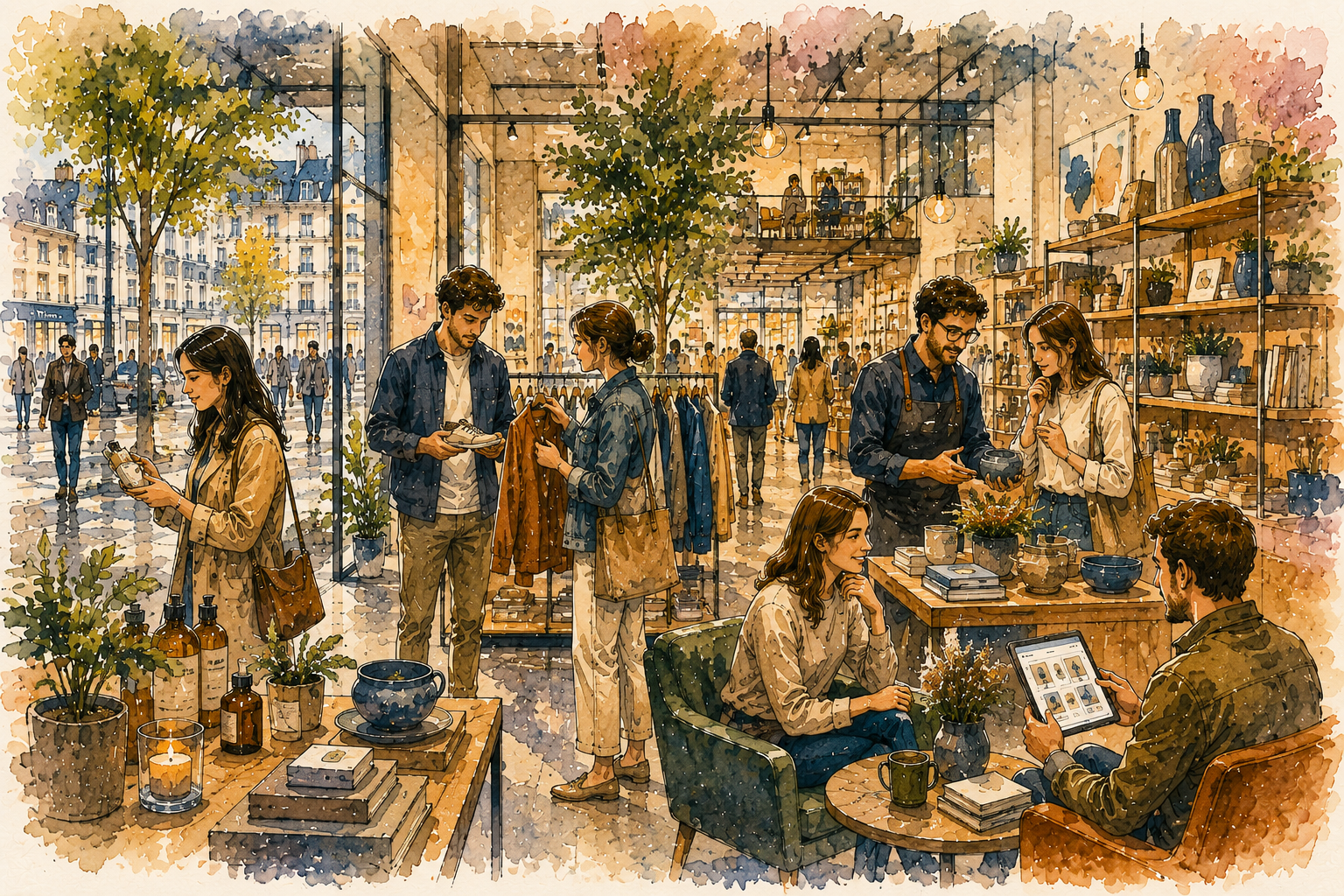
In an age of algorithms and personalised recommendations, physical retail continues to provide something digital systems struggle to replicate fully: trust, discovery, social interaction and the confidence that comes from direct human experience.
