The Race Against Q-Day: Is Our Digital Society Prepared?

Protecting trust in the quantum age
Europe is investing in technologies that could transform medicine, industry and scientific discovery. Yet one of those same technologies could eventually undermine the digital security on which modern society depends.
Bank accounts, medical records, government communications, digital identities and commercial transactions all rely on cryptography. For decades, these systems have provided the foundations of digital trust.
Quantum computing could change that.
Europe is racing to develop quantum capabilities while simultaneously preparing to protect its digital infrastructure against the risks they could introduce.
The decisive question is not simply when powerful quantum computers will arrive, but whether society will be ready when they do.
Five questions expose the other side of the quantum revolution.
🟦 1 | What is Q-Day — and do we know when it will arrive?
Q-Day describes the hypothetical point at which a sufficiently advanced quantum computer becomes capable of breaking widely used public-key cryptographic systems.
These systems help protect confidential communications, verify digital identities and authenticate electronic transactions.
Today’s quantum computers have not demonstrated the ability to break these systems at the scale required.
Scientists continue to work on increasing computational capacity, reducing errors and improving reliability. No definitive date for Q-Day can currently be established.
Yet uncertainty about its arrival does not eliminate the need for preparation.
The tension: society must prepare for a technological event whose timing remains unknown.
🟦 2 | Could quantum computers unlock our digital lives?
The potential consequences extend across almost every sector of society.
- Banking: authentication and secure financial transactions.
- Healthcare: confidential medical records and patient information.
- Government: diplomatic communications and sensitive public records.
- Industry: intellectual property and commercially sensitive information.
- Digital identity: certificates, electronic signatures and authentication systems.
Not every password or encryption system will automatically become vulnerable. Different cryptographic methods face different levels of risk.
The principal concern is the potential vulnerability of widely deployed public-key systems, including RSA and elliptic-curve cryptography.
Digital security is not simply about keeping information secret. It is also about knowing whether information, identities and transactions are authentic.
The tension: the technology that could expand our scientific capabilities could also weaken some of the mechanisms through which society establishes trust.
🟦 3 | Can tomorrow’s technology threaten today’s information?
One of the most significant concerns is known as Harvest Now, Decrypt Later.
As the US National Institute of Standards and Technology NIST explains, encrypted information collected today could potentially be decrypted in the future using sufficiently powerful quantum computers.
This creates a particular challenge for information that must remain confidential for years or decades.
Medical histories, diplomatic correspondence, commercially sensitive research and personal information do not necessarily lose their sensitivity over time.
Protecting future communications will therefore not be enough. Organisations must also consider the long-term vulnerability of information they exchange today.
The tension: quantum computers capable of breaking today’s widely used public-key encryption may not yet exist, but the associated confidentiality risk has already begun.
🟦 4 | Can Europe protect its digital infrastructure in time?
Post-quantum cryptography is designed to protect digital systems against attacks from both conventional and quantum computers.
In August 2024, NIST published its first three definitive post-quantum cryptographic standards.
In June 2025, EU Member States, supported by the European Commission, published a coordinated implementation roadmap.
Europe’s transition envisages three important milestones:
- End of 2026: national transition plans, inventories of cryptographic systems and preparatory activities.
- End of 2030: migration of critical infrastructure and high-risk applications.
- End of 2035: migration of medium-risk applications and, where feasible, those presenting lower risks.
Europe is now approaching its first major preparedness milestone. But developing new security standards is only the beginning.
Banks, hospitals, governments and businesses must identify vulnerable systems, update software and hardware, coordinate suppliers and maintain operational continuity throughout the transition.
They must also ensure that their digital infrastructure can adapt as security standards continue to evolve.
The tension: developing new cryptographic standards is a scientific achievement. Implementing them across an entire digital society is an institutional and industrial challenge.
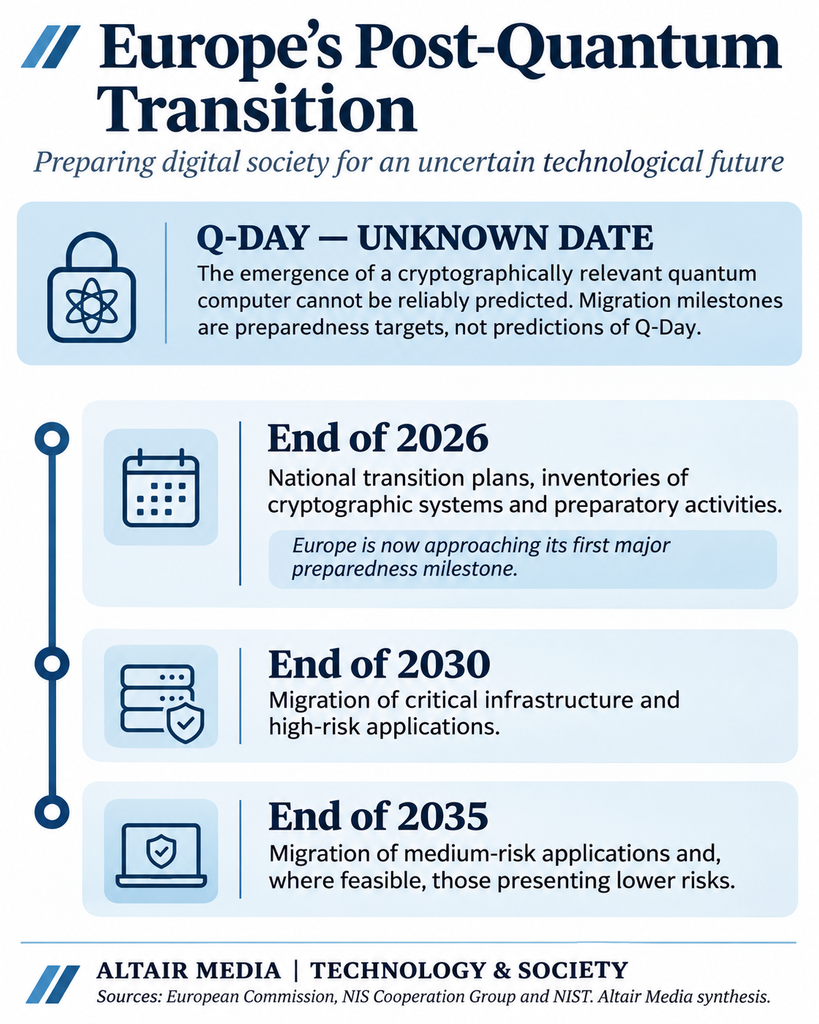
Caption: Europe’s post-quantum transition: from the development of new cryptographic standards towards the protection of critical infrastructure and digital society.
Source: Altair Media analysis based on the European PQC implementation roadmap and NIST standards.
🟦 5 | Who is responsible for protecting our digital future?
For large financial institutions and technology companies, quantum preparedness is becoming a strategic cybersecurity consideration. But what about smaller businesses, municipalities, schools, healthcare providers and ordinary citizens?
Many depend on digital infrastructure they neither develop nor directly control. Their security relies on software providers, cloud services, financial institutions and public authorities making appropriate decisions on their behalf.
Quantum readiness therefore raises questions about institutional responsibility, investment capacity and access to technological expertise.
It could also expose a new form of digital inequality: the difference between organisations capable of financing advanced cybersecurity and those dependent on the preparedness of others.
Digital trust is a collective responsibility. Yet the capacity to protect it is not equally distributed.
The tension: quantum security requires collective resilience, yet the resources and expertise needed to achieve it are unevenly distributed.
🟦 THE SIGNAL
Throughout this series, we have explored the scientific, industrial, economic and human foundations of Europe’s quantum future.
But technological leadership cannot be measured solely in investment, computing power, industrial capacity or scientific discovery.
It must also be measured by society’s ability to manage the consequences of technological progress.
Europe faces a dual responsibility: developing the technologies that could shape tomorrow’s economy while protecting the digital society it has already built.
The ultimate test of the quantum revolution may not be what our technology can do, but whether society can continue to trust the systems on which it depends.
This article concludes Altair Media’s seven-part Quantum Series, exploring the scientific, industrial, economic and societal dimensions of Europe’s emerging quantum ecosystem.
Credit
Illustration: Altair Media / OpenAI (AI-generated editorial watercolour).
Caption
Protecting trust in the quantum age. An editorial watercolour illustrating the interconnected nature of modern digital society, where banks, hospitals, public institutions, businesses and citizens depend on shared digital infrastructure. The emergence of quantum computing raises fundamental questions about the future of digital security, institutional responsibility and societal resilience.
Conceptual illustration of the relationship between quantum technology and digital trust.
