The Logistics War
Why Supply Chains Decide Military Campaigns
For more than four years, the war in Ukraine has dominated headlines around the world. Daily reports describe missile strikes, drone attacks, territorial advances and battlefield casualties. Yet behind every visible battle lies another conflict—one fought through logistics, energy, industrial production, transport networks and increasingly digital infrastructure.
Recent European initiatives illustrate how rapidly this hidden architecture is evolving. France and Germany have announced plans to develop a sovereign European alternative to the military artificial intelligence platforms provided by Palantir, recognising that command software and battlefield data have become strategic assets in their own right. The discussion is no longer simply about military capability. It is increasingly about technological sovereignty and control over the infrastructure upon which modern defence depends.
The war in Ukraine therefore represents more than a regional conflict. It demonstrates that military power increasingly depends upon the resilience of interconnected systems extending far beyond the battlefield itself. Weapons remain essential, but they can only operate when supported by functioning supply chains, industrial production, transport corridors, energy networks and secure digital communications.
The Architecture of War examines modern conflict through that broader lens. Rather than focusing on battles alone, this series explores the physical, industrial and digital infrastructure that enables military power—and why understanding those systems is becoming increasingly important for Europe’s security, resilience and strategic autonomy.
The Hidden War Behind the Front Line
A modern battle tank appears to be a self-contained weapon. In reality, it represents the visible endpoint of an extraordinarily complex ecosystem. Long before a tank reaches the battlefield, steel must be produced, electronic components manufactured, ammunition assembled and fuel refined. Spare parts have to be transported, engineers maintain the vehicles, while railway networks, roads, bridges and logistics hubs ensure that equipment reaches the front when required.
Every kilometre a military vehicle advances depends upon an invisible chain of infrastructure stretching hundreds or even thousands of kilometres behind it. The same principle applies to aircraft, artillery systems, drones and missiles. Every modern weapon ultimately relies upon factories, transport corridors, communications networks, energy infrastructure and increasingly the digital systems that coordinate military operations.
Military capability therefore begins long before combat starts.
History’s Enduring Lesson
History repeatedly illustrates the same principle. Napoleon’s campaign in Russia, Germany’s invasion of the Soviet Union and the Allied offensives during the Second World War all demonstrated that military success ultimately depended upon logistics as much as battlefield victories. Weapons may win battles. Logistics determines whether wars can continue.
Technology has transformed warfare. The underlying principle has changed remarkably little.
Ukraine’s Strategy of Disruption
The war in Ukraine demonstrates how this historical lesson continues to shape modern conflict. Military operations increasingly target the foundations that sustain military power, including railway junctions, fuel depots, bridges, ports, warehouses and logistics hubs, rather than frontline positions alone.
The objective is rarely destruction for its own sake. More often, it is strategic disruption. Every delayed fuel delivery, damaged bridge or interrupted railway line reduces operational flexibility, slows reinforcements and increases the cost of sustaining military operations. Time itself becomes a strategic resource.
Rather than destroying an army outright, degrading the systems that support it can gradually erode its ability to fight.
Why Logistics Still Matters in the Age of AI
Modern warfare is often associated with drones, artificial intelligence and autonomous systems. Yet even the most advanced military technologies remain dependent upon remarkably physical infrastructure.
Heavy equipment still moves by rail. Fuel continues to flow through pipelines, storage facilities and tanker trucks. Ports receive military cargo, factories manufacture ammunition and power grids supply the electricity that keeps industrial production running.
The same principle increasingly applies to digital warfare. Artificial intelligence depends upon data centres, semiconductor manufacturing, fibre-optic communications and reliable electricity. Military cloud platforms require secure networks, resilient computing infrastructure and trusted software. Even battlefield algorithms ultimately rely upon physical systems that must be built, protected and maintained.
Technology has become more sophisticated. Infrastructure remains indispensable.
Europe’s Strategic Lesson
For Europe, these developments extend far beyond the war in Ukraine. Across the continent, governments are investing in military mobility, industrial production, energy resilience and sovereign digital capabilities. These initiatives are often presented as separate policy domains. Increasingly, however, they form part of the same strategic ecosystem.
The recent decision by France and Germany to pursue a European alternative to Palantir illustrates this shift. Digital command platforms are no longer viewed simply as software solutions. They are becoming part of the critical infrastructure upon which military sovereignty increasingly depends.
Railways, ports, energy grids, communications networks, industrial capacity, cloud infrastructure and artificial intelligence are no longer separate systems. Together they form the architecture that enables military power.
Beyond the Front Line
Wars are often remembered through battles, military leaders and decisive offensives. Yet the visible battlefield represents only one layer of modern conflict.
Behind every military operation lies an ecosystem of infrastructure that sustains it. Supply chains transport equipment. Energy powers industry. Railways move heavy armour. Factories replace lost equipment. Communications coordinate operations. Digital platforms process information and support decision-making.
The battlefield remains where wars are fought. Increasingly, however, they are sustained—or lost—within the infrastructure that lies behind it.
Understanding modern conflict therefore requires looking beyond armies and weapons. It requires understanding the architecture that makes military power possible.
Military power is an ecosystem
Every tank, drone or missile represents the visible endpoint of an interconnected ecosystem of logistics, energy, industry, communications, finance and digital infrastructure. Modern wars are increasingly shaped by the resilience of that ecosystem rather than by individual weapons alone.
Part of The Architecture of War — a Perspective series examining how logistics, industry, energy, communications and digital infrastructure have become the hidden architecture of modern military power.
Credit
Credit: Altair Media Europe | AI-generated editorial illustration
Caption
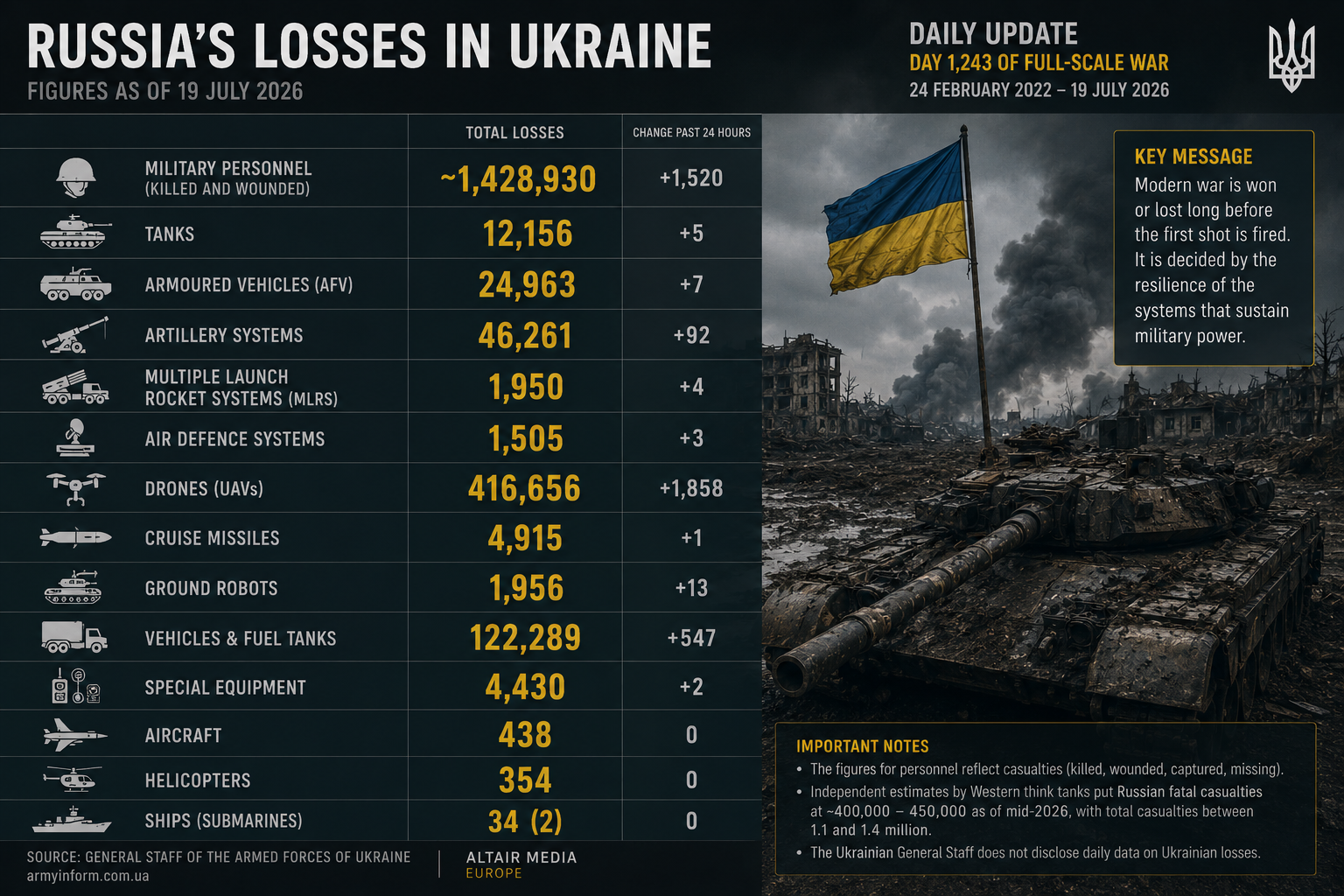
Daily battlefield updates often report destroyed tanks, aircraft and military equipment. Less visible are the interconnected systems that sustain them. The Logistics War examines how supply chains, railways, energy networks, industrial production and digital infrastructure have become critical components of modern military power and strategic resilience.
