The Entrepreneurial City
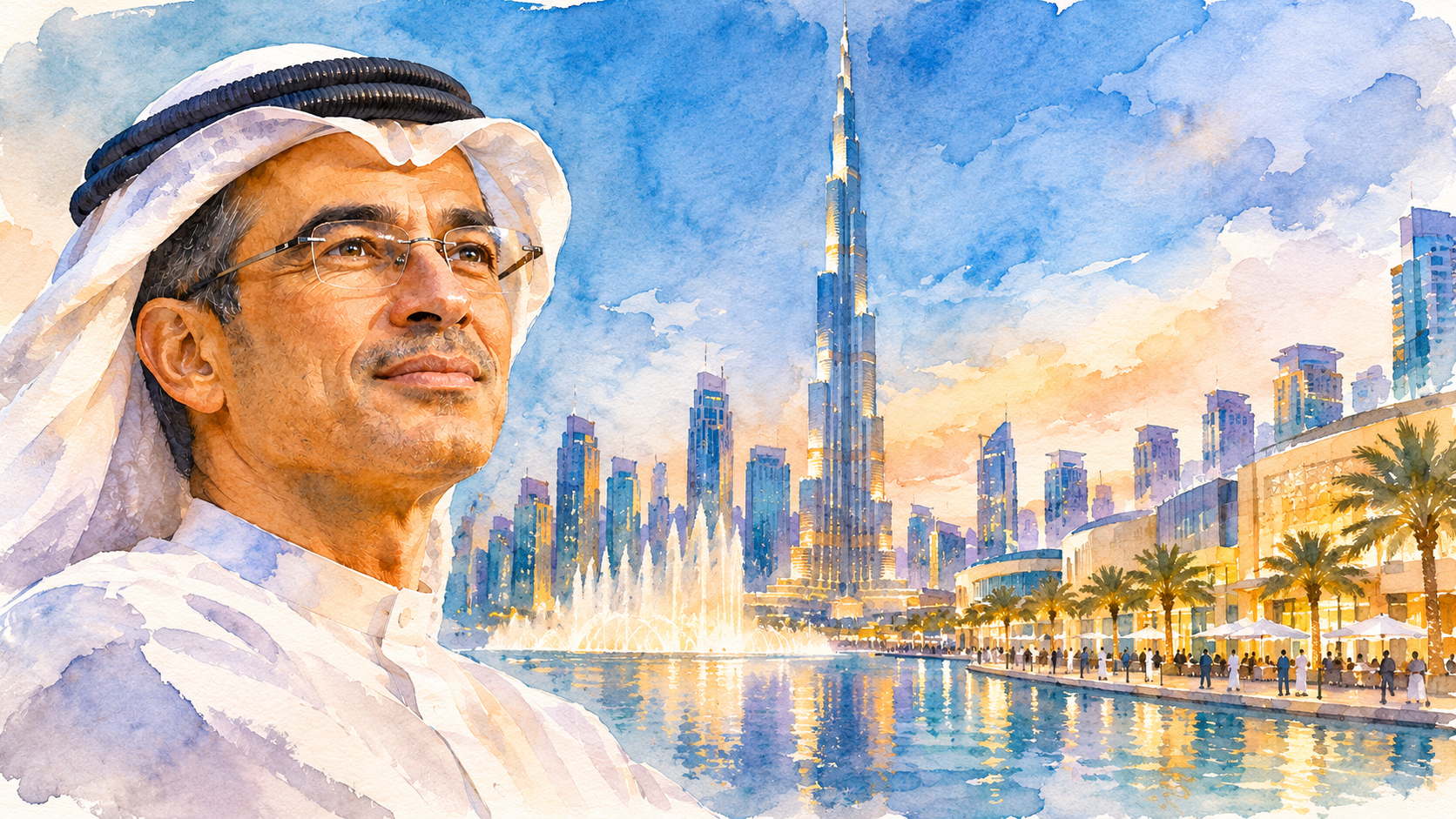
Mohamed Alabbar and the private capital that builds markets around places
Mohamed Alabbar is usually described as a property developer, but that description misses something important. Through Emaar, he has spent three decades combining homes, shopping, hotels, entertainment and public space into places designed to generate their own demand. The real product is not simply the building. It is the economic activity that begins to form around it.
Alabbar is the founder and Managing Director of Emaar Properties, while his wider business interests extend across e-commerce, hospitality, food, finance and international development. Emaar itself has delivered more than 130,000 residential units and built some of Dubai’s most recognisable assets, including Burj Khalifa and Dubai Mall.
But Downtown Dubai reveals the more interesting model. A conventional developer builds homes because people already want to live in a particular location. Alabbar helped develop a destination in which residences, offices, hotels, retail, restaurants, entertainment and landmarks reinforced one another.
People did not simply buy apartments. They bought access to a place in which retail benefited from tourism, hotels benefited from attractions, property values benefited from public space and global visibility, and restaurants and entertainment increased footfall across the district.
That creates a different form of capital allocation. Instead of waiting for a mature market and then supplying it, the developer commits capital to several interdependent assets in the expectation that the ecosystem itself will create demand.
The city as a platform
Alabbar has described his business in similar terms, arguing that property itself is relatively ordinary and that the real challenge is creating the life around it — food, landscaping, wellness, culture and services. That is a useful way to understand Emaar.
An apartment generates a sale, but the mall, hotel, entertainment venue and commercial district can continue generating activity long afterwards. In 2025, Emaar’s malls, hospitality, leisure, entertainment and commercial-leasing businesses generated AED 10.5 billion in recurring revenue and accounted for around 32% of group EBITDA.
The economics of a city are therefore very different from the economics of a building. A building can be completed and sold. A successful district has to continue attracting residents, visitors, businesses and capital, which means the developer becomes partly responsible for maintaining the network of experiences and services that keeps the location economically relevant.
In that sense, Emaar increasingly resembles a platform company whose platform happens to be physical.
Private capital inside a larger public vision
Alabbar’s model should not be mistaken for private enterprise operating independently of the state.
Dubai’s growth has depended on public infrastructure, aviation, regulation, long-term urban planning and an economic strategy designed to attract international capital, companies and residents. Alabbar himself has repeatedly credited the UAE’s wider institutional environment for allowing companies such as Emaar to plan and invest with confidence.
The interesting relationship is therefore not state versus private capital. It is what happens when public strategy creates the conditions in which entrepreneurial capital can move quickly.
Roads, airports, utilities and regulation make the city possible. Private developers then have to decide what people will actually choose to use, buy and visit. That introduces a different form of discipline from sovereign investment: a government can decide that a sector is strategically important, but an entrepreneur eventually has to discover whether customers agree.
Exporting the model
Alabbar has increasingly taken that approach beyond Dubai.
Through Eagle Hills, he is involved in large mixed-use developments across markets from Eastern Europe to the Middle East and Asia. These projects typically combine residential property with hospitality, retail, waterfronts and public destinations rather than treating individual buildings in isolation.
That suggests the model itself may be exportable: identify a location whose potential has not yet been fully priced, commit capital at scale and build enough complementary uses to change how the market perceives the place.
But exporting the formula also reveals its risk. Dubai combines tourism, aviation, infrastructure, international labour and capital flows in ways that cannot simply be reproduced elsewhere. A landmark building cannot manufacture an economy by itself, and an ambitious masterplan does not automatically create a community.
The developer can build the physical ecosystem, but it cannot command people to participate in it.
When confidence becomes concentration
That is the central tension in Alabbar’s model.
Building before demand is fully visible can create extraordinary value, but it can also commit enormous amounts of capital to assumptions about future population growth, tourism, property prices and consumer behaviour.
Emaar’s scale gives it significant advantages, yet it also means that execution matters enormously. In 2025 the company recorded property sales of more than $21 billion and entered 2026 with a substantial development backlog.
The larger the project, the more important it becomes to distinguish between creating demand and simply assuming that demand will eventually arrive.
Entrepreneurial capital therefore performs a different experiment from sovereign capital. It does not only ask what should be built. It asks whether people will come when it is built.
The entrepreneurial city
That makes Mohamed Alabbar a useful final figure in The New Architecture of Gulf Capital.
Yasir Al-Rumayyan uses sovereign wealth to create new domestic markets. Khaldoon Al Mubarak connects Abu Dhabi to global capabilities. Sultan Al Jaber moves capital between energy systems. Mohammed Al-Sowaidi converts concentrated resource wealth into a global portfolio for future generations.
Alabbar represents the next step: his capital has to turn strategy into places that people actually choose.
The success of that model cannot ultimately be measured by towers, square metres or property sales alone. It depends on whether the surrounding ecosystem becomes economically valuable enough to sustain itself after the original development decision has been made.
That is why Alabbar’s most interesting achievement may not be a building at all, but the idea that private capital can create a market by building the place in which that market wants to exist.
This article is part of The New Architecture of Gulf Capital, an Altair Media series examining how sovereign wealth, energy and private enterprise are shaping the region’s post-oil economy.
Credit
Illustration: Altair Media / OpenAI
Caption
Mohamed Alabbar, founder of Emaar Properties. His model of development combines real estate, retail, hospitality and public space into destinations designed to generate their own economic activity — turning the city itself into a platform for private capital.
