The Energy Cost of Intelligence
How Artificial Intelligence Is Reshaping Europe’s Energy Landscape
Artificial intelligence is frequently discussed through the language of algorithms, models and software. Yet intelligence ultimately depends upon something far more tangible: electricity.
Every large language model, scientific simulation and AI assistant relies upon vast amounts of energy. Datacentres, GPU clusters and hyperscale campuses are rapidly becoming some of the largest consumers of electricity in the modern economy, connecting artificial intelligence directly to questions of generation capacity, transmission infrastructure and industrial planning.
For decades, computing was largely perceived as a digital activity. Increasingly, however, it resembles heavy industry.
The question therefore may be changing.
Not:
How powerful are our models?
But:
Can our energy systems sustain the intelligence economy?
The internet era rewarded connectivity. The cloud era rewarded compute. The AI era increasingly rewards access to energy.
From Information Economy to Energy Economy
Training advanced models requires thousands of accelerators operating continuously for weeks or months. Inference, the process through which models generate outputs, predictions and recommendations, depends upon persistent access to specialised hardware, cooling systems and reliable electricity supplies.
The defining constraint of the AI economy may no longer be knowledge. It may be megawatts.
Artificial intelligence is therefore transforming energy into a strategic input. Perhaps the defining constraint of the AI economy is no longer knowledge. It is megawatts.
Around the world, organisations are constructing facilities of unprecedented scale. Hyperscalers increasingly resemble utility companies, while AI factories increasingly resemble industrial sites.
The Geography of Intelligence
Datacentres are evolving into energy-intensive campuses designed around direct access to transmission infrastructure, renewable generation and long-term power agreements. The geography of intelligence may therefore increasingly follow the geography of energy.
The geography of intelligence may increasingly follow the geography of energy.
This dynamic is already becoming visible. Hydropower-rich regions in Scandinavia attract compute-intensive investments, while France’s stable nuclear baseload provides another compelling environment for AI infrastructure. Elsewhere, grid congestion and permitting delays are beginning to emerge as significant constraints on future compute deployment.
Data can travel at the speed of light. Electricity often cannot.
Europe’s Energy Question
Europe enters the intelligence era with considerable advantages. It possesses advanced electricity markets, ambitious renewable strategies, strong engineering capabilities and an increasingly interconnected energy system.
At the same time, Europe also faces structural challenges. Transmission bottlenecks, grid congestion, lengthy permitting procedures and competing demands for renewable generation all create friction within the energy transition. Added to this are the rapidly growing energy requirements associated with artificial intelligence.
The challenge therefore extends beyond datacentres themselves. It concerns industrial priorities. How much compute capacity should Europe host? How much electricity should remain available for strategic capabilities? Which sectors deserve priority access to increasingly scarce resources?
These questions increasingly resemble decisions once associated with steel mills, ports and manufacturing clusters. Energy policy gradually becomes AI policy.
Intelligence and Infrastructure
Artificial intelligence is often portrayed as a software revolution. Yet it may equally represent an infrastructure revolution.
Models require GPUs, GPUs require datacentres, datacentres require electricity and electricity itself depends upon grids, planning processes, capital allocation and institutional capacity. Intelligence therefore emerges not merely from code, but from ecosystems capable of sustaining it.
Artificial intelligence is not only a software revolution. It is an infrastructure revolution.
For decades, software appeared almost weightless. Artificial intelligence reminds us that intelligence possesses physical characteristics. It requires space, cooling systems, energy flows, transmission capacity, concrete, copper and transformers.
The future of intelligence may increasingly depend upon infrastructures that societies once considered mundane.
Beyond Efficiency
For years, energy debates focused primarily on decarbonisation, affordability and security of supply. Artificial intelligence introduces another objective. Capacity.
How much electricity can societies mobilise? How rapidly can infrastructure expand? How resilient are energy systems during periods of disruption?
Perhaps the next phase of technological competition will concern not merely algorithms, but the ability to transform electrons into intelligence.
The Strategic Question
Europe increasingly debates technological sovereignty through the lens of semiconductors, cloud infrastructure and artificial intelligence. Yet perhaps the conversation should extend one layer deeper.
Who manufactures chips remains important. But another question may prove equally decisive.
Who controls the energy systems that power intelligence?
Because the future of artificial intelligence may ultimately depend less upon software itself, and more upon access to strategic energy capacity.
Part IV — Compute explores the physical foundations of artificial intelligence, examining how energy, semiconductors, photonics and compute infrastructure are reshaping Europe’s technological landscape. Because intelligence is no longer only a software challenge. It is increasingly an infrastructure challenge.
Credit
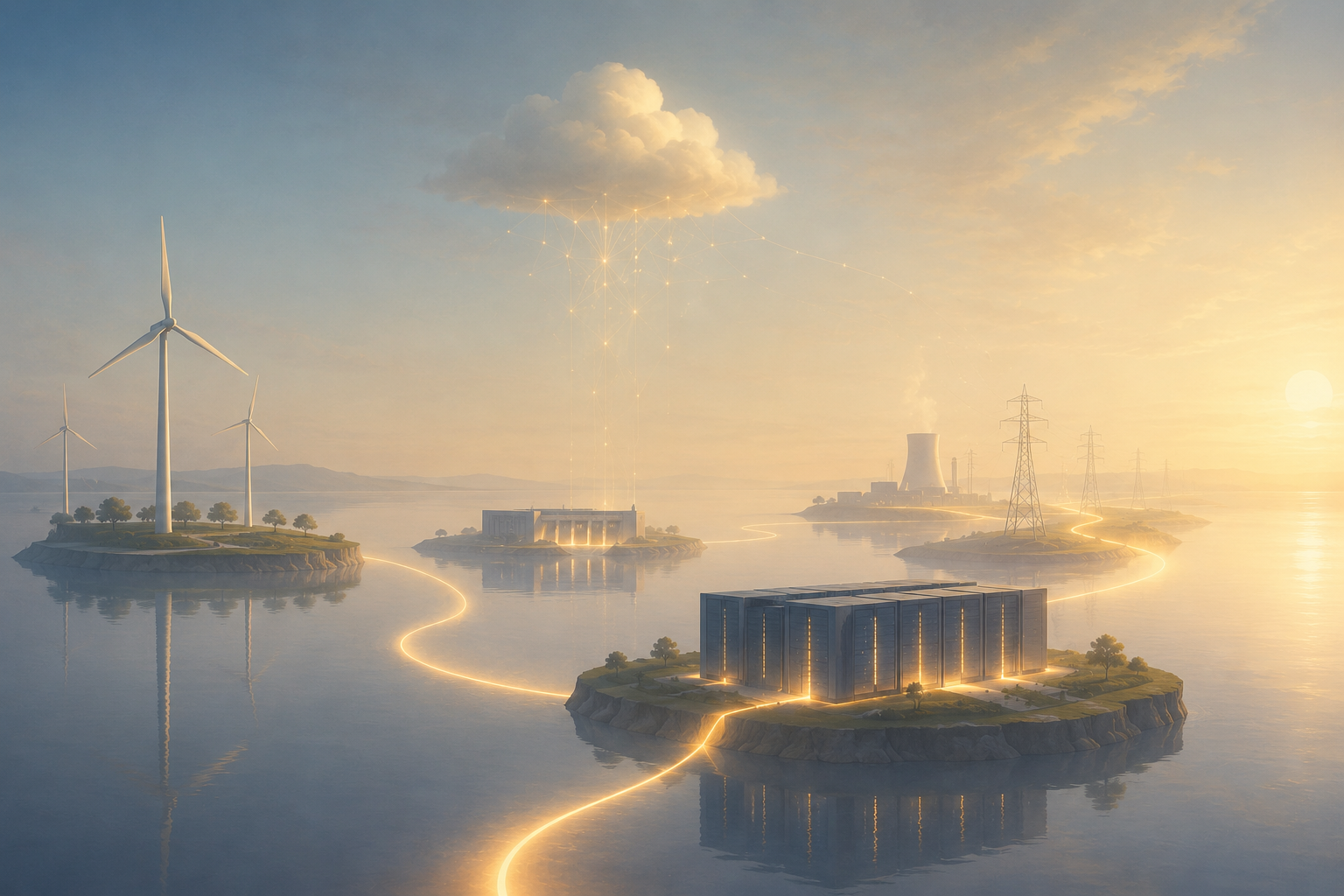
Artwork: Altair Media / AI-generated visualisation inspired by the convergence of energy systems, compute infrastructure and Europe’s emerging intelligence economy.
Caption
A surreal interpretation of Europe’s emerging intelligence infrastructure. Floating compute islands, renewable energy, transmission networks and datacentres symbolise a future in which artificial intelligence is no longer defined solely by algorithms, but increasingly by the physical systems that generate, transport and sustain the energy behind intelligence.
