Perspective | Capital Sovereignty I
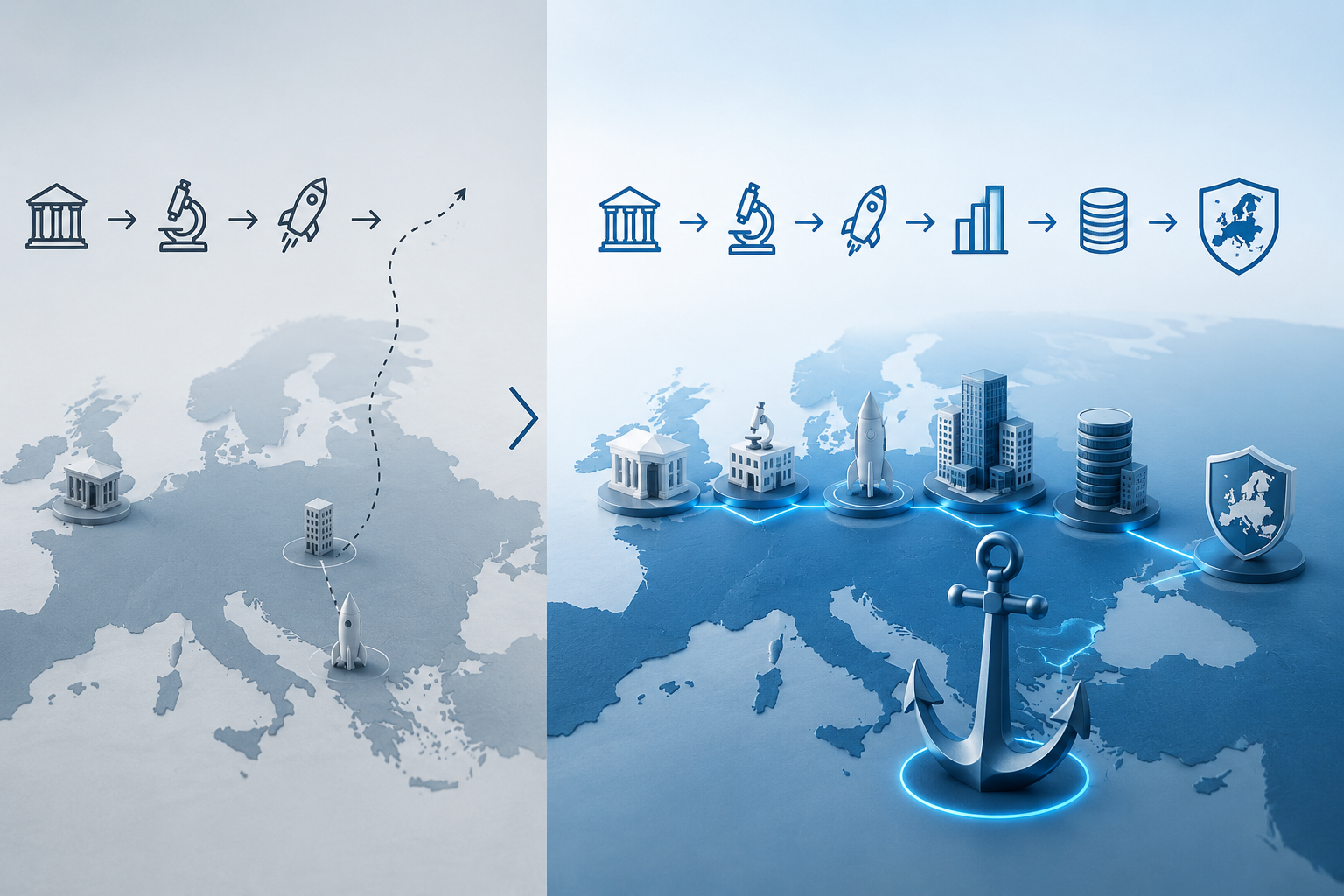
From Exit Economy to Anchored Growth
Europe has long excelled at creating knowledge, research and innovation. Retaining ownership, scale and long-term value creation within Europe has proven more difficult. Emerging growth initiatives suggest that Europe may finally be learning not only how to innovate, but also how to finance its own future.
For decades, Europe mastered the economics of invention. Universities produced research, governments financed innovation and entrepreneurs transformed scientific discoveries into promising companies. Yet when businesses entered their growth phase, Europe consistently hit the same structural ceiling: capital.
Too often, the trajectory followed a familiar pattern.
Yesterday
Public Funding → Research → Startup → Exit
Today, however, a different architecture may be emerging.
Tomorrow
Public Funding → Research → Startup → Scale-up → European Growth Capital → European Anchoring
The emergence of larger European growth initiatives, including EQT’s Scaleup Europe strategy, suggests that Europe may be beginning to address one of its oldest structural weaknesses: financing companies beyond the startup phase while retaining ownership, industrial capabilities and long-term value creation within Europe.
Europe learned how to fund research. The next challenge is funding growth.
This is not merely a financial story. It is increasingly becoming a question of industrial strategy, economic resilience and technological sovereignty.
■ A Changing Architecture
For many years, Europe possessed nearly every ingredient necessary for innovation. It had world-class universities, highly specialised industrial clusters and public programmes designed to stimulate technological development.
Institutions such as the European Innovation Council, the European Investment Fund and the European Investment Bank significantly strengthened the earliest stages of innovation. Yet success often contained an unintended paradox.
Europe excelled at producing innovation.
Scaling innovation proved more difficult.
European companies regularly discovered that the capital required to move from promising startup to globally competitive enterprise remained easier to obtain elsewhere. Large growth rounds frequently originated outside Europe, bringing with them not only financing, but also influence over ownership structures, listings and strategic decision-making.
■ The Missing Middle
For decades, Europe’s innovation ecosystem resembled an incomplete chain. Research existed. Entrepreneurship existed. Public funding existed. What remained comparatively underdeveloped was the scale-up layer.
Europe built an innovation economy. The challenge now is building a scale-up economy.
This explains why discussions surrounding European growth capital have become increasingly prominent. Large-scale investment vehicles are no longer viewed solely as financial instruments. Increasingly, they appear as strategic mechanisms capable of preserving industrial capabilities, technological leadership and economic decision-making within Europe.
In that sense, initiatives such as EQT are interesting not simply because of their size, but because they may represent a broader shift in European thinking.
Europe appears to be moving beyond the assumption that innovation inevitably culminates in acquisition, relocation or foreign listings. Instead, a different ambition may be emerging.
To remain. To grow. To anchor.
■ Capital as Infrastructure
Perhaps the most significant shift is conceptual. Europe has traditionally treated capital as a market outcome. Increasingly, capital appears less as a financial variable and more as a strategic layer of economic coordination.
Energy determines production. Telecommunications determine connectivity. Semiconductors determine computational capacity. Capital determines which technologies are ultimately scaled, owned and governed.
Innovation creates technologies.
Capital determines where they remain.
Viewed from this perspective, growth capital becomes more than finance. It becomes a coordinating mechanism connecting public investment, industrial policy, entrepreneurship and long-term competitiveness.
This is particularly relevant in sectors such as artificial intelligence, semiconductors, advanced manufacturing, photonics and telecommunications, where scaling increasingly requires investment commitments measured not in millions, but in hundreds of millions—or even billions—of euros.
■ Beyond the Exit Economy
For decades, European policymakers asked a relatively straightforward question:
How can Europe become more innovative?
The coming decade may increasingly be defined by another:
How can Europe retain the value generated by its own innovation ecosystem?
The answer may lie in the emergence of a more coherent capital architecture connecting research, entrepreneurship, scale and ownership into a continuous economic chain.
Europe already knows how to generate ideas. The question now is whether Europe can also learn to finance its own future. If so, capital may become one of the defining strategic infrastructures of the twenty-first century.
Europe’s transition from an exit economy towards anchored growth may only just be beginning.
Part of Capital Sovereignty, an Altair Media series examining Europe’s evolving financial architecture, growth ecosystems and long-term economic trajectory.
Altair Strategic Forum
The Altair Strategic Forum explores Europe’s technological, industrial, financial and institutional transformation. As Europe develops new architectures for capital, innovation and long-term growth, the Forum seeks to create a space for dialogue, analysis and strategic reflection. Professionals and organisations interested in following its development may register their interest and receive occasional updates.
member.altairmedia.eu
Credit
Credit: Altair Media / Conceptual illustration inspired by Europe’s evolving capital architecture.
Caption
From exit economy to anchored growth. Europe may be moving beyond an innovation model centred on exits towards a capital architecture designed to scale, retain and anchor value creation within Europe.
