Nokia — Europe’s Hidden 6G Architect
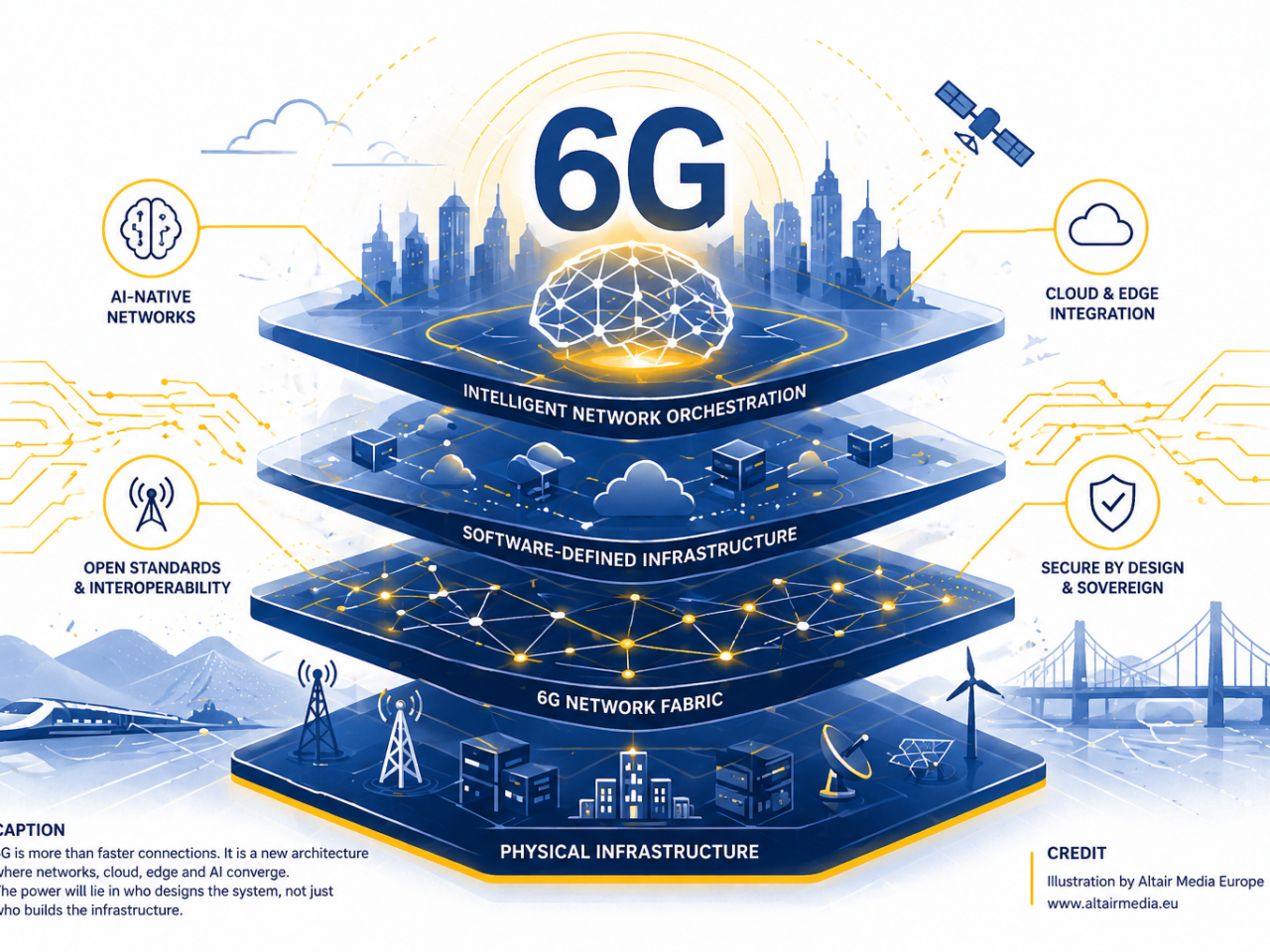
While much of Europe’s telecom debate focuses on operators, a different layer of power is taking shape—less visible, but potentially more decisive. Nokia does not run networks at scale across Europe. But it helps define how those networks are built. The question is not how large Nokia is. It is how deeply it shapes the system beneath—and beyond—the network.
Nokia operates at the level of technology, standards and architecture. Its equipment, software and research capabilities underpin networks deployed by operators across Europe and globally. In that sense, it is not the backbone itself—but part of the blueprint. And in the transition toward 6G, that blueprint matters.
Unlike previous generations, the next phase of connectivity is not just about speed or capacity. It is about integration—between networks, cloud, edge computing and AI-driven systems. The architecture becomes more distributed, more software-defined and more deeply embedded in broader digital ecosystems.
This is where Nokia’s position becomes strategic. Because in a layered system, those who design the interfaces between layers gain influence.
Read MoreCan Europe Be Sovereign Without Controlling Capital?

Exploring how financial dependence shapes Europe’s strategic autonomy in a global system
The invisible dependency
Europe increasingly speaks the language of sovereignty. Energy sovereignty. Technological sovereignty. Strategic autonomy. These terms have become central to how the continent understands its position in a shifting global order. They reflect a growing awareness that control over critical systems is no longer optional, but essential. Yet one dimension of sovereignty remains less explicitly addressed. Capital.
Europe is not short of capital. Its economies generate substantial savings and its institutional investors — particularly pension funds — manage vast pools of long-term assets. On paper, the resources exist to finance its own future.
In practice, those resources often take a different path.
European capital is frequently channelled into global investment structures, where it is pooled, reallocated and ultimately deployed according to logics that are not necessarily European. In some cases, European savings help fund American venture capital, which in turn invests in or acquires European companies.
What appears as global efficiency reveals a more uncomfortable reality. In isolation, this is market logic. In a geopolitical context, it becomes a structural vulnerability.
Read MoreFinancial Systems Are Infrastructure — Europe Treats Them Otherwise

Why financial architecture determines what gets built — and why Europe underestimates its strategic role
An overlooked layer
Europe knows how to think in infrastructure. Across the continent, investments in energy grids, transport networks and digital connectivity are framed as matters of resilience and sovereignty. The logic is widely understood: without these systems, economic and societal stability cannot be sustained.
Yet one layer remains consistently underestimated. The financial system itself.
Beyond the idea of a sector
Finance is still commonly treated as a sector — a domain of markets, institutions and services that supports the “real economy” but exists outside of it. It is regulated, optimised and debated, but rarely positioned as a foundational system in its own right.
That distinction is no longer tenable.
Because financial systems do not simply facilitate economic activity. They shape it. They determine which technologies scale, which industries emerge and which infrastructures are built — and which are not. In that sense, finance is not adjacent to infrastructure. It operates beneath it, as a structuring layer that defines what becomes possible.
“Capital markets are not just a reflection of the economy — they are a driver of its structure.”
Christine Lagarde, President of the European Central Bank
Once this is recognised, the question shifts. The design of financial systems is no longer a technical matter. It becomes a strategic one.
Read More