Latvia — Europe’s Strategic Connector
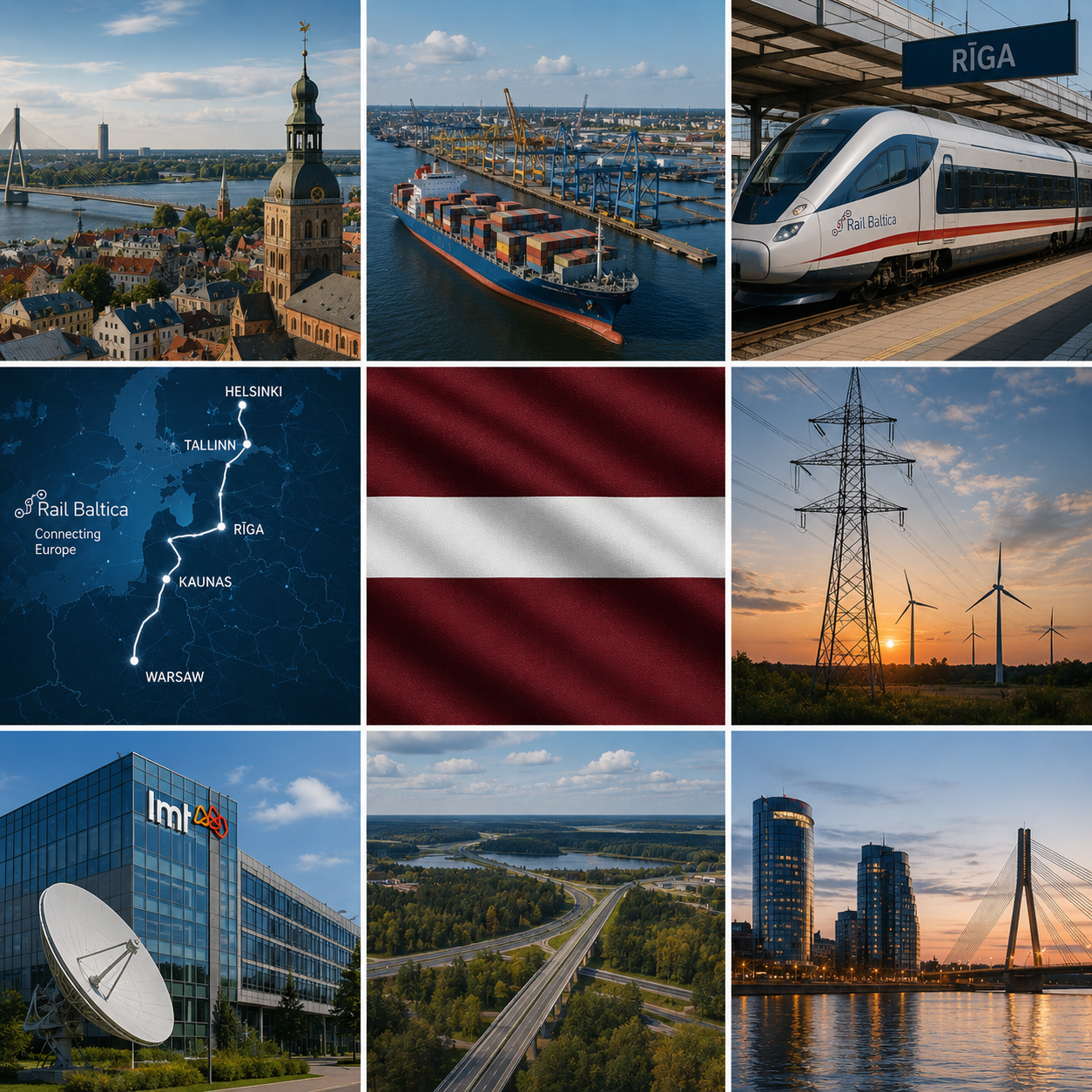
Why resilience is built through connectivity
Situated between Northern and Eastern Europe, Latvia occupies a strategic position that extends far beyond its size. Through transport networks, digital infrastructure, energy diversification and regional cooperation, the country is strengthening its role as one of Europe’s emerging connectors in an increasingly uncertain geopolitical environment.
For centuries, Latvia’s geography has shaped its economy. Situated on the eastern shores of the Baltic Sea, the country has long served as a meeting point between regions, cultures and trade routes. Goods, people and ideas have passed through its ports and transport corridors for generations, making connectivity one of Latvia’s defining characteristics. Today, that geography is acquiring renewed strategic significance.
Geography may shape a nation’s position. Connectivity determines its influence.
As Europe’s economic landscape changes and security considerations increasingly influence industrial policy, Latvia is redefining itself not simply as a transit country, but as a resilient European partner connecting infrastructure, markets and institutions.
Geography as an Economic Asset
Latvia’s location has always been central to its development. The ports of Riga, Ventspils and Liepāja connect Northern Europe with the wider Baltic region, while road and rail corridors continue to support trade throughout the continent.
Perhaps no project illustrates this transformation more clearly than Rail Baltica. Designed to integrate the Baltic States into the European rail network, the project represents far more than a new transport corridor. It has become one of Europe’s most important examples of dual-use infrastructure: strengthening commercial logistics while simultaneously improving military mobility along NATO’s eastern flank.
Infrastructure no longer simply connects economies. It increasingly connects security, resilience and sovereignty.
Infrastructure is no longer simply about moving goods. It is increasingly about ensuring that Europe can move resources, people and capabilities quickly and reliably when circumstances demand it. Infrastructure has become strategy.
Building Economic Resilience
Like many European economies, Latvia faces demographic pressures, labour shortages and global competition. Rather than relying upon a single sector, the country has gradually diversified its economy.
Advanced manufacturing, logistics, information technology, financial services and renewable energy all contribute to a broader economic base.
Digital connectivity forms an increasingly important part of this transition. Latvian companies and research organisations are contributing to developments in secure communications, 5G applications and maritime connectivity, illustrating that strategic infrastructure today includes both physical transport corridors and digital networks.
Economic resilience increasingly depends upon the interaction between the two.
Energy After Dependence
Recent years have fundamentally altered Europe’s approach to energy security. For Latvia, diversification has become a strategic priority.
A defining moment came with the Baltic States’ decision to disconnect from the BRELL electricity system, historically synchronised with Russia and Belarus, and integrate fully with the Continental European electricity network. The transition represented far more than a technical adjustment. It marked a strategic realignment of critical infrastructure.
Every energy network reflects a geopolitical choice.
Energy networks increasingly reflect geopolitical choices as much as engineering decisions. Reliable electricity, cross-border interconnections and renewable generation are becoming essential foundations for long-term competitiveness and resilience.
Security and Economic Development
Latvia’s proximity to Russia inevitably shapes national priorities. Yet security today extends well beyond military capabilities.
Cybersecurity, digital communications, critical infrastructure and trusted institutions increasingly reinforce one another. Investment decisions now depend as much upon resilience as upon taxation or labour costs.
Economic competitiveness therefore rests upon the reliability of entire systems. The distinction between civilian infrastructure and national security is gradually becoming less pronounced.
A Society Adapting to Change
Demographic change remains one of Latvia’s long-term challenges. Population decline and migration have influenced labour markets, education and regional development for many years.
Rather than viewing these developments solely as constraints, Latvia increasingly focuses on improving productivity, strengthening skills and deepening European cooperation.
The challenge is not simply to maintain economic growth. It is to ensure that infrastructure, institutions and human capital continue developing together.
Europe’s Strategic Connector
Latvia rarely dominates European headlines. Its contribution is often quieter. Yet modern economies depend upon countries capable of connecting regions, maintaining resilient infrastructure and coordinating increasingly complex networks.
Latvia demonstrates that strategic influence is not determined solely by population or economic size. It is increasingly shaped by reliability.
In the twenty-first century, resilience may become Europe’s most valuable form of connectivity.
As Europe strengthens its industrial base and critical infrastructure, countries capable of connecting systems may become just as important as those producing breakthrough technologies.
Perhaps Latvia’s greatest contribution lies precisely there. Not simply as a bridge between regions. But as one of the countries helping Europe build a more connected, more resilient and strategically integrated future.
Image Credit
AI-generated illustration for Altair Media Europe
Caption
Latvia — Europe’s Strategic Connector.
Positioned at the crossroads of Northern and Eastern Europe, Latvia is strengthening its role through transport infrastructure, digital networks, energy integration and regional cooperation. As Europe invests in resilience, Latvia demonstrates that connectivity itself has become a strategic capability.
