Germany — Industrial Power Meets Network Control
The Architecture of Dependency in Europe’s Largest Economy
Germany built its economic power through industrial precision, engineering continuity and long-term infrastructure thinking. But in the digital era, a new tension is emerging beneath that industrial strength: who controls the systems modern industry increasingly depends upon?
Europe’s largest economy remains globally influential in manufacturing, logistics, automation and industrial technology. Yet many of the digital layers now shaping those industries — cloud infrastructure, AI systems, software environments and hyperscale computing — are largely controlled elsewhere.
That contradiction increasingly defines Germany’s position inside Europe’s digital future.
Industrial power in a platform age
Germany’s infrastructure culture differs from many other European countries because it remains deeply tied to industrial logic.
Networks are not viewed merely as consumer services, but as extensions of industrial production itself. Connectivity supports factories, ports, logistics systems, energy infrastructure and machine-to-machine coordination. This is one reason why Germany became an important testing ground for industrial 5G and private network deployment.
But the digital economy increasingly operates according to a different logic than traditional industry.
Industrial power once depended on physical control over factories, machines and supply chains. Today, influence also depends on ownership of cloud environments, data architectures, AI infrastructure and software ecosystems.
That shift creates growing unease within parts of the German economic model.
Germany’s famous Mittelstand companies — highly specialised industrial firms that form the backbone of the national economy — remain world leaders in engineering and advanced manufacturing niches. Yet many increasingly depend on digital infrastructures they do not fully control themselves.
“Germany’s strength lies in industrial ecosystems, not platform dominance.”
Marietje Schaake, international policy fellow, Stanford University
This helps explain why debates around digital sovereignty have intensified across Germany in recent years. The concern is no longer simply about technology adoption, but about strategic dependency.
Can Europe’s industrial core remain competitive if the digital systems beneath it are increasingly shaped by foreign platform power?
Deutsche Telekom and the cloud contradiction
Germany’s telecom position is closely linked to Deutsche Telekom, one of Europe’s most influential operators.
Like many major European telcos, Deutsche Telekom increasingly presents itself not only as a telecom company, but as part of Europe’s strategic infrastructure layer — connecting networks, edge computing, cloud services and AI environments.
That reflects a broader shift inside the telecom sector itself.
Operators increasingly speak about:
- AI-native infrastructure;
- cloud federation;
- cybersecurity;
- edge computing;
- industrial resilience;
- digital sovereignty.
Yet Germany’s telecom strategy also reveals a deeper paradox.
While Deutsche Telekom supports European discussions around sovereignty and infrastructure control, it simultaneously works closely with American hyperscalers including Microsoft and AWS to modernise networks and expand enterprise cloud services.
In practice, this means Europe’s largest telecom operators increasingly function both as guardians of European infrastructure and distributors of external cloud ecosystems.
This is not hypocrisy so much as structural reality.
Germany and France once positioned Gaia-X as a major European initiative for sovereign cloud infrastructure. But the project gradually exposed how difficult it is for Europe to reduce dependency while remaining deeply interconnected with the same global cloud companies it seeks to balance.
“Europe has industrial capabilities, but lacks sufficient control over the digital platforms shaping the next economy.”
Francesca Bria, innovation economist and digital policy expert
The result is a hybrid infrastructure model in which sovereignty and dependency increasingly coexist.
Between openness and control
Germany’s dilemma ultimately reflects a broader European tension.
Its economy depends on openness, exports and interconnected global supply chains. At the same time, the geopolitical environment is becoming more fragmented and strategic technologies increasingly function as instruments of power.
That creates difficult questions for Europe’s largest economy.
Can Germany remain economically open while reducing strategic infrastructure dependencies? Can Europe build sovereign digital capabilities without isolating itself from global technology ecosystems? And can industrial leadership survive if the underlying architecture of the digital economy is controlled elsewhere?
These questions extend far beyond telecom alone.
Because the next generation of networks is no longer simply about faster connectivity. It is about who controls the systems through which modern economies increasingly operate.
And in Europe’s emerging digital architecture, Germany may become the clearest example of how industrial strength and digital dependency can exist at the same time.
This article is part of FASE III — NATIONAL ARCHITECTURES, a series exploring how European countries approach infrastructure, sovereignty and digital power in the next network era.
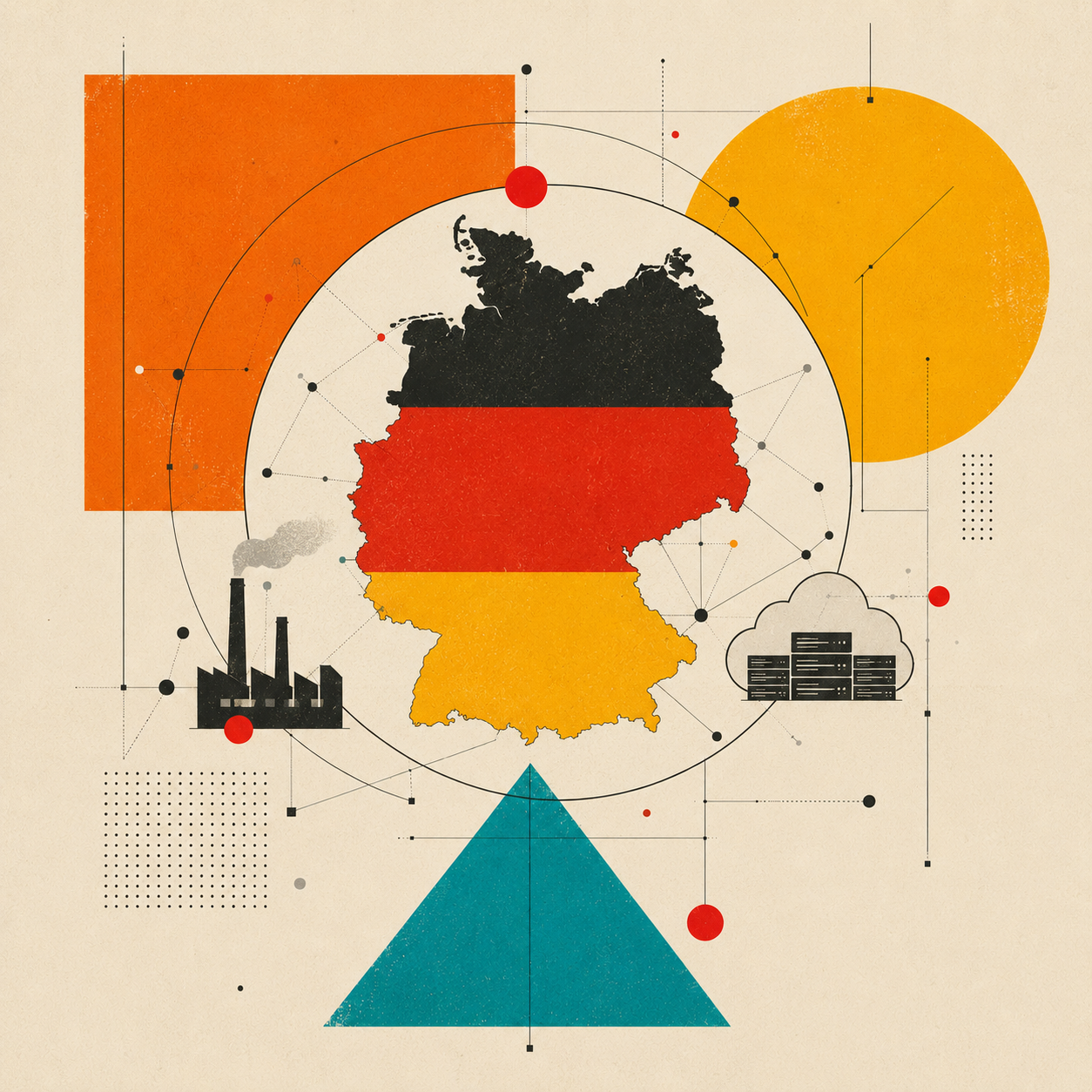
Illustration: Abstract visual interpretation of Germany’s industrial and digital infrastructure landscape, inspired by European network architecture, sovereignty and platform dependency.
Caption: Germany’s industrial strength increasingly depends on digital systems shaped beyond its own borders — revealing the growing tension between manufacturing power, cloud infrastructure and European technological sovereignty.
