Europe’s Scaleup Ambition Meets Singapore’s Patient Capital
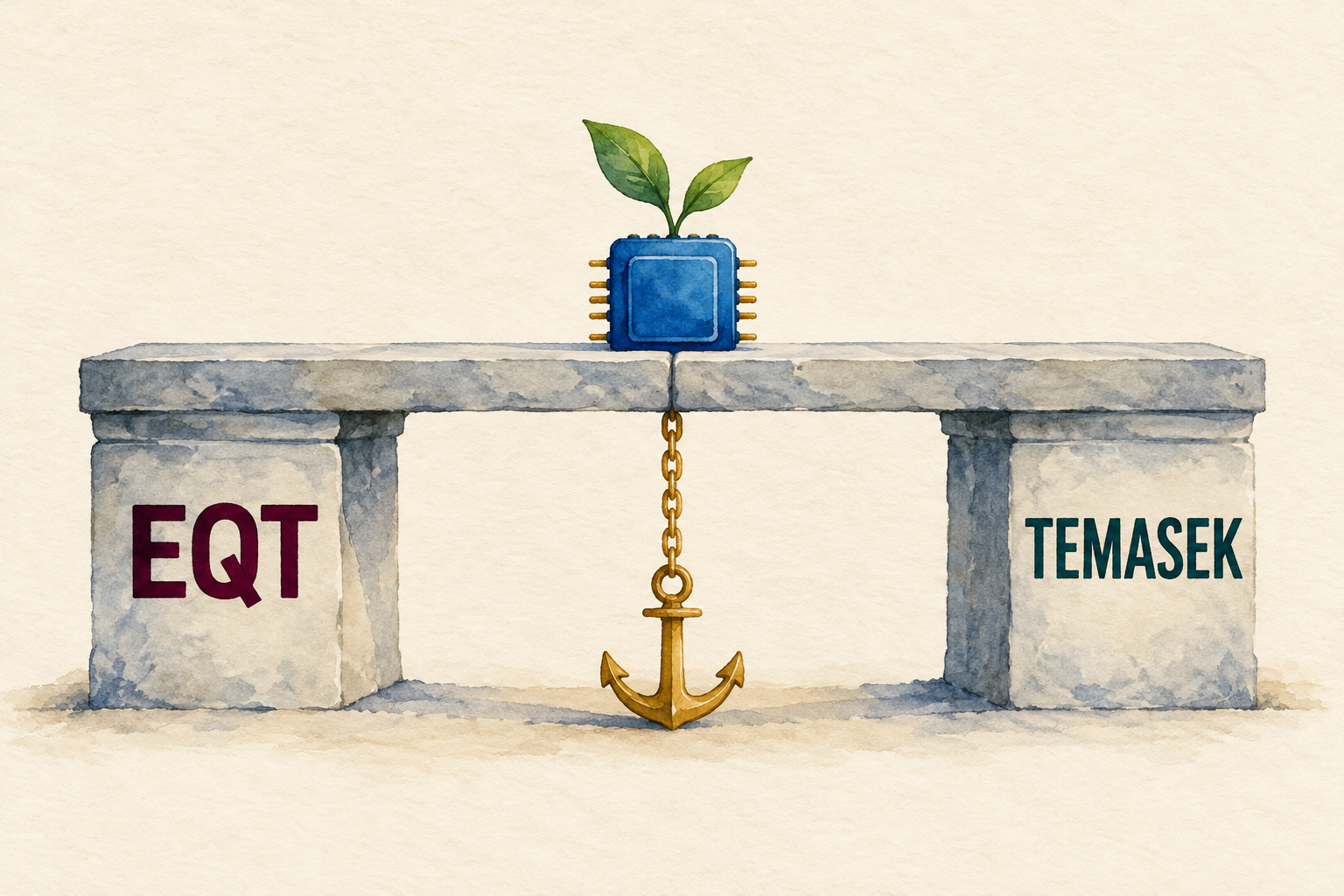
Temasek’s reported $250 million commitment connects Singapore’s long investment horizon with Europe’s harder challenge: retaining strategic influence after a growth fund exits.
Europe’s effort to finance its technology champions is attracting global capital. According to the Financial Times, Singapore’s Temasek has agreed to commit $250 million to the EQT-managed Scaleup Europe Fund. The reported deal raises a harder question: can Europe retain headquarters and jobs while also preserving influence over intellectual property and strategic decisions?
The development connects two Altair themes: Europe’s search for growth capital and Temasek’s ability to invest across generations. Six questions reveal the tension.
🟦 What would Temasek actually be financing?
The reported commitment would enter the fund itself. That differs from Samsung’s participation alongside the fund in Mistral’s financing round: one supplies capital for a portfolio; the other backs a particular company.
The FT reported on 5 October that an announcement was expected later that month. EQT and Temasek declined to comment. No separate official confirmation was identified in the sources reviewed for this article.
If confirmed, the significance extends beyond the cheque. A non-European institution would be helping finance the vehicle created to strengthen European technology ownership.
🟦 Why would Singapore back Europe’s champions?
Temasek has already set out its reasoning. In September, it described Europe as a priority market, supported the Scaleup Europe Fund’s ambition and advocated a single European capital market. Its approach combines capital, sector expertise and international networks to help companies grow while remaining rooted in Europe.
A fund commitment can provide exposure across several companies and access to a manager’s investment expertise. It could also create relationships relevant to later direct investments, although no such strategy or special co-investment rights have been announced for Temasek.
The commercial logic is plausible. The strategic alignment still needs testing: Europe wants stronger capabilities, while Temasek needs attractive investments.
🟦 Does foreign capital weaken European sovereignty?
The EIC explicitly allows for non-European investors aligned with the fund’s objectives, while requiring strong European anchoring within its investor base.
That is a workable principle. Global money can expand Europe’s financing capacity and reduce pressure on companies to relocate to obtain it.
The difficulty lies in defining the anchor. Headquarters, intellectual property, manufacturing, board influence and shareholder ownership describe different kinds of attachment. Later financing rounds can change voting rights and bargaining power while headquarters remain in place.
A foreign investor in the fund does not automatically control its portfolio companies. Equally, a European address cannot establish where effective decision-making power resides.
🟦 Who decides when returns and strategic interests collide?
EQT manages the fund independently on commercial terms. The Commission participates as an investor; it does not direct individual investment decisions.
That independence gives the model credibility. It also places a limit on what policymakers can expect from it.
Consider a company whose most profitable expansion route moves important operations abroad. Growth may benefit shareholders while weakening Europe’s industrial position. Investment terms, board influence and the fund’s guidelines would then matter more than its European branding.
The tension becomes sharper at exit: a commercially attractive buyer may offer a future that sits uneasily with the fund’s strategic purpose.
🟦 Can patient capital survive a fund’s exit clock?
In The Sovereign Balance Sheet, Altair Media Asia examined Temasek’s ability to organise capital across generations. Participation in a managed fund introduces another timetable.
The original, indicative selection framework envisaged a closed-ended fund with a ten-year life and possible extensions. The final contractual terms must be distinguished from that proposed structure.
Temasek’s long horizon would therefore not automatically become the fund’s horizon. Industrial development can take longer than investors are willing to wait for distributions.
A long-term institution could remain involved through a later direct investment or another vehicle. That is a possible route, not an announced Temasek plan. It would also reopen the ownership question: whose capital carries the company into its next decade?
🟦 What happens when the fund sells?
An investment can help a company scale in Europe without guaranteeing European ownership after an exit.
A listing, secondary sale or acquisition would each redistribute influence differently. The decisive question is who replaces the fund as an influential shareholder, and whether that ownership sustains the European capabilities the investment helped build.
European pension capital is already participating: ABP has committed €250 million. The issue is whether institutional participation becomes deep and sustained enough to support companies through later rounds and into public markets.
That connects the fund to Europe’s wider capital-market integration challenge. Listing venue, ownership and operational location can diverge. Europe needs investors capable of supporting its champions beyond the first successful exit.
Signal
Temasek’s reported commitment would broaden the capital behind Europe’s scaleup ambition. The harder task is to organise ownership that lasts beyond the fund’s investment cycle.
Europe’s test is to retain influence over critical technology, industrial capacity and strategic decisions when the growth capital exits.
Credit
Illustration: Altair Media / OpenAI
Caption
EQT and Temasek depicted as pillars supporting technological growth, with an anchor symbolising European strategic influence. Temasek’s reported fund commitment raises the question of how that influence can endure beyond the investment cycle.
