Europe’s Innovation Layer
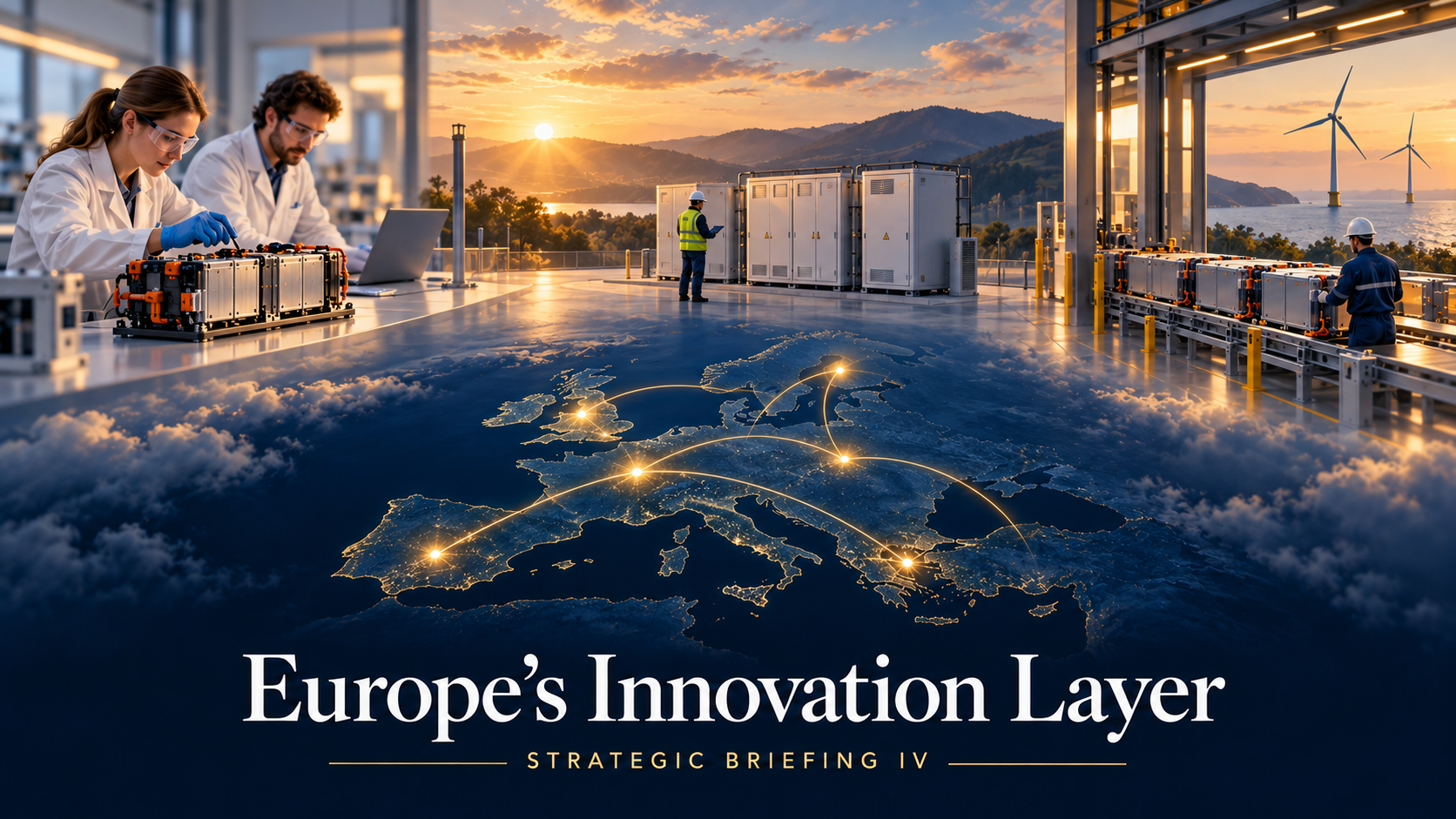
How Europe’s innovators are turning scientific breakthroughs into energy-system capabilities
Strategic Briefing IV
Europe’s next energy system is taking shape in research laboratories, young technology companies and industrial demonstration sites. Its development depends on whether scientific breakthroughs can become reliable equipment and services deployed at scale. The European Innovation Council’s (EIC) energy portfolio offers a concrete view of this innovation layer, and of the industrial relationships needed to turn invention into usable capacity.
Electrification places new demands on Europe’s energy system. Variable renewable generation increases the need for flexibility, while industrial users require equipment that can replace fossil-fuel processes without compromising production. Meeting these demands depends partly on the people and organisations developing new ways to generate, store, convert and manage energy.
Some work on components that remain almost invisible to the public. Others develop equipment intended to change entire industrial processes. Their strategic contribution becomes measurable when a technology can be manufactured reliably, integrated into existing operations and deployed at a cost that customers can sustain.
Europe’s innovation strength becomes strategic when scientific breakthroughs turn into reliable industrial capabilities.
This is the central question behind Europe’s innovation layer: how does scientific and technical knowledge become usable capacity in the energy system?
A portfolio of possible capabilities
In June 2026, the European Innovation Council published a mapping of nearly 100 EIC-supported companies across twelve energy domains. These include storage, electricity transmission and management, hydrogen, heating and cooling, power electronics, clean generation and advanced materials. The mapping provides a concrete starting point for examining the breadth of European energy innovation.
Altair Media’s Building Europe’s Energy Architecture series approached this portfolio through the relationships between technologies. Storage, grids, industrial transformation and digital coordination were examined as complementary capabilities. This briefing extends that analysis to the conditions under which those capabilities can be developed and deployed.
The portfolio is a selected view of EIC-supported activity. Europe’s wider innovation base also includes university research, national programmes, established manufacturers and developments financed without EIC support. The mapping should therefore be read as evidence of particular capabilities under development, rather than a complete inventory of European innovation.
Its breadth also demands care. Different companies address different operating environments and stand at different stages of maturity. A commercially available control service and an experimental energy technology cannot be assessed against the same timetable. The relevant question is what each can contribute, when, and under which conditions.
Where energy innovation begins
Universities and research institutes provide part of the scientific foundation. Advances in electrochemistry can change storage performance; materials research can affect the efficiency and durability of energy equipment. Engineering research helps translate these advances into devices that function beyond controlled laboratory conditions.
A successful demonstration proves a technology can work. Repeatable deployment proves it can become part of the energy system.
Deep tech describes innovations rooted in substantial scientific or engineering advances. In energy, development often involves physical processes that need repeated testing. A promising material must survive manufacturing. A component must withstand operating temperatures and repeated use. A new process must work with the inputs available at an industrial site.
The transition into a company introduces another set of decisions. Researchers and founders need to identify a customer problem, establish access to intellectual property and recruit people capable of building and delivering a product. Access to shared testing facilities can be particularly valuable when a young business cannot afford specialised equipment of its own.
Innovation also emerges from practical experience. Manufacturers identify weaknesses in equipment; industrial users encounter processes that are expensive or difficult to electrify. Cooperation between these users and research teams can make development more relevant to the conditions in which a technology will eventually operate.
The EIC across the innovation journey
The EIC supports several parts of this development process. Pathfinder, Transition, Accelerator and STEP Scale Up address different development needs. Pathfinder funds breakthrough research, while Transition supports technological validation and preparation for market entry. Accelerator provides grants and investment for commercialisation and growth. STEP Scale Up seeks to catalyse larger investment rounds for further expansion. These instruments offer different routes into support; they do not constitute a compulsory sequence for every company.
Their strategic purpose is to help promising developments progress through stages where uncertainty can make financing difficult. Research funding supports exploration before a commercial proposition is established. Later support can help a company develop its product and attract investors willing to finance further growth.
Financing the company and financing its first commercial deployment are two different investment challenges.
An EIC award provides resources and can improve visibility. Commercial success still depends on performance, customer demand and execution. The energy portfolio makes it possible to examine what supported companies are building and what remains necessary before their technologies can have a wider effect.
The EIC Board’s June 2026 statement explicitly recognises different time horizons. It identifies technologies that could be deployed immediately alongside frontier technologies with longer development paths. It also calls for continuity of funding, faster permitting and stronger industrial and public demand to support deployment.
How technologies contribute to the system
Storage illustrates why the function of an innovation matters as much as its label. Skeleton Technologies develops supercapacitors for applications requiring rapid delivery of power. Their characteristics differ from those of batteries designed to store larger quantities of energy over longer periods.
AQUABATTERY takes another approach, developing a flow battery using salt and water for long-duration storage. Its proposed contribution concerns the ability to shift electricity availability over longer periods, with a different material and equipment architecture.
These examples address different needs. Fast power response and sustained energy delivery have distinct engineering requirements. Evaluating a storage technology therefore requires attention to its intended duration, operating conditions and place within the wider installation.
Sympower illustrates the role of coordination. Its services connect and aggregate energy assets, including batteries and flexible industrial demand, and use them in electricity markets. The wider significance is that equipment gains additional value when its operation can respond to system needs. This requires usable interfaces, reliable control and market arrangements that reward the service provided.
CorPower Ocean adds a generation example through its development of wave-energy converters. The strategic question for technologies of this kind extends from energy capture to installation, maintenance and repeatable delivery. A promising generating device must become an energy project that operators can manage over its lifetime.
Together, these examples show how the innovation layer interacts with existing infrastructure and operating companies. New equipment needs connections and operating partners. Digital services need access to physical assets. Each capability depends on relationships beyond the company developing it.
Demonstration and the first customer
A demonstration project helps establish how a technology performs in a relevant environment. It can expose problems that laboratory testing misses, including maintenance requirements, integration difficulties and variation in real operating conditions.
The next challenge is repeatability. Customers need evidence that performance can be maintained across multiple installations. Manufacturers must deliver consistent quality, while operators require spare parts, technical support and clear responsibilities when something fails. A successful demonstration provides a foundation for answering these questions, but does not settle them all.
The first industrial customer consequently plays an important role. A utility or manufacturer can provide a testing environment, operational feedback and a reference for future sales. In return, it takes on risks associated with equipment or services that have a limited operating history.
The first customer contributes more than revenue: it provides operating evidence and shares the risk of deployment.
That relationship needs a credible allocation of risk. Development contracts, staged acceptance and appropriate warranties can help clarify what the supplier must demonstrate and what the customer is prepared to undertake. The objective is to make adoption possible while protecting the continuity of the customer’s operations.
Established energy companies and industrial users can make a decisive contribution as customers willing to share early deployment risk. This may involve committing to equipment purchases, joining deployment consortia or signing offtake agreements to buy a project’s energy or other output. Such commitments can help establish a market and reduce revenue uncertainty, although they do not eliminate technical risk. The EIC Board’s call to mobilise industrial demand places these purchasing decisions alongside investment as a condition for wider deployment.
Financing the company and financing deployment
Different stages of development require finance suited to different uncertainties. Research grants can support work whose commercial outcome remains open. Equity can finance product development and company growth. Manufacturing expansion requires capital for facilities, production equipment and working capital before sales generate sufficient cash.
Deployment introduces a further distinction. Financing the technology company does not automatically finance installations using its equipment. A company may have secured a substantial investment round while prospective customers still struggle to fund their first projects.
First-of-a-kind (FOAK) commercial-scale installations face a particular financing gap. They must establish an operating record while carrying construction costs and the risk that technology will perform differently at scale. Capital for the developer may therefore be available before finance for its first commercial projects. The EU Innovation Fund explicitly targets risk sharing for innovative projects of this kind.
Bankability describes whether a project’s expected cash flows, contracts and allocation of risk give lenders sufficient confidence to finance it on acceptable terms. Technical validation helps, but delivery, operating performance and the creditworthiness of contractual partners also matter. Early projects may require customer capital and public support alongside lending. The EIB’s assessment of a first commercial geothermal demonstration in Germany illustrates how technology, construction and offtake risks can require such a financing package.
The appropriate mix depends on the technology and the project. Finance cannot compensate indefinitely for poor performance or an uncompetitive cost structure. Its useful role is to support credible development and evidence gathering until commercial delivery becomes more predictable.
The measure of progress should consequently extend beyond money raised. Repeat customers, operating installations and dependable production provide evidence that an innovation is becoming usable capacity. A growing company and a growing deployment base are related achievements, each with its own requirements.
Building capacity in Europe
For Europe, the location of research is only part of the strategic picture. Manufacturing, supplier expertise and operational knowledge also determine how much capability remains available within the European economy.
International investment and partnerships can help European companies expand. Strategic resilience depends on the resulting arrangements: where equipment is produced, who can maintain it, how supplies are secured and whether critical expertise remains accessible. European invention alone does not answer these questions.
The same reasoning applies to materials. Electrification changes the resources and components on which energy systems depend. Innovation in recovery, recycling and alternative materials can help address those dependencies, although its value must also be demonstrated through cost, quality and reliable supply.
The EIC energy portfolio offers a practical basis for examining these developments without assuming that every supported technology will succeed. Its contribution can be assessed through the capabilities that reach deployment, the evidence supporting them and the industrial relationships that sustain them.
Europe’s innovation layer grows where research teams, entrepreneurs and operating companies can work through these challenges together. Its strategic value becomes visible when reliable equipment is delivered at scale, digital services improve the operation of physical assets and industrial expertise supports further development. Scientific breakthroughs then become durable industrial capacity. That is how new ideas become part of Europe’s energy architecture.
Strategic Briefing IV continues the examination of Europe’s energy landscape, leading companies and infrastructure by exploring the innovation capabilities shaping their future development.
Credit
AI-generated illustration by OpenAI for Altair Media.
Caption
From research laboratories to demonstration projects and industrial production: an editorial illustration of the innovation capabilities shaping Europe’s energy future.
