Europe Is Building the Machinery of Sovereignty
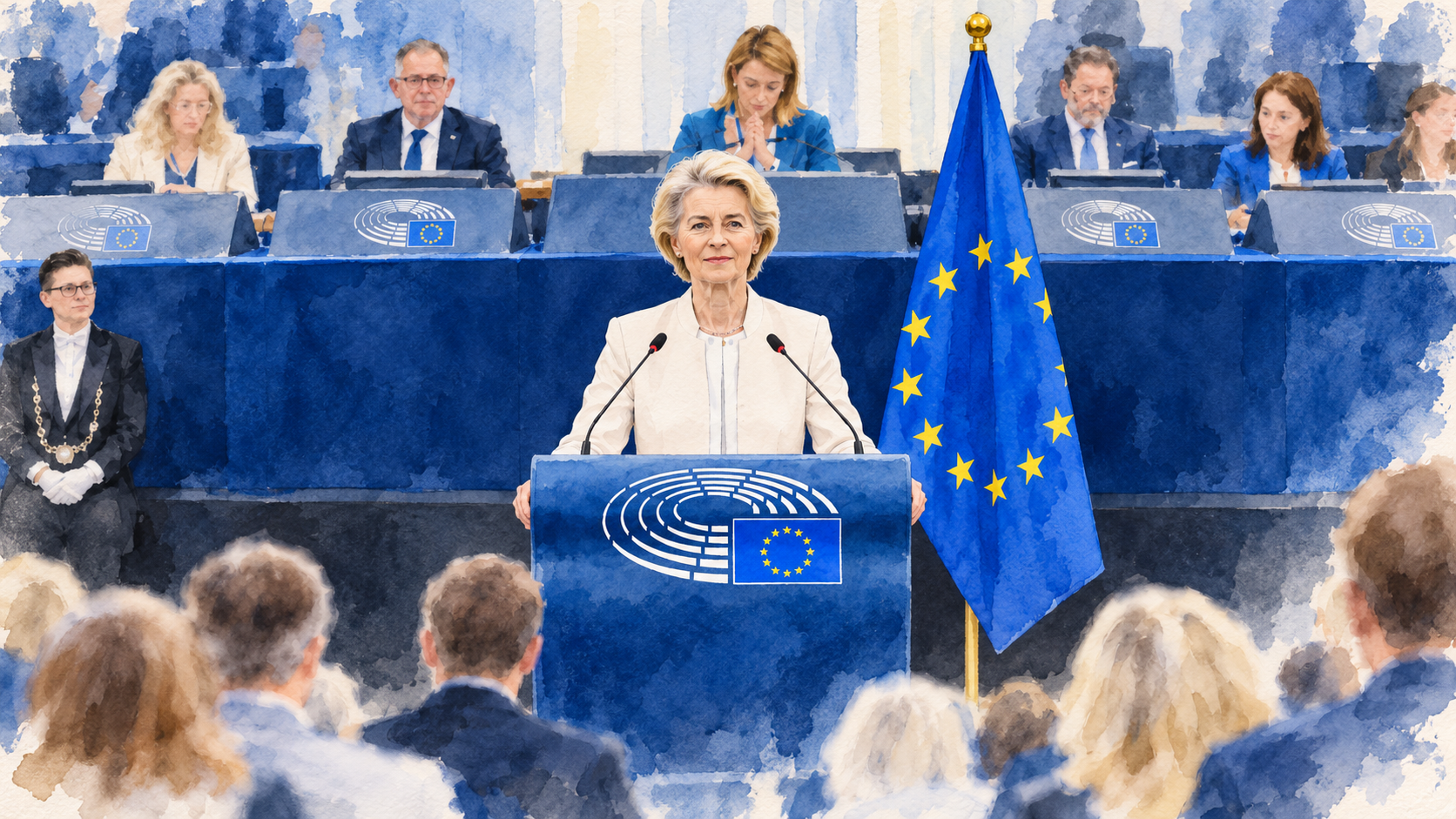
Von der Leyen’s State of the Union suggests a deeper shift: Europe is moving from regulating dependence to building the capacity to reduce it.
Europe has spent years defining what sovereignty should mean. Now comes the harder part: building it. In her 2026 State of the Union, Ursula von der Leyen repeatedly moved beyond the familiar vocabulary of strategic autonomy, resilience and economic security. The emphasis was increasingly physical and institutional: grids, storage, raw-material reserves, computing capacity, banking, defence assets and security structures. That matters.
Europe’s constraint is no longer simply a lack of rules, ambitions or strategies. Political intent repeatedly runs into physical bottlenecks, fragmented capital, supply dependencies and institutions that were built for a slower and more predictable world.
The emerging question is therefore no longer only what Europe should regulate. It is what Europe must actually be able to do.
🟦 Can Europe be sovereign if its infrastructure cannot move power?
Europe can install renewable energy faster than its grids can absorb it. That is rapidly becoming a strategic constraint.
Von der Leyen noted that Europe installed more than 80 GW of renewable capacity last year, while several times that amount remains waiting for a grid connection. The policy response is therefore shifting away from simply adding new climate targets towards accelerating transmission, interconnectors and storage.
The distinction is critical. Producing electricity is not the same as having an energy system capable of delivering it. Europe can build wind farms, solar parks, nuclear capacity and ambitious industrial electrification strategies, but without sufficient high-voltage infrastructure that generation remains constrained.
The bottleneck has moved downstream. Once the constraint sits inside the grid, energy policy becomes infrastructure policy. Sovereignty begins at the cable.
🟦 Can Europe reduce dependence without controlling access to what it needs?
For decades, Europe assumed that global markets would supply critical inputs whenever companies were willing to pay. Geopolitics has weakened that assumption.
Europe remains heavily dependent on China for critical raw materials and particularly exposed in several rare-earth supply chains. The proposed European Corporation on Critical Raw Materials — intended to procure and stockpile materials required for chips, batteries, clean technology and defence — signals a departure from conventional market policy.
Trade agreements create access. Diversification reduces concentration. Strategic procurement and stockpiling do something more: they create buffer capacity.
Europe is beginning to treat access to critical inputs not simply as a commercial outcome, but as infrastructure that may require collective European intervention.
That changes the relationship between markets and security. The boundary between market efficiency and strategic capacity is moving.
🟦 Can Europe build industrial sovereignty without mobilising private capital at European scale?
Europe does not suffer from a shortage of savings. It suffers from difficulty converting those savings into European-scale investment.
The contradiction is increasingly difficult to ignore: a large internal market, substantial household wealth and significant industrial capabilities coexist with fragmented capital markets, national financial systems and companies that often still look outside Europe when they need serious expansion capital.
The proposed Banking Package and Savings and Investments Union expose a deeper structural tension. For more than a decade, European financial regulation understandably concentrated on supervision, resilience and systemic risk. Now the continent simultaneously wants to finance defence capacity, energy grids, AI infrastructure, semiconductor production, industrial transformation and deep-tech scale-ups.
Those ambitions require more than public money. Public capital can initiate industrial capacity. It cannot finance European scale on its own. Private capital must be able to move across borders, aggregate risk and finance companies through the difficult transition from innovation to industrial scale. That makes capital allocation part of sovereignty.
If European industrial champions still need American capital markets to finance their global expansion, part of Europe’s strategic architecture remains externally dependent.
🟦 Can Europe exercise strategic power through institutions built for consensus?
The same tension appears in security. Cyberattacks, sabotage, drone incursions and other forms of pressure below the threshold of conventional warfare increasingly demand rapid coordination. Yet European institutions were largely designed around negotiation, legal process and carefully distributed authority.
Proposals for an Emergency Security Protocol and a European Security Council reveal the underlying diagnosis. Europe does not necessarily lack instruments. It often lacks the institutional wiring to deploy them quickly.
That creates a fundamental tension. European integration derives much of its legitimacy from compromise, shared authority and the protection of national interests. Strategic competition increasingly rewards speed, concentration and decisiveness.
Europe therefore faces a difficult institutional challenge: increasing its capacity to act without dismantling the governance principles that hold the Union together.
Money can be allocated relatively quickly. Equipment can be purchased. Decision architectures are much harder to redesign.
🟦 Can Europe turn new machinery into actual capacity?
This is where all the previous questions meet. A raw-material corporation does not automatically secure rare earths. A Banking Package does not integrate capital markets. A Grids Package does not connect a gigawatt. A Security Council does not create strategic consensus.
Institutions can be announced quickly. Capacity cannot. It still has to pass through permits, balance sheets, procurement systems, national governments, supply chains and physical infrastructure.
Those execution barriers are not new. Permitting delays, fragmented procurement, national protectionism, regulatory overlap and risk aversion have constrained European projects for years.
The architecture may be changing. The operational friction remains. That is the harder test. European sovereignty will ultimately be measured not by the machinery it creates, but by what that machinery can make happen.
Signal
European sovereignty is acquiring a physical balance sheet: a transmission line, a strategic stockpile, a bank balance sheet, computing capacity and an emergency protocol. For two decades, much of Europe’s global influence came from its ability to write rules.
That power remains. But a world increasingly organised around compute, energy, capital, materials and security demands another kind of capability. Europe now has to build the systems that allow policy to become power.
Sovereignty is no longer only something Europe can regulate. It is something Europe must be able to operate.
Credit
Illustration: Altair Media, based on European Commission press imagery.
Caption
European sovereignty is becoming less abstract: increasingly, it is about the infrastructure, capital and institutions Europe can actually mobilise and operate.
