Europe Doesn’t Need Another Silicon Valley
Why specialised ecosystems may be Europe’s greatest competitive advantage
SIGNAL III
For decades, discussions about European innovation have been dominated by comparison. Why doesn’t Europe have its own Silicon Valley? Why are Europe’s technology companies smaller? Why do so many start-ups leave for the United States? The questions are understandable. But they may also be the wrong questions.
Europe has never competed through a single technology hub. Its strength has always emerged from something more distributed: a network of specialised regions, universities and industrial ecosystems, each developing expertise in different parts of the innovation chain.
The Baltic photonics ecosystem is not an exception. It is part of a much larger European pattern.
🟦 Innovation Has a Geography
Innovation does not emerge randomly. It develops where universities, research institutes, companies, investors and public institutions reinforce one another over many years. Across Europe, these ecosystems have evolved around different technological capabilities rather than around one dominant industry.
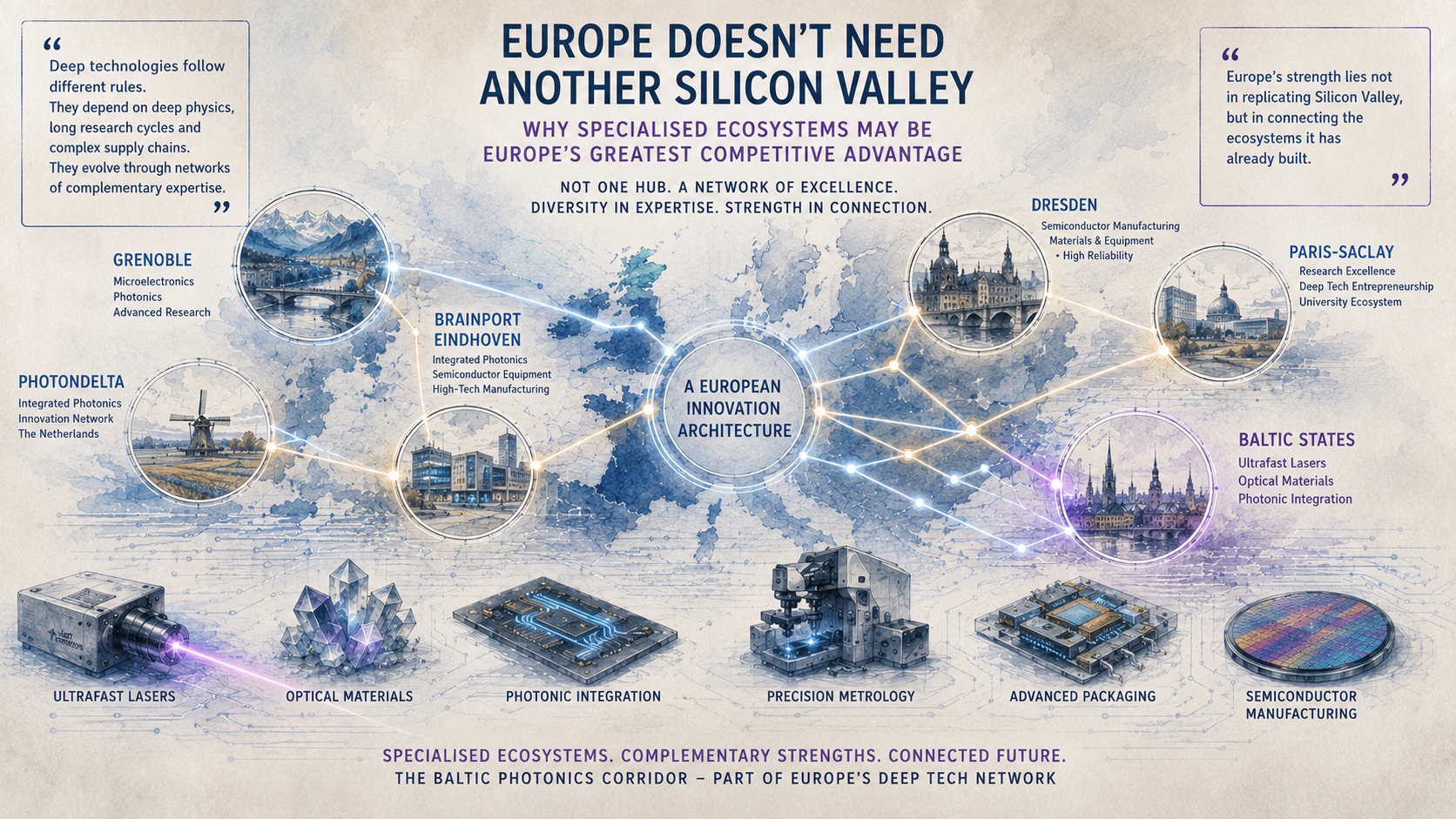
Brainport Eindhoven has become synonymous with integrated photonics, semiconductor equipment and high-tech manufacturing. Dresden has built one of Europe’s strongest semiconductor manufacturing clusters. Grenoble combines microelectronics, photonics and advanced scientific research.
Paris-Saclay brings together universities, laboratories and deep-tech entrepreneurship on an exceptional scale. PhotonDelta connects Dutch expertise in integrated photonics into a national innovation ecosystem.
Across Lithuania and Latvia, highly specialised expertise in ultrafast lasers, optical materials and photonic integration is quietly strengthening Europe’s technological foundations.
Taken separately, these regions appear to tell different stories. Taken together, they reveal a European innovation architecture.
🟦 Diversity as an Industrial Strategy
Much of the global debate assumes that innovation depends on concentration. Silicon Valley has become the dominant reference point: one location, one ecosystem, thousands of companies.
Europe has followed a different path. Its technological capabilities are distributed across countries, languages and institutional traditions.
At first glance, this fragmentation appears to be a weakness. In practice, it also creates diversity. Different universities pursue different scientific traditions. Different regions develop different industrial strengths. Different companies solve different technological problems.
The result is not one giant ecosystem. It is an interconnected network of specialised capabilities.
This reflects a deeper difference between the American and European innovation models. Silicon Valley was largely built around software, digital platforms and consumer markets that could scale rapidly from a single location. Deep technologies such as semiconductors, photonics and quantum engineering follow different rules. They depend on decades of scientific research, specialised facilities, advanced manufacturing and complex international supply chains. These capabilities are difficult to concentrate in one place. They naturally evolve through networks of complementary expertise.
🟦 The Value of Specialisation
No single European region leads every technology. Nor should it. Modern semiconductor manufacturing already depends on hundreds of highly specialised organisations spread across multiple countries.
One region develops advanced materials. Another designs photonic chips. Another builds precision manufacturing equipment. Another produces metrology systems. Innovation increasingly resembles an ecosystem rather than a hierarchy. Its resilience comes not from uniformity, but from complementarity.
The Baltic States demonstrate exactly this principle. Their contribution is not measured by industrial scale alone, but by the specialised photonics, laser technologies and optical engineering they contribute to the wider European innovation ecosystem.
🟦 Connecting the Ecosystems
The real challenge for Europe may therefore not be creating another Silicon Valley. It may be connecting the ecosystems it already possesses.
Scientific collaboration. Shared infrastructure. Cross-border investment. Talent mobility. Industrial partnerships.
European funding programmes such as Horizon Europe and the EU Chips Act increasingly recognise that innovation does not stop at national borders.
The challenge is rarely a lack of scientific excellence. More often, it lies in the administrative, financial and institutional boundaries that still separate Europe’s innovation ecosystems. Capital, infrastructure and talent continue to move more easily within national borders than across them. Reducing that friction may prove just as important as developing new technologies.
Their success will ultimately depend less on creating entirely new ecosystems than on strengthening the connections between those that already exist.
Europe already possesses extraordinary scientific capabilities. Its next challenge is to ensure that these capabilities function as one interconnected innovation network.
🟦 Beyond Competition
Europe’s future competitiveness will not depend solely on building larger factories or creating larger technology companies. It will depend on whether specialised ecosystems can collaborate without losing the diversity that made them successful in the first place.
The Baltic photonics corridor illustrates this broader lesson. Innovation does not always require another Silicon Valley. Sometimes it requires recognising that Europe’s greatest technological strength already exists. It is simply distributed.
Reflection
For decades, Europe has asked itself why it failed to create another Silicon Valley. Perhaps that question has always looked in the wrong direction.
Silicon Valley emerged from the economics of software. Europe’s future may instead be shaped by the physics of deep technology—where progress depends on specialised knowledge, advanced manufacturing and long-term scientific collaboration rather than rapid digital scale.
If that is true, Europe’s greatest challenge is no longer to imitate another innovation model. It is to recognise the one it has already built.
The Baltic photonics corridor is therefore more than a regional success story. It offers a glimpse of how Europe may compete in the age of deep technology—not through one dominant hub, but through a continent connected by complementary centres of excellence.
Next in this series
Executive Dialogue
Following this three-part Signal series, Altair Media continues the conversation with Alise Pizika. Rather than revisiting the technology itself, the discussion explores a broader question: how can Europe strengthen the connections between its specialised innovation ecosystems and translate scientific excellence into lasting industrial capability?
Credit
Illustration: AI-generated artwork for Altair Media Europe
Caption
Europe Doesn’t Need Another Silicon Valley explores how Europe’s distributed network of specialised innovation ecosystems—from Brainport Eindhoven and Dresden to Paris-Saclay and the Baltic States—may represent a distinct competitive model for deep technology, built on complementary expertise rather than a single dominant hub.
