Erasmus University Rotterdam
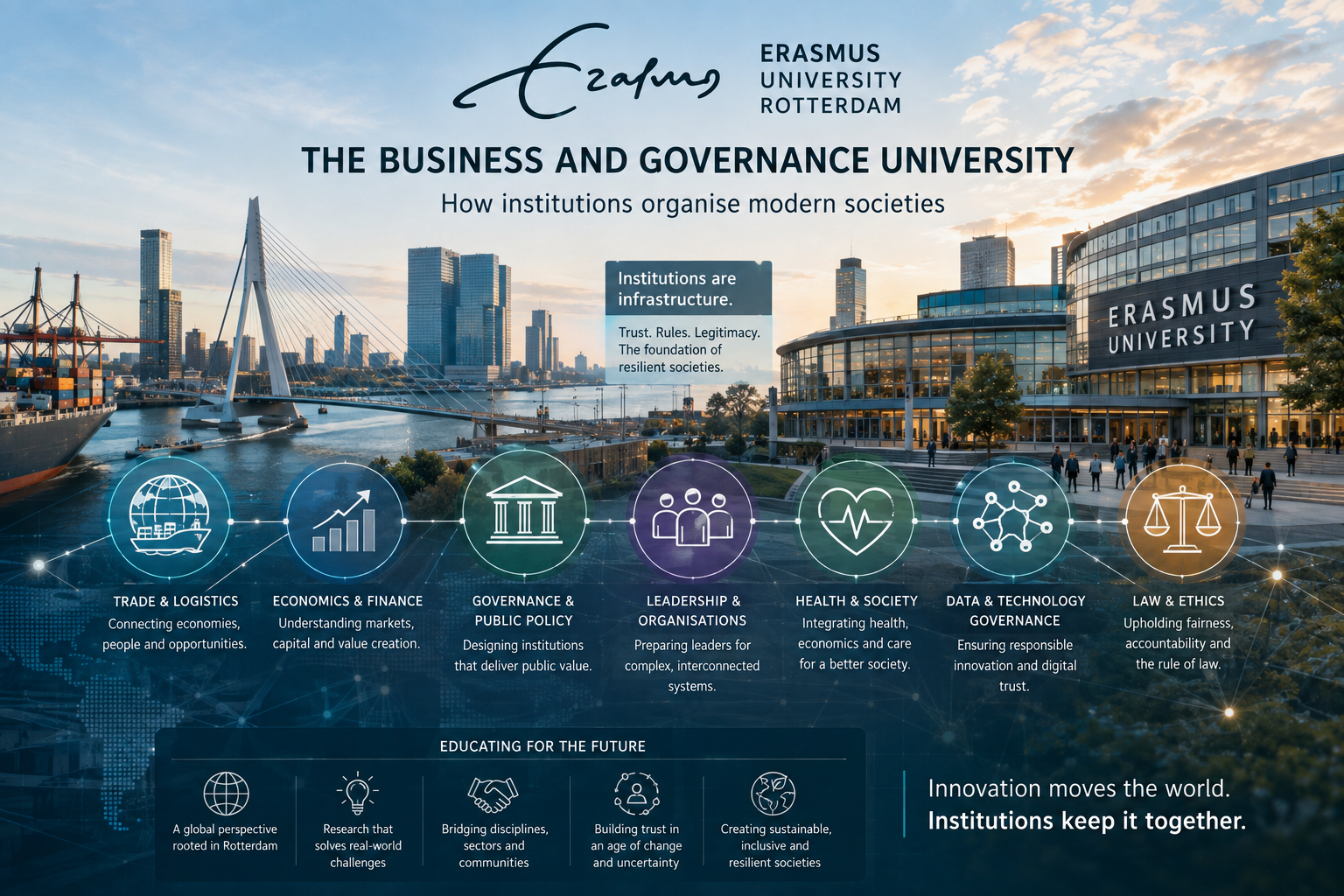
How Institutions Organise Modern Societies
The Business and Governance University
Europe often celebrates technological innovation. Artificial intelligence, semiconductors, quantum technologies and sustainable energy increasingly dominate political and economic agendas. Yet innovation alone does not create resilient societies.
Every technological breakthrough eventually raises institutional questions. Who governs artificial intelligence? Who finances innovation? Who regulates digital markets? Who maintains public trust while societies change at unprecedented speed?
Technology transforms economies. Institutions determine whether those transformations remain sustainable. Few universities illustrate that relationship more clearly than Erasmus University Rotterdam.
The university is not simply educating economists, managers or public administrators. It is helping prepare the people responsible for organising increasingly complex societies.
Beyond Business
The word business often evokes images of financial markets, corporate careers and management education. That picture captures only part of Erasmus University. Its disciplines increasingly converge around a broader challenge: understanding how complex societies organise themselves.
Complex societies require more than innovation. They require institutions capable of organising complexity.
Economics, law, public administration, behavioural science, management and governance each contribute different perspectives, yet together they explore one fundamental question:
How should modern societies organise complexity while maintaining trust and legitimacy?
Increasingly, that question defines the university’s identity.
Rotterdam As A Living Laboratory
Universities are shaped by their surroundings. Rotterdam has always been more than a city. It is one of Europe’s largest ports and one of the continent’s principal gateways for trade, logistics and international commerce.
Here, global supply chains become tangible. Financial flows intersect with physical infrastructure. International business meets public administration. Decisions made in boardrooms quickly affect ports, hospitals, governments and citizens.
For Erasmus University, Rotterdam is therefore more than a location. It is a living laboratory where theory and practice continuously inform one another.
Institutional Infrastructure
Markets are often described as self-organising systems. History suggests otherwise. Markets function because institutions create confidence. Contracts are enforceable, financial systems remain stable, governments provide predictability and public institutions maintain legitimacy.
Trust is therefore not merely a social value. It is infrastructure. Just as electricity networks enable industrial production and digital networks enable communication, institutional quality enables economies to function over the long term.
Trust is not simply a social value. It is one of society’s most important infrastructures.
Perhaps governance should increasingly be understood as critical infrastructure in its own right.
Leadership In An Age Of Complexity
Leadership has changed fundamentally. Today’s leaders rarely solve isolated problems. They navigate interconnected systems in which technological, economic and social developments continuously influence one another.
Artificial intelligence reshapes labour markets. Climate policy affects financial systems. Healthcare increasingly depends on digital infrastructure, while geopolitical tensions disrupt supply chains.
Leadership therefore becomes less about control and more about coordination. It requires judgement, communication and institutional thinking, together with the ability to balance competing interests under conditions of uncertainty.
Health, Economics And Society
One of Erasmus University’s distinctive strengths lies in the close relationship between economics, governance and medicine through Erasmus MC. That integration became particularly visible during the COVID-19 pandemic, when public health, economic stability and political decision-making became inseparable.
The most complex challenges can no longer be solved by a single discipline.
The same integration is becoming increasingly relevant today. Healthcare systems face ageing populations, rising costs, artificial intelligence, data governance and growing expectations regarding quality of care.
These challenges cannot be solved through medicine alone. They require institutional innovation capable of integrating technology, economics and public policy into resilient healthcare systems.
Governing Innovation
Technological progress increasingly outpaces institutional change. Artificial intelligence evolves within months. Legislation often requires years. This growing gap is frequently described as a weakness of governance.
Perhaps it should be understood differently. Good governance is not the opposite of innovation. It is the condition that allows innovation to scale responsibly.
Artificial intelligence requires accountability. Financial innovation requires oversight. Digital platforms require legitimacy. The next phase of European competitiveness may therefore depend as much on institutional capability as on technological capability.
Beyond Rotterdam
Ultimately, this article is not about one university. It asks a broader European question. Who organises technological societies Engineers design systems. Scientists generate knowledge. Entrepreneurs build companies. Institutions create legitimacy…
Innovation changes societies. Institutions determine whether that change creates long-term resilience.
Perhaps Europe’s long-term competitiveness will depend not only on producing better technologies, but also on cultivating institutions capable of governing increasingly complex societies.
Final Reflection
Every technological revolution ultimately becomes an institutional challenge. Artificial intelligence requires governance. Capital requires regulation. Healthcare requires coordination. Trade requires trust. Democracy requires capable public institutions.
Erasmus University therefore contributes something distinctive to Europe’s future. Not primarily by developing technology. But by educating the people responsible for governing the societies in which those technologies operate.
Innovation may transform the world. Institutional capacity determines whether that transformation ultimately strengthens society.
This article is part of The Dutch Education System, a Perspective series exploring education, talent and the future capacity of society.
Credit
Altair Media / AI-generated visualisation inspired by Erasmus University Rotterdam and the Rotterdam metropolitan innovation ecosystem.
Caption
Innovation changes societies. Institutions determine whether that change creates long-term resilience. Erasmus University Rotterdam brings together governance, economics, healthcare and leadership to educate the people responsible for organising increasingly complex societies.
