Electrification Is Not the Destination
Why Europe’s first electro-powered continent will require much more than electricity
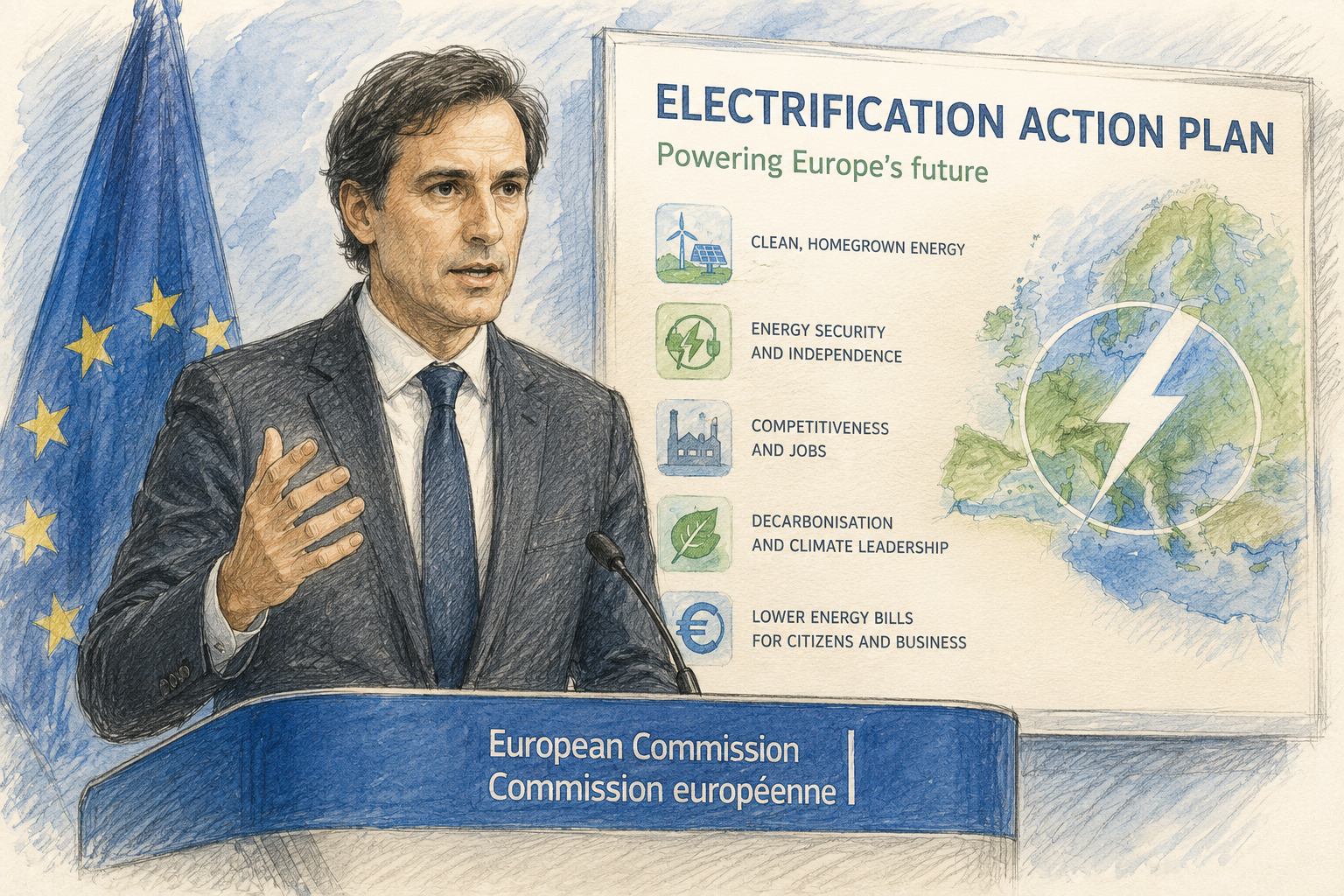
The European Commission has presented an ambitious vision: Europe should become the world’s first electro-powered continent. Electrification is increasingly presented as the foundation of Europe’s future economy, promising lower emissions, greater energy security, improved competitiveness and reduced dependence on imported fossil fuels.
The ambition is significant. Yet electrification changes dependency more than it eliminates it.
Europe may gradually become less dependent on imported fossil fuels, while becoming increasingly dependent upon electricity grids, digital infrastructure, industrial coordination and computational intelligence. Electricity appears remarkably simple at the point of consumption. It becomes extraordinarily complex at the point of architecture.
This shifts the debate. The primary challenge is no longer simply generating more renewable electricity. It is designing the interconnected system that allows millions of new electric assets to function together reliably, efficiently and competitively.
The question is therefore no longer whether Europe can electrify. The question is whether Europe can build the architecture that electrification requires.
🟦 Six Architectural Questions
🟦 The Infrastructure Mismatch
Can Europe’s infrastructure evolve at the same pace as its ambitions?
Renewable generation can often be deployed within a few years. Expanding transmission networks, however, frequently requires far longer due to permitting procedures, physical construction and long-term planning. Electrification therefore introduces an uncomfortable asymmetry: Europe may succeed in producing more clean electricity before it is capable of moving that electricity where it is needed.
The challenge may not become one of generation. It may become one of coordination.
🟦 The Molecular Boundary
Where does electricity reach its limits?
Not every industrial process can be electrified directly. Steel, chemicals, aviation, shipping and other energy-intensive sectors continue to require high-temperature heat, energy-dense fuels or molecular feedstocks. Electrification therefore raises another architectural question.
Where do electrons remain the most efficient solution and where must molecules such as hydrogen become part of the wider energy system?
The future energy architecture will likely depend upon both.
🟦 The Intelligence Question
Who coordinates Europe’s digital energy system?
A highly electrified continent will rely upon millions of batteries, electric vehicles, factories, heat pumps and distributed renewable assets continuously interacting with one another.
This transforms electricity from a physical infrastructure challenge into a computational one. Forecasting, optimisation and automated decision-making increasingly determine how efficiently electricity networks operate.
The deeper question is no longer whether Europe can digitise its electricity system. It is whether Europe controls the intelligence upon which that system increasingly depends.
🟦 The Industrial Dilemma
Can Europe transform industry while preserving competitiveness?
Industrial transformation requires far more than replacing one energy source with another. Factories must redesign production processes, invest in new equipment and secure reliable supplies of affordable electricity while remaining internationally competitive.
The challenge therefore extends beyond engineering.
How can Europe accelerate industrial electrification without weakening the productive capacity upon which its prosperity depends?
🟦 The Integration Challenge
Are we building technologies—or building a system?
Storage, electricity grids, hydrogen infrastructure, digital platforms and industrial innovation are often discussed as separate policy domains. Yet none of these capabilities creates resilience in isolation.
A battery changes the behaviour of the grid. Digital coordination changes the value of flexibility. Industrial electrification changes electricity demand. Each innovation alters the system around it.
Europe’s greatest challenge may therefore no longer be technological innovation itself. It may be systemic integration.
🟦 The Coordination Question
Who designs interoperability?
Markets allocate capital. Companies develop technologies. Engineers build infrastructure. Governments establish regulation. Yet no single actor automatically creates architecture.
Architecture emerges through common standards, interoperable systems, long-term planning and institutions capable of coordinating investments across sectors.
The defining question may therefore not be who controls Europe’s energy transition. But who designs the relationships that allow its different components to function as one coherent whole.
🟦 Signify
The European Commission is right to place electrification at the centre of Europe’s future economy. Clean electricity will increasingly underpin competitiveness, industrial resilience and strategic autonomy.
Yet electrification should perhaps be understood less as the destination than as the foundation.
Every additional electric vehicle increases the need for charging infrastructure. Every new battery increases the need for digital coordination. Every additional renewable installation increases the demands placed upon electricity grids. Every new industrial connection increases the complexity of the wider system. Electrification therefore does not reduce complexity. It reorganises it.
The societies that lead the coming decades may not simply be those capable of generating the largest quantities of clean electricity. They may be those capable of coordinating electricity, molecules, infrastructure, intelligence and industrial production into one coherent architecture.
Perhaps that is the deeper implication of becoming an electro-powered continent. Not building more electricity. Learning how to build the system around it.
Further reading: This Signal builds upon Altair Media’s Building Europe’s Energy Architecture series, which explores how storage, grids, hydrogen, digital energy systems and industrial transformation are evolving into an integrated European energy architecture.
Credit
Credit: Altair Media / OpenAI Image Generation
Caption
Caption: The European Commission’s Electrification Action Plan signals a new phase in Europe’s energy transition. As electrification accelerates, the strategic challenge shifts from generating clean electricity to coordinating the infrastructure, digital intelligence and industrial capabilities that together form Europe’s emerging energy architecture.
