Can Allison Kirkby Make BT Smaller—and More Powerful?
The Verizon venture gives BT global reach with less direct exposure to its international business. At home, a vast fibre network is nearing completion. The harder question is whether BT can earn more from the services built on top of it.
Allison Kirkby is changing the shape of BT. The proposed venture with Verizon would combine the companies’ international enterprise operations in a jointly owned business. BT would retain a stake in global connectivity while directing more of its own management attention and capital towards the UK. The transaction is expected to close in 2027, subject to approvals.
This is a significant shift in emphasis. BT has spent years building the physical foundations of Britain’s digital economy. Openreach’s fibre network now passes 23.4 million premises, and 9.4 million are connected. The build is approaching its target of 25 million premises by December 2026. The question for Kirkby is what kind of company BT becomes as construction gives way to competition for customers and cash flow.
The question for Kirkby is what kind of company BT becomes as construction gives way to competition for customers and cash flow.
Global reach, shared responsibility
The Verizon agreement is neither a sale of BT’s international business nor a retreat from multinational customers. The proposed 50:50 venture would bring together operations serving more than 3,000 customers across over 180 countries, with approximately $4 billion in combined annual revenue. Verizon would make a $625 million payment to BT to equalise the two contributions.
For Kirkby, the attraction is scale without requiring BT to carry the entire international operation alone. But shared ownership also means shared decisions. The venture must still turn its combined customer base into a competitive platform in a market where cloud providers increasingly influence how companies buy networks and security.
BT’s strategic centre of gravity, meanwhile, moves more decisively towards Britain.
The fibre test
Openreach illustrates both the strength and the difficulty of that position. Its fibre connections are growing quickly, yet its total broadband lines fell by 192,000 in the quarter to June. BT still expects a decline of roughly 800,000 lines over its financial year. Those figures should not be treated as a simple verdict on fibre demand: Openreach added 574,000 fibre connections in the same quarter.
Shared ownership also means shared decisions.
Two changes must be kept distinct. Moving a customer from copper to Openreach fibre replaces an older connection within the network. Losing a wholesale customer to a rival network removes business from Openreach altogether. BT’s reported net line losses do not provide a clean breakdown between these forces. The commercial risk is that alternative networks, including CityFibre and nexfibre, compete for the same retail providers just as BT seeks a return on its fibre investment.
Ofcom has designed its 2026–31 rules to support both the move away from copper and competition between fibre networks. The tension is real: on 28 September, it directed Openreach to withdraw one proposed wholesale customer offer over competition concerns, while allowing other offers to proceed. BT cannot assume that owning the largest network gives it unrestricted freedom to defend its customer base through pricing.
Above the network
Kirkby’s larger ambition is to make BT more valuable to customers than a supplier of access lines. BT Business is assembling a UK sovereign services portfolio spanning connectivity, voice, cloud and AI. Its cloud offering uses Rackspace Technology’s UK data centre infrastructure. In a separate plan, Nscale intends to build up to 14 megawatts of AI data centre capacity across three existing BT sites, using NVIDIA technology; BT will provide infrastructure and connectivity.
These partnerships give BT a route into customers’ computing and security decisions. They do not, by themselves, establish how much of the resulting value BT will retain. Providing sites, power access and dependable networks is commercially useful. The more demanding test is whether BT can define services, manage the customer relationship and develop capabilities that are difficult to replace when partners supply the cloud operations or computing technology.
Keeping workloads in Britain can answer important customer requirements. It does not automatically tell us who owns the software, sets the service terms or earns the strongest returns.
That distinction matters more than the label “sovereign”. Keeping workloads in Britain can answer important customer requirements. It does not automatically tell us who owns the software, sets the service terms or earns the strongest returns.
Less room for error than Deutsche Telekom
The comparison with Tim Höttges at Deutsche Telekom clarifies Kirkby’s constraints. Deutsche Telekom’s controlling interest in T-Mobile US gives it a large American earnings engine alongside its European network and cloud ambitions. BT’s strategy is more tightly bound to one national market and its regulated infrastructure.
BT spent £5.1 billion on capital expenditure in the year to March 2026 and generated £1.5 billion in normalised free cash flow. It reported £20.0 billion of net debt and a £4.2 billion gross accounting pension deficit. Management expects normalised free cash flow of around £2 billion in the current financial year and £3 billion by the end of the decade. These are substantial resources, but also substantial claims on future cash.
A smaller reported group could become a more consequential one.
The Verizon venture may give BT a more focused structure. It cannot remove the need to win wholesale customers, fill the fibre network and show that new services earn returns after the costs of building and maintaining the backbone.
A smaller reported group could become a more consequential one. The proof will be visible less in the size of BT’s network than in the customers it keeps, the services it defines and the cash those services produce.
Perspective: Kirkby is sharing the cost and control of BT’s international reach while concentrating its investment case in Britain. As the fibre build matures, the decisive measure shifts from premises passed to durable returns from customers and services.
Credit
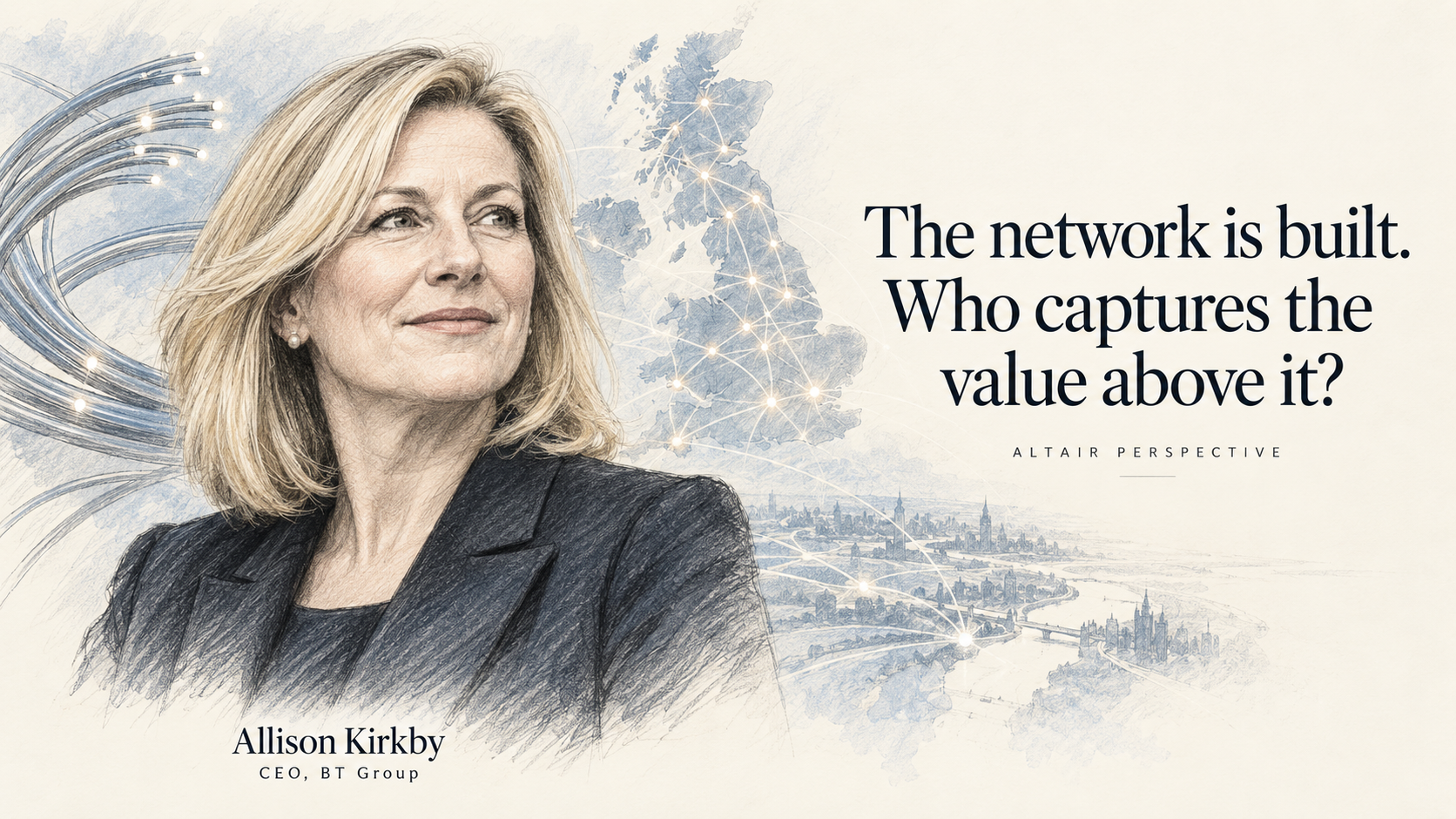
Illustration: Altair Media, AI-assisted pencil portrait. The text in the image is an Altair Media editorial pull quote, not a statement by Allison Kirkby.
Caption
Allison Kirkby, CEO of BT Group. Her strategy puts Britain’s networks at the centre of a larger question: who earns the value from the services built on top of them?
