Europe’s AI Gigafactories
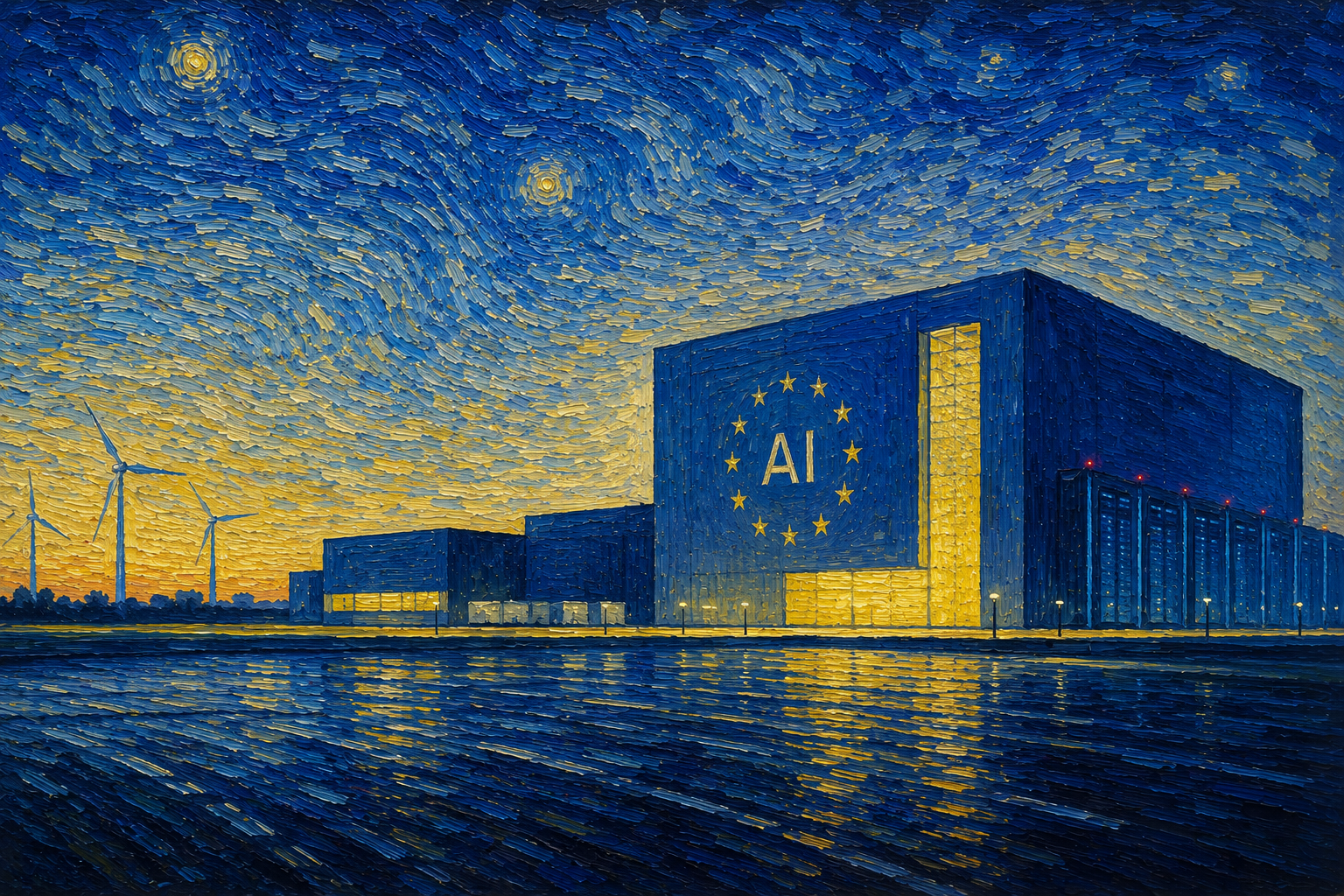
The infrastructure behind Europe’s artificial intelligence ambitions.
The European Commission has launched an initiative to support the development of up to seven AI Gigafactories across Europe, backed by approximately €10 billion in public investment. The announcement immediately positioned Europe within the global AI race.
Yet before discussing where these Gigafactories should be built, a more fundamental question deserves attention.
What exactly is an AI Gigafactory?
🟦 Why is an AI Gigafactory different from a traditional data centre?
The term AI Gigafactory suggests industrial scale and technological ambition, yet it remains surprisingly undefined.
Unlike a conventional data centre, an AI Gigafactory is not simply a place where computing takes place. It combines large-scale AI training, advanced computing infrastructure, research capability and industrial applications into a single strategic ecosystem. That distinction matters.
Training frontier AI models requires a fundamentally different architecture from operating cloud services or traditional supercomputers. Before Europe can build AI Gigafactories, it must first understand the infrastructure they are intended to become.
🟦 Why has AI become an infrastructure challenge?
For years, advances in artificial intelligence were largely driven by software. That is no longer the case.
Today’s frontier AI models depend on tens of thousands of accelerators connected through ultra-fast optical interconnects, supported by High Bandwidth Memory (HBM), advanced semiconductor packaging, liquid cooling and unprecedented energy density.
Scale is no longer primarily a software challenge. It has become an infrastructure challenge. Artificial intelligence increasingly advances at the speed of physical systems rather than software development.
🟦 Why does every AI Gigafactory begin with electricity?
Every discussion about artificial intelligence eventually arrives at a much less glamorous subject: Energy.
Training frontier AI models requires enormous quantities of reliable electricity, advanced cooling systems and high-capacity fibre connectivity.
Processors may attract the headlines. Electricity determines whether the infrastructure can operate at all.
In practice, Europe’s power grids may become just as strategically important as its AI strategy.
🟦 Why can’t AI Gigafactories simply be built anywhere?
Unlike traditional industrial projects, AI Gigafactories cannot simply be distributed according to political geography. Their success depends on a rare combination of conditions.
Reliable electricity. High-capacity digital connectivity. Research universities. Industrial supply chains. Highly specialised engineering talent.
Location therefore becomes far more than a regional development decision. It becomes a strategic choice about where Europe’s future computing capacity can realistically flourish.
🟦 Why are supply chains becoming strategic infrastructure?
Artificial intelligence is often presented as software. In reality, every frontier AI model depends on one of the world’s most sophisticated industrial supply chains.
Advanced chips. High Bandwidth Memory. Semiconductor packaging. Photonics. Optical networking. Power electronics. Precision manufacturing.
Constructing the building may ultimately prove easier than securing the technologies required to operate it.
🟦 Can Europe achieve AI sovereignty without controlling the technology?
The European Commission acts primarily as a catalyst rather than an operator. That makes governance as important as technology.
If future AI Gigafactories depend predominantly on non-European hardware platforms, proprietary software ecosystems and external semiconductor supply chains, physical ownership alone will not automatically create technological sovereignty.
Strategic autonomy ultimately depends not only on where infrastructure is located, but on who controls the technologies that make it function.
Final Reflection
Europe’s AI Gigafactory initiative represents an important shift in European industrial thinking.
Artificial intelligence is increasingly recognised not simply as software, but as strategic infrastructure. That changes the conversation.
Building AI now depends on electricity grids, semiconductor ecosystems, photonics, connectivity, engineering talent and long-term industrial coordination.
Europe’s AI future will therefore be determined not only by its ability to develop more powerful algorithms, but by its capacity to build—and sustain—the physical systems upon which artificial intelligence ultimately depends.
Signal
Artificial intelligence may be written in software. But Europe’s AI future will be built through infrastructure.
Credit
Artwork: OpenAI Image Generation (2026), created exclusively for Altair Media.
Caption
An artistic interpretation of Europe’s AI Gigafactories. Rather than portraying a conventional factory, the illustration symbolises the emergence of AI as strategic infrastructure—where energy, computing, industrial capability and long-term vision converge to shape Europe’s technological future.
