T-Systems — The Telecom Legacy in Europe’s Cloud Transition
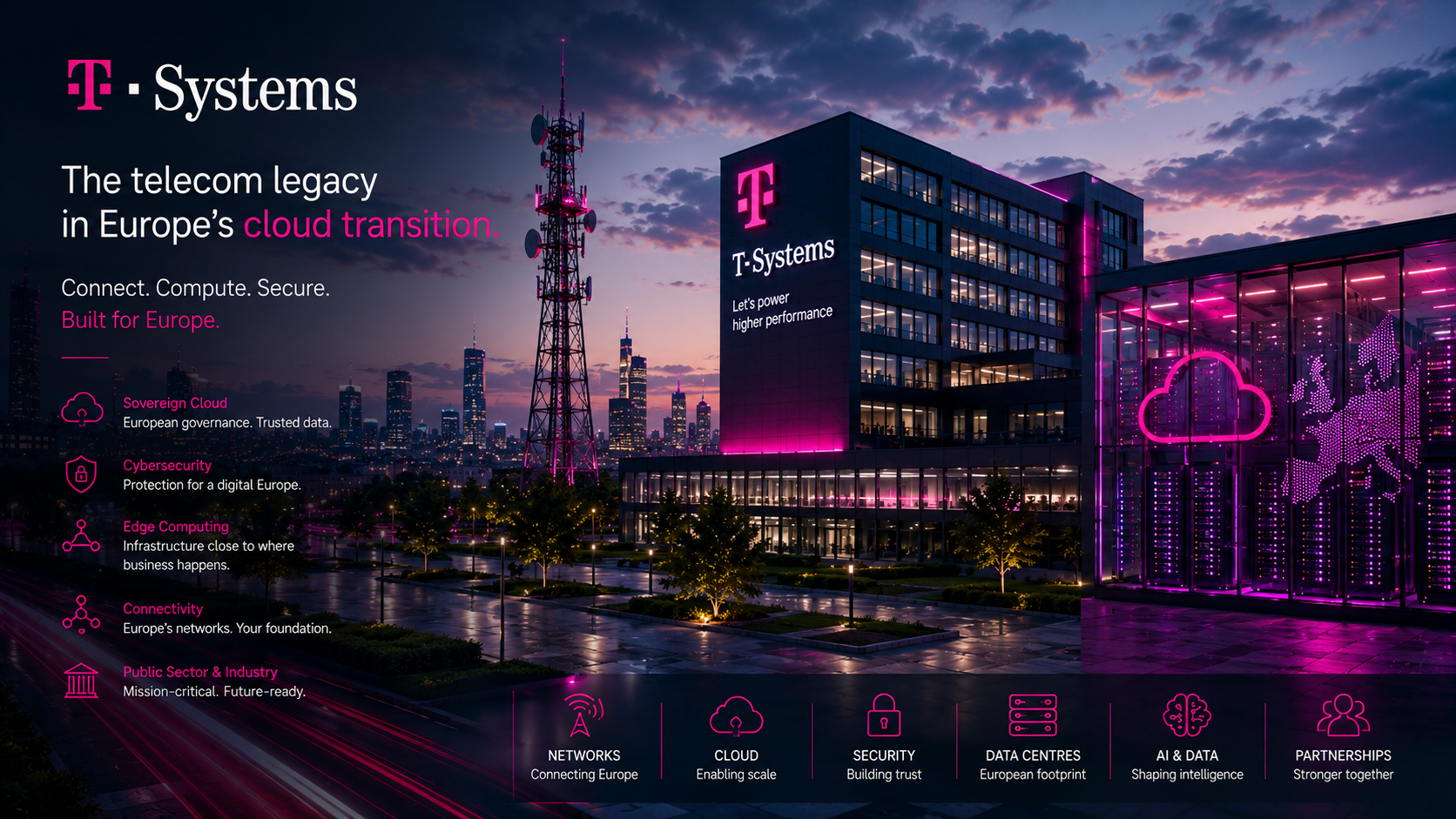
Can Europe’s telecom infrastructure become its computing infrastructure?
Strategic Briefing
Cloud computing is often framed as a contest between hyperscalers, software platforms and artificial intelligence ecosystems. Yet Europe possesses another type of infrastructure player: telecommunications operators with decades of experience in networks, data centres, enterprise services and mission-critical systems.
Few companies illustrate this intersection more clearly than T-Systems.
As the enterprise arm of Deutsche Telekom, T-Systems occupies a unique position within Europe’s digital landscape. It combines connectivity, cloud services, cybersecurity and managed infrastructure, positioning itself at the convergence of telecommunications and computing.
Its evolution raises an increasingly important question. Could Europe’s next generation of cloud infrastructure emerge not from startups, but from its telecom incumbents?
Overview
Headquarters
Frankfurt, Germany
Founded
2000
Parent Company
Deutsche Telekom
Ownership
European
Primary Markets
Germany, Europe
Positioning
Enterprise cloud, sovereign services and mission-critical digital infrastructure
Strategic Focus
Connectivity, cloud, cybersecurity, public sector and regulated industries
Geographic Footprint
T-Systems benefits from one of Europe’s largest telecommunications ecosystems. Its operations span numerous European markets and are closely connected to the broader infrastructure footprint of Deutsche Telekom.
Key markets include:
- Germany
- Austria
- Netherlands
- Central Europe
- selected global enterprise markets
Its client base largely consists of:
- governments
- industrial companies
- healthcare organisations
- financial institutions
- critical infrastructure operators
Unlike many cloud providers, T-Systems has historically focused less on developers and startups and more on complex enterprise environments.
Infrastructure & Capabilities
T-Systems offers a broad portfolio of digital infrastructure services.
Its activities include:
- Sovereign cloud environments
- Managed cloud
- Hybrid cloud
- Cybersecurity
- Connectivity services
- Edge computing
- Data platforms
- Artificial intelligence services
- Digital transformation consulting
- Mission-critical infrastructure
The company increasingly positions itself around trusted cloud solutions aligned with European governance requirements.
Partnerships with global cloud providers coexist alongside efforts to develop European sovereign alternatives.
This duality has become one of its defining characteristics.
Sovereignty Assessment
T-Systems occupies a somewhat different place within Europe’s cloud ecosystem. It possesses substantial infrastructure expertise but remains deeply integrated within broader global technology environments.
European ownership ★★★★★
European governance ★★★★★
European jurisdiction ★★★★★
Telecom infrastructure integration ★★★★★
Enterprise reach ★★★★★
Cloud independence ★★★☆☆
Hyperscale capability ★★★☆☆
Public sector relevance ★★★★★
Its greatest strength may not be scale. It may instead be trust.
For decades, telecommunications operators have managed critical networks. Cloud may simply represent the next stage of that evolution.
Competitive Position
T-Systems occupies an unusual strategic position.
It competes simultaneously with:
- AWS
- Microsoft Azure
- Google Cloud
while also collaborating with these companies in hybrid and managed environments.
Its closest European peers include:
- OVHcloud
- IONOS Cloud
- STACKIT
- Orange Business
- Capgemini cloud services
Yet T-Systems remains differentiated by its telecom heritage. Where many cloud providers began with compute, T-Systems began with networks.
That distinction may become increasingly important as cloud, connectivity and artificial intelligence continue to converge.
Strategic Significance
T-Systems highlights a broader transformation occurring across Europe’s digital landscape.
Telecommunications networks once carried information. Increasingly, they are becoming platforms for processing it.
Artificial intelligence, edge computing and industrial automation all require closer integration between connectivity and compute.
This may create opportunities for companies capable of combining both domains.
In that sense, T-Systems offers a glimpse into a possible European model in which cloud infrastructure is built upon existing telecommunications capabilities.
Strategic Outlook
Europe already possesses extensive digital infrastructure. It has fibre networks. It has data centres. It has cybersecurity expertise. It has enterprise relationships.
The question is whether these assets can be assembled into a computing ecosystem capable of supporting Europe’s ambitions in artificial intelligence, industrial competitiveness and digital sovereignty.
T-Systems represents one possible answer. Its trajectory suggests that the future of cloud may not solely belong to hyperscalers. It may also belong to those who already operate the networks upon which modern economies depend.
Part of Building Europe’s Cloud Architecture — an Innovation & Technology Lab series exploring cloud not as software, but as infrastructure.
Credit
Artwork: Altair Media / AI-generated visualisation
Caption
T-Systems occupies a distinctive position within Europe’s digital landscape, operating at the intersection of telecommunications, cloud infrastructure and sovereign computing. Its evolution reflects the growing convergence of networks, data centres and artificial intelligence as foundational layers of modern infrastructure.
