SMART Photonics Plans Joint Production Service with GlobalFoundries
The Eindhoven company is connecting its light-producing chips with an international manufacturing platform, targeting commercial availability in the second half of 2027.
SMART Photonics has partnered with GlobalFoundries to offer chip designers a joint manufacturing service for optical devices used in applications including data-centre communications. Announced on 21 September, the collaboration combines Eindhoven’s specialist photonics technology with GlobalFoundries’ silicon platform. General availability is targeted for the second half of 2027.
The agreement creates a potential route to a wider market for SMART Photonics. Designers would be able to use components from both manufacturers through a jointly engineered production process, rather than developing the connection between them independently.
For Brainport, the commercial question is concrete: can that combined offer make it easier for chip designers to turn specialised technology into products they can order repeatedly?
What each company brings
SMART Photonics specialises in indium phosphide, a semiconductor material capable of generating and amplifying light. Its manufacturing platform combines optical functions on chips designed by customers, supporting applications in communications and sensing.
GlobalFoundries contributes its silicon photonics platform, which supports high-speed optical connections and integration with electronics and packaging. Its wider offering includes design tools, manufacturing services and the expertise needed to connect optical components to complete systems.
The technologies perform complementary roles. SMART Photonics supplies components that produce and strengthen optical signals; GlobalFoundries provides a platform into which those components can be integrated.
Under the agreement, SMART Photonics’ lasers and optical amplifiers will be mounted in a cavity on the silicon platform. The companies report more than a year of joint engineering to achieve the physical fit and transfer light efficiently between the components.
That interface is central to the challenge. Components that work individually must continue to perform when assembled together. Their positioning and optical connections affect how much useful light reaches the next part of the device.
For designers, the intended benefit is a repeatable manufacturing route. A qualified combination would allow them to concentrate more effort on their product’s functions, while working within processes established by the suppliers.
Where the customers could come from
Data-centre communications provide a clear target. AI infrastructure depends on moving large amounts of information between computing systems. Optical communication modules convert information between electrical and optical signals so it can travel over fibre connections.
GlobalFoundries already supplies technology for these modules. Its broader photonics offering also supports approaches that place optical connections closer to processors and networking equipment, reducing the distance over which information must travel electrically.
A separate agreement illustrates demand in that market. On 17 September, GlobalFoundries announced an expanded collaboration with Marvell to increase capacity for silicon germanium technology used in optical connectivity. The agreement builds on existing production and addresses growing requirements for AI infrastructure.
That concerns a different technology. Marvell has not been identified as a customer of the new SMART Photonics service. The agreement nevertheless provides context: GlobalFoundries is expanding manufacturing relationships around the connections that increasingly large computing systems require.
The SMART Photonics announcement does not name initial customers, disclose orders or quantify expected production volumes. It identifies the applications, manufacturing approach and availability target. Publicly named customer programmes would provide further evidence of adoption.
The steps towards production
SMART Photonics already describes a structured route for customers using its existing platform. Designers obtain development tools, reserve manufacturing capacity, submit their designs and complete checks before production. Early manufacturing runs allow them to validate a design before moving to larger volumes.
Those tools contain tested optical building blocks. Designers combine them into circuits while following the factory’s production rules, connecting what is drawn in software with what can be manufactured reliably.
For the joint service, designers will need clear specifications, testing requirements, prices and delivery conditions. They will also need to understand responsibility for the combined device: who investigates a failure, what performance is guaranteed and how production losses are handled. These are practical purchasing questions, rather than details settled by announcing a partnership.
SMART Photonics advertises annual capacity for 5,000 four-inch wafers. That describes available manufacturing capacity, not actual output or the number of usable chips delivered. Separately, the company describes six-inch capacity being developed with TNO for operation in 2028. That expansion and the joint service’s 2027 target are distinct milestones.
The next evidence will come from qualified designs, dependable deliveries and repeat orders. For Brainport, the milestone is a service customers can use under clear production conditions—and products that demonstrate why they chose it.
This article is part of Brainport’s Next Chapter: Building a European Customer Base, a series following the region’s latest developments in chips, AI and photonics.
Credit
AI-generated illustration: OpenAI / Altair Media.
Caption
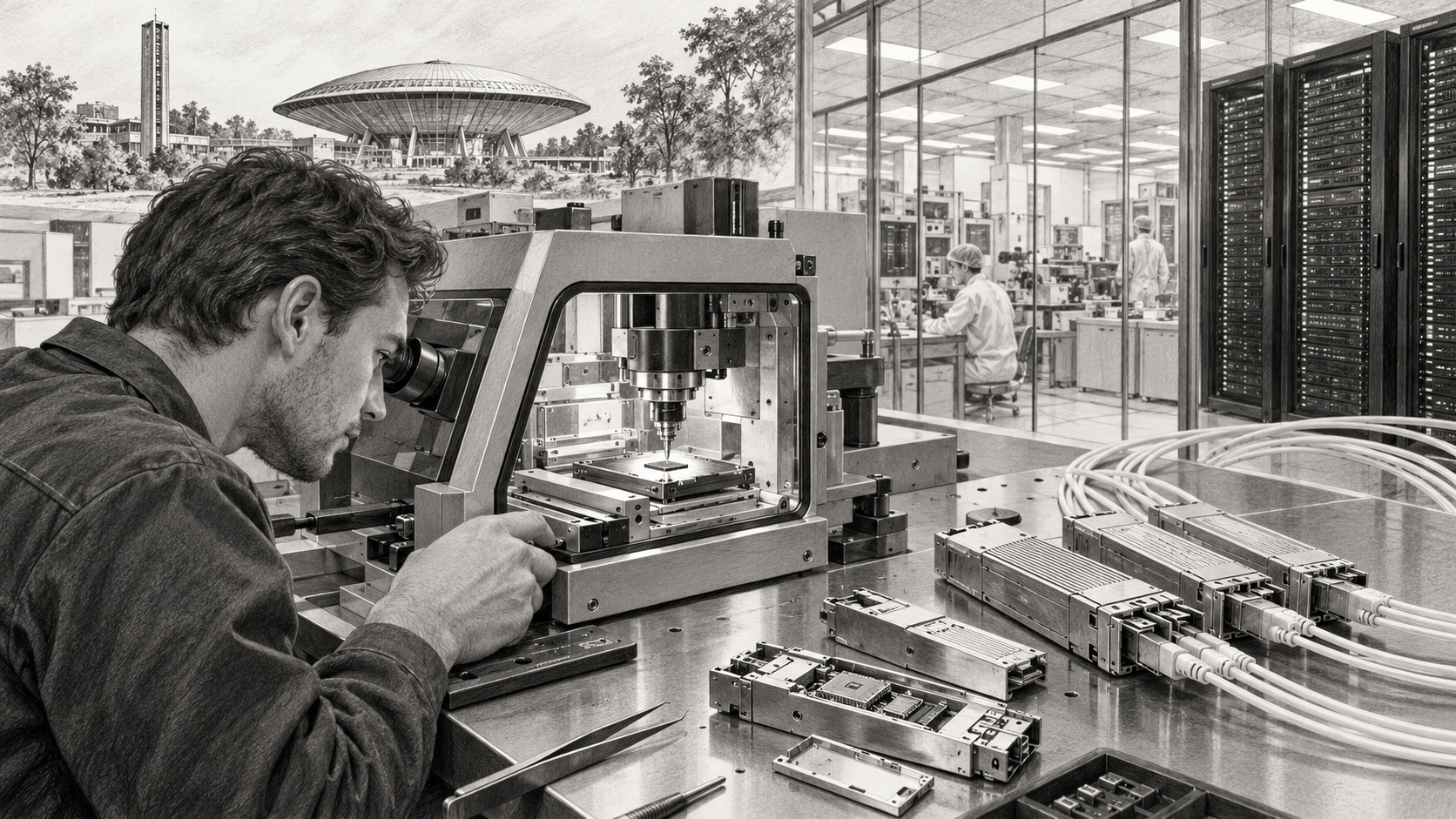
Conceptual illustration of photonic component assembly and optical communication modules, connecting Eindhoven’s expertise with data-centre applications. The scene does not depict either company’s actual facilities.
