Akhetonics and the First Market for All-Optical Computing
Europe’s photonics ambition faces a practical test: a workload worth switching for.
Akhetonics wants to keep data optical through computation, memory and control, extending photonics beyond connections between electronic chips. Its ambition is broad, but its first market may be narrow. The challenge is to identify a task where lower latency and energy use outweigh limited memory, unfamiliar hardware and the cost of adoption.
Finding that market means connecting the architecture’s strengths to a specific customer problem. Six questions trace the steps from a working optical circuit to a product a customer can deploy—and order again.
🟦 What justifies taking the entire computation optical?
Akhetonics is developing integrated photonic chips that perform programmable digital logic, extending light’s role into the processor itself. Keeping data optical could remove repeated conversions between light and electrical signals. But it also requires optical alternatives for functions electronics already performs reliably and cheaply. Each additional optical function must earn its place in the system.
🟦 Does limited memory define the first market?
The abstract for CTO Leonardo Del Bino’s October 6 seminar at NHR@FAU states the constraint plainly: optical memory is scarce. It identifies promising workloads with high data rates, sensitivity to delay and modest storage requirements. Candidates include logical verification, constraint solving and specialised search.
That suggests a focused commercial opening. General programmability gives a processor flexibility; the amount of usable memory helps determine which customer problems it can economically solve.
🟦 What evidence would justify a purchase?
Akhetonics’ 2024 paper presents a two-bit all-optical CPU demonstrator. This establishes an architectural principle. A purchasing decision requires evidence at the scale of the intended application: being programmable does not establish competitive performance.
The company acknowledges that lasers, amplifiers and tuning still require electricity. Efficiency at an individual optical gate therefore tells only part of the story. Operating economics depend on the energy consumed by the complete system.
The commercial test is time, energy and cost per correctly completed task, measured against an appropriate electronic alternative.
🟦 Who carries the cost of adoption?
Akhetonics describes compiler and emulation tools intended to support familiar programming languages, including C++. That reduces a potential barrier, but software compatibility does not establish application performance.
A customer still needs to validate results, connect the processor to existing infrastructure and maintain the deployment. The first implementation needs a clear division of responsibility between Akhetonics, integration partners and the buyer. Otherwise, integration work can consume the savings promised by the hardware.
🟦 Can European fabrication become dependable supply?
Akhetonics says its photonic chips can use mature manufacturing processes available in existing foundries. Its June 2026 update also describes work within the European 2D Pilot Line on design tools and kits for integrating new materials into photonic platforms.
The industrial test extends to repeatability: consistent devices, predictable packaging, acceptable yields and delivery schedules. European manufacturing capability provides a foundation. Customers need that capability translated into a supported product they can order again.
🟦 What turns a pilot into a repeat order?
SPRIND supported early validation, while a €6 million investment round announced in November 2024 backed further development. Those commitments finance technical progress; they do not establish recurring demand.
The decisive pilot would connect a defined workload to measured performance, an integration budget and explicit purchasing criteria. For Akhetonics, a narrow application could provide the strongest first market—if the advantage survives deployment and gives the customer a reason to expand.
Signal
A first deployment can validate an application. Repeat orders would show whether Akhetonics can turn a measured technical advantage into a sustainable business—and whether Europe’s photonics ecosystem can deliver the systems customers need.
Credit
Altair Media / AI-generated illustration using OpenAI. Logo: Akhetonics.
Caption
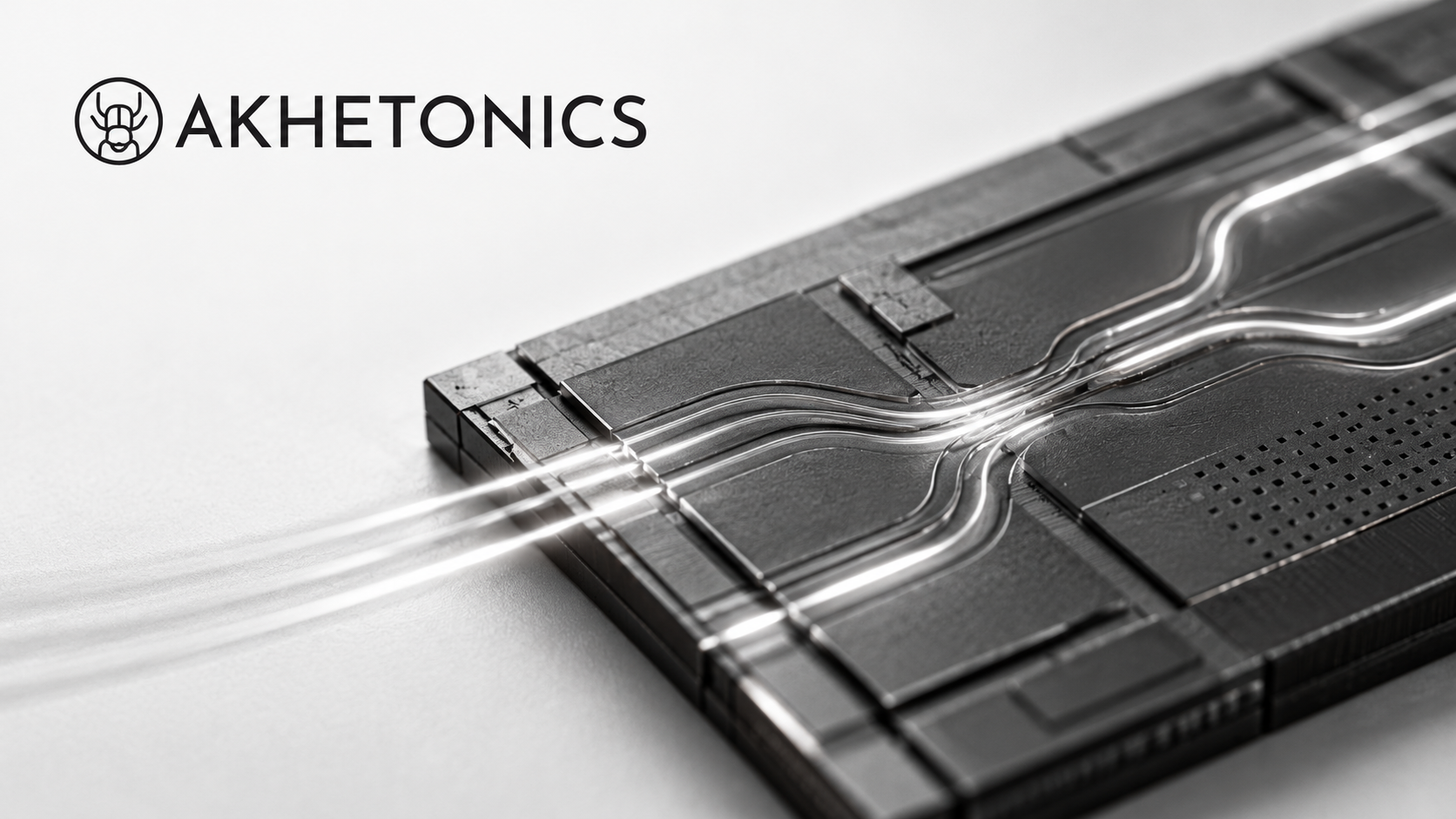
Conceptual illustration of optical computing, featuring the Akhetonics logo. The commercial challenge is translating optical performance into a dependable system customers can deploy and order again.
