Eindhoven Researchers Bring AI Closer to Home
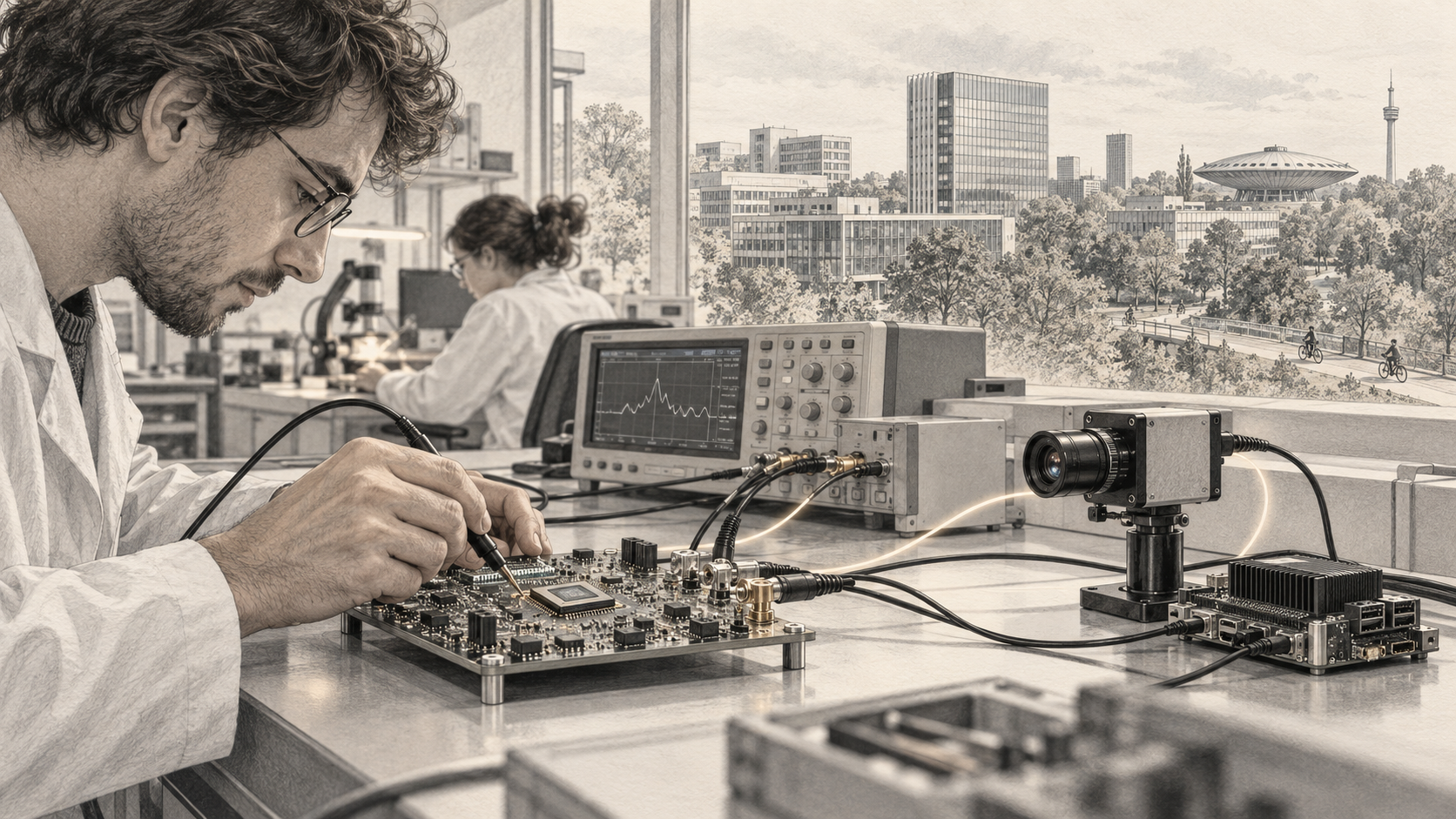
A European research project has tested chips that could help everyday devices do more of their own AI processing. The next step is turning that research into products.
Researchers in a European project led by Eindhoven University of Technology have built and tested computer chips designed to carry out AI tasks directly inside devices. The work could help cameras, machines and other equipment respond faster while relying less on distant data centres. TU Eindhoven presented the results in September.
The chip platform, called Chimera, brings together different processing components, each suited to particular tasks. The aim is to give devices useful AI capabilities within the limits of their batteries, size and cooling.
For Brainport, the development connects university research with a practical industrial question: which companies could turn the technology into products? Eindhoven businesses including ViNotion and Axelera AI participated in the wider project, alongside established manufacturers and research institutions across Europe.
The research programme, CONVOLVE, received approximately €8.4 million in EU funding. It began in November 2022 and formally ended in April 2026. Its ambitions included making AI processors more energy-efficient, shortening development time and building security into the hardware.
More computing inside the device
When an AI application sends information to a remote server, the answer has to travel back before the device can act on it. Processing more information locally could reduce that delay and make equipment less dependent on an internet connection.
The potential extends beyond phones and laptops. A camera might identify something important in its images before sending information onwards. A machine could interpret a sound or detect a change in its surroundings. These are examples of the kinds of tasks the project’s industrial partners are investigating.
Making this work requires careful choices about energy. Moving information around inside a chip can consume a substantial amount of power. The researchers therefore considered the software, processing components and memory together, looking for ways to reduce unnecessary work and data movement.
Lead researcher Manil Dev Gomony described the approach in the university’s announcement. Instead of developing those elements separately, the team designed them together, balancing speed, accuracy, flexibility and energy consumption from the outset.
Working chips and practical tests
The team tested manufactured prototype chips using realistic AI tasks. That provides firmer evidence than a design evaluated only through computer simulations, although it remains a research-stage result.
A technical paper from researchers at ETH Zürich, the University of Bologna and Chips-IT describes one Chimera implementation. In one operating configuration, it performed 896 billion operations per second while consuming 600 milliwatts—less than one watt. The work was funded partly through CONVOLVE.
That measurement describes the chip under particular test conditions. It cannot tell a manufacturer how long a finished device’s battery would last or how much electricity an entire installation would save. Those outcomes depend on the camera, memory, communications and software around the processor.
ViNotion provides a concrete connection to industrial use. The Eindhoven company contributed traffic analysis as one of the project’s four main applications, allowing researchers to assess their techniques against a realistic task. Its contribution included research into stopping calculations when further processing is unnecessary and identifying individual objects within images.
For such applications, the useful result is a system that can recognise what matters quickly and accurately, using the power available to it. Testing against an industrial application helps expose the compromises that a laboratory benchmark alone may miss.
From research to a product
The consortium gives the technology several possible routes towards industry. Bosch contributed work on sound recognition, NXP brought security expertise and GN helped define speech and audio applications. Axelera AI contributed research into adaptable AI models and the software needed to run them efficiently. These were defined research roles within the project.
Participation gives these companies access to research and opportunities to evaluate it. It does not, by itself, establish a purchase order or a commitment to manufacture Chimera.
Other developers can also examine and adapt the technology. Chimera’s design is publicly available through the PULP platform, a collaboration between ETH Zürich and the University of Bologna. It provides a configurable foundation for combining different processing components, potentially allowing parts of the work to be reused in future designs.
Turning that foundation into a commercial product requires further decisions: which application to target, how to manufacture it economically and who will maintain the software and support customers. The published materials reviewed do not provide a commercial delivery date for Chimera.
That is the next development to watch. Brainport’s contribution already includes research, tested hardware and businesses bringing practical requirements into the project. Its commercial significance will become clearer when a manufacturer chooses an application and commits the resources to bring it into production.
This article is part of Brainport’s Next Chapter: Building a European Customer Base, a series following the region’s latest developments in chips, AI and photonics.
Credit
AI-generated illustration: OpenAI / Altair Media.
Caption
Conceptual illustration of chip research and local AI processing in Eindhoven, with the city’s Evoluon landmark in the background. The scene does not depict the actual Chimera laboratory.
