Can Deutsche Telekom Turn American Scale into European Power?
Tim Höttges has the cash flow, networks and customer relationships to build beyond telecom. The question is whether Deutsche Telekom can capture value in cloud and AI where operators once watched it move elsewhere.
Deutsche Telekom has something many European infrastructure companies lack: financial room to make large choices. T-Mobile US has become the group’s dominant business. In the second quarter of 2026, the American segment generated €19.6 billion in revenue, compared with €29.9 billion for the group as a whole. Deutsche Telekom now expects approximately €20 billion in group free cash flow after leases for the year.
That strength raises a European question. Tim Höttges can keep expanding networks, return cash to shareholders and invest in cloud and artificial intelligence. Deutsche Telekom is doing all three. But the choices carry different risks. A better mobile network strengthens an established business. A European cloud platform asks customers to move valuable work onto infrastructure they could already buy from global providers.
“But without infrastructure, even AI is speechless.”
Tim Höttges, CEO, Deutsche Telekom, at Hannover Messe 2026.
For years, telecom operators built the connections through which digital services reached customers. The largest cloud providers built platforms above those networks and captured much of the new demand for computing and software. Höttges appears determined to give Deutsche Telekom a larger role in the next phase. His vision brings networks, data centres, cloud services and AI computing power into one proposition for European industry.
What does American success make possible?
T-Mobile US is the source of Deutsche Telekom’s greatest scale, but its success is not a single pot of money waiting to be spent in Europe. The US company has its own investors, investment needs and shareholder returns. Deutsche Telekom said in February that it held 52.8% of T-Mobile US and did not plan to sell shares in 2026. In 2025, approximately €2 billion of T-Mobile US dividends were attributable to Deutsche Telekom’s stake.
The wider benefit is strategic as well as financial. American earnings support the group’s strength and give management more room to invest. In 2025, Deutsche Telekom spent €16.9 billion across the group on capital expenditure excluding spectrum, including €5.9 billion in Germany, primarily on networks. Höttges says the company invests around €6 billion a year in Germany across fiber, mobile networks and data centres.
Yet management is also returning substantial capital. Deutsche Telekom increased its 2026 share buyback programme from up to €2 billion to up to €5 billion, citing its financial results and debt ratios as reasons it had the room to do so. The decision may make sense to shareholders. It also reveals the choice facing a company with ambitions beyond its existing business: how much financial strength should reinforce today’s valuation, and how much should support a long effort to build tomorrow’s platforms?
This is not a simple contest between buybacks and investment. Money alone cannot create a successful cloud. A platform needs software, specialised staff, dependable operations and customers willing to build on it. Capital matters because it gives Deutsche Telekom time to develop those capabilities before their commercial returns are certain.
Partner and competitor
T-Systems has long lived with that difficulty. It provides corporate IT services in a market shaped by AWS, Microsoft Azure and Google Cloud. Deutsche Telekom’s own annual report describes the pressure those hyperscalers place on platforms and innovation, alongside intense price competition in IT services.
T-Systems works with those providers in its multicloud business. It has also offered a sovereign cloud service powered by Google Cloud. At the same time, Deutsche Telekom is expanding its own T Cloud Public as a European alternative. The company must therefore help customers use global platforms while persuading some of them that its platform deserves a larger share of their future workloads.
Deutsche Telekom says T Cloud Public already provides 80% of the core functions familiar from leading hyperscalers and aims for full parity in those functions by the end of 2026. That is a company target, not proof that the platforms are interchangeable for every customer. The harder measure will be sustained use: which applications move, which ones stay, and whether developers find the tools they need.
The financial scale remains revealing. T-Systems recorded €1.1 billion in second-quarter revenue and €99 million in adjusted EBITDA after leases. Revenue grew, but orders received during the quarter fell against the previous year. The division is improving; it remains small beside the American mobile business and the cloud companies with which it both competes and partners.
Deutsche Telekom’s opportunity may lie in work for which connectivity, operational control, security and computing power must come together. Governments, manufacturers and regulated businesses may value a provider that can operate infrastructure close to their processes and under European rules. The commercial test is whether that combination becomes a service customers choose for its capabilities, rather than an assurance attached to technology supplied by others.
The industrial AI wager
In February, Deutsche Telekom opened its Industrial AI Cloud in Munich with partners including NVIDIA, SAP and Siemens. T-Systems operates the facility. SAP contributes a platform for enterprise applications, while industrial partners bring potential uses for the computing capacity. SupplyOn, for example, is connecting its supply-chain platform to the facility. These are early indications of how the infrastructure could become part of actual industrial processes.
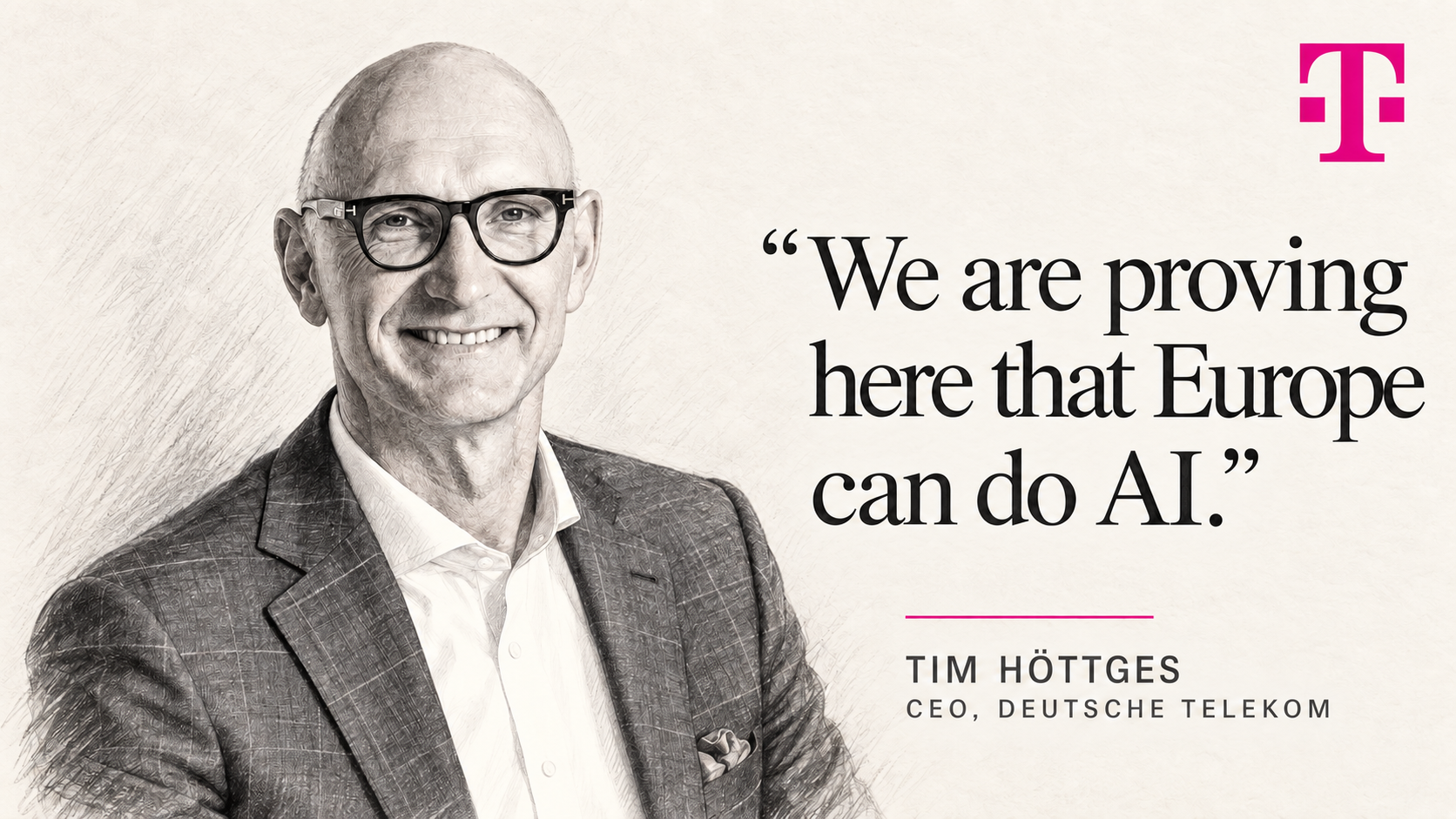
“We are proving here that Europe can do AI.”
Tim Höttges, CEO, Deutsche Telekom, at the opening of the Munich AI factory.
Europe can operate AI infrastructure and build applications around its industrial knowledge. But the word sovereign has limits that should remain visible. The Munich facility runs on nearly 10,000 NVIDIA Blackwell GPUs and uses NVIDIA software. Its location, data controls and operation are European; critical parts of its computing architecture come from an American supplier. That does not invalidate the project. It defines the dependency within it.
Partnerships also determine how value is divided. NVIDIA supplies a crucial computing layer. SAP brings enterprise software and customer relationships. Industrial firms own their processes and data. Deutsche Telekom supplies and operates the infrastructure. If applications on that infrastructure grow, will the operator gain an enduring share of the value, or chiefly earn a return on the capacity beneath them?
Höttges has called on European companies to become customers of European platforms. This is where sovereignty becomes a commercial proposition. A facility can be built through investment; a platform acquires strategic weight when customers commit important workloads and continue to develop on it.
Beyond one company
Deutsche Telekom is also working with Orange, Telefónica, TIM and Vodafone on a European Edge Continuum, designed to connect computing environments across their networks. The five operators demonstrated a federation in 2026. According to their announcement, it was operational in laboratory environments; industrial and commercial rollout are the next steps.
“This federation proves that Europe is not just talking about digital sovereignty. We are building it.”
Christine Knackfuß-Nikolic, Chief Sovereign Officer, T-Systems, in the European Edge Continuum announcement.
The demonstration shows that operators can cooperate across borders. It cannot yet show that developers will build for the system, or that customers will pay enough to sustain it. Europe has spent years discussing what its fragmented telecom market cannot do. This initiative offers a practical test of what its largest operators can create together.
Höttges is therefore shaping more than Deutsche Telekom’s investment programme. He is testing whether a European operator can use financial strength, trusted infrastructure and customer access to move upward in the digital economy. T-Mobile US gives the group scale. T Cloud and the Munich facility give it places to invest. Cooperation with other operators could extend its reach across Europe.
The outcome remains open. Deutsche Telekom may become a stronger European platform company, or a highly successful network operator whose customers create the most valuable services elsewhere. The measure will not be how much infrastructure it builds. It will be whether European customers build lasting businesses on it, and whether Deutsche Telekom shares in the value they create.
Image credit: AI-generated pencil illustration for Altair Media, based on Deutsche Telekom’s official press portrait. Quote: Tim Höttges, from Deutsche Telekom’s announcement of the Munich AI factory, 4 February 2026.
Caption: Tim Höttges, CEO of Deutsche Telekom, at the launch of the Munich Industrial AI Cloud. His claim that Europe can do AI raises the next question: how much of the value created will European companies control?
