From Budget Bargaining to a National Agreement
Five ways to turn minority budget talks into a durable strategy
Rob Jetten has invited opposition parties to help reshape the Netherlands’ 2027 budget. The invitation matters, but agreement will require more than adjustments to individual spending lines. Parties need a common view of the practical constraints, a genuine role in choosing priorities, and confidence that any settlement can survive both chambers and deliver results beyond 2027.
The Council of State offers a useful starting point. It says the Miljoenennota identifies the country’s long-term challenges clearly, but that the proposed budgets and tax measures do not yet fully reflect that analysis. The task is larger than finding enough votes for one year. It is to connect political agreement to a course the country can sustain.
1. Establish a common account of the constraints
Parties will not agree on every cause or solution. They can, however, work from the same official forecasts and practical limits: demographic change, grid capacity, available workers, permitting times and the likely costs of delay.
The government could put these alongside its goals for housing, healthcare, defence, energy and economic growth. Where the evidence is disputed, it should show the range of estimates and explain what changes under each scenario. This would make political disagreement more precise: parties could contest a goal or a choice without relying on incompatible versions of the underlying facts. The Council of State has called for measurable goals, an assessment of delivery capacity and a clearer account of spending trade-offs.
2. Give opposition parties authorship within a financial framework
A minority government needs more than support for individual measures. Other parties must be able to recognise their contribution in the result. The cabinet could identify a limited number of decisions that remain open and invite alternative proposals within the same published financial framework.
That gives parties room to shape priorities while making the costs of each proposal visible. The talks should also consider support in the Senate from the outset. An agreement that passes the House of Representatives but fails in the other chamber offers little stability.
3. Make postponed reforms time-bound negotiations
Delaying a contested reform can create space to design a better one. It can also move its cost beyond the current budget. The difference lies in the terms of the delay.
For each postponed social security reform, the government could set out the problem to be solved, who will develop alternatives, when those proposals are due and how their financial and social effects will be assessed. Employers, unions and opposition parties would then have a meaningful role without leaving the outcome open indefinitely. The cabinet has already made room for such discussions; the next step is to give them a testable result.
4. Build an investment agreement around delivery
Housing, industrial growth and electrification depend on more than separate spending commitments. They depend on grid capacity, permits, available workers and coordination between national, regional and local government.
A cross-party agreement could select a small number of priorities and publish the steps needed to deliver each one. Grid expansion, for example, could be linked explicitly to housing construction and industrial demand. Progress would then be judged by capacity built and projects completed, alongside money allocated. This would also reveal where adding funds cannot yet speed up delivery.
5. Bring the European timetable into the Dutch debate
The national budget is being negotiated while Europe shapes its proposed long-term budget for 2028–2034. The European Commission’s 2026 assessment identifies several of the same Dutch constraints, including the electricity grid, housing, nitrogen and investment in technology. These are connected decisions, even when they appear in separate debates in The Hague.
The cabinet and Parliament could identify together which priorities benefit from European cooperation or future EU programmes, and which must be financed and delivered nationally. That would strengthen the Dutch position in European negotiations. It would not remove the need for choices at home: the Council of State expects spending growth in 2027 to exceed the agreed European path.
The strategic choice
A broad agreement does not require every party to share the same political vision. It requires credible answers to three questions: What must be solved together? Who can shape the solution? And how will the costs and results be accounted for?
A minority government can turn its need to negotiate into a way of governing. To do so, it must make the constraints visible, leave meaningful choices open and build support for decisions that last beyond the next budget vote.
Image credit
Illustration: Altair Media / AI-generated
Caption
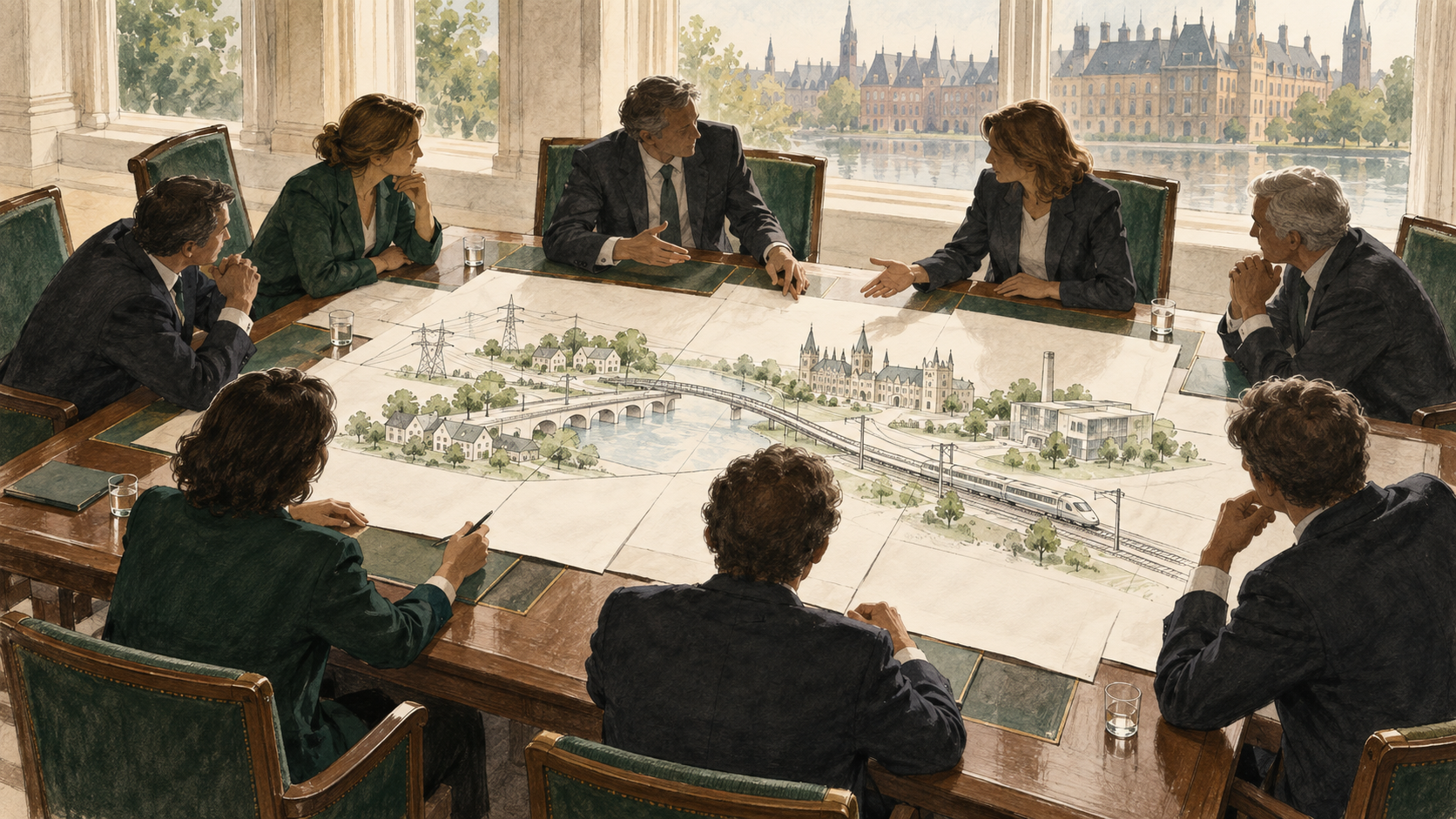
An imagined negotiating table brings different parties around a shared plan for the Netherlands’ housing, energy and infrastructure needs.
