🇧🇪 Portrait of a European — Belgium
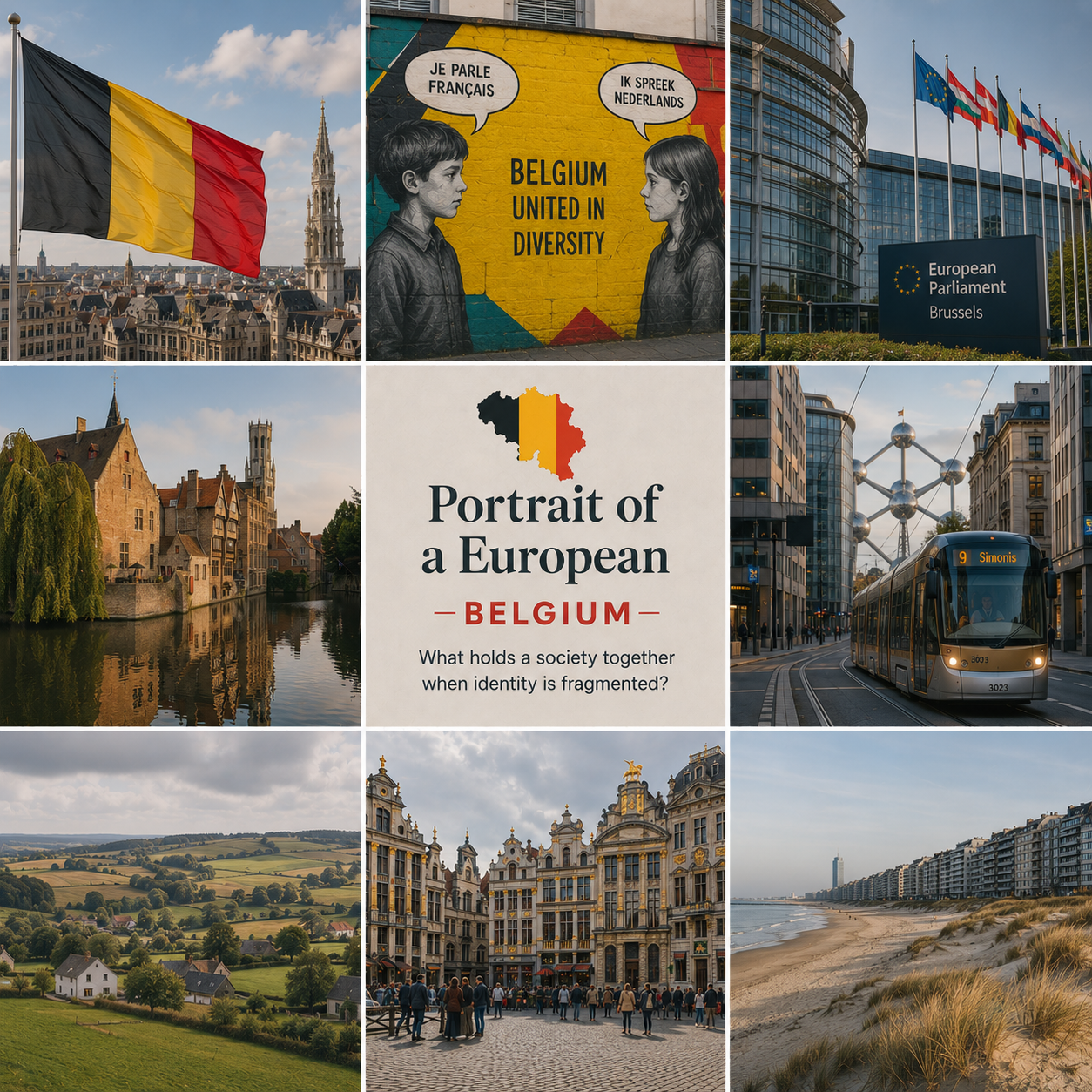
What holds a society together when identity is fragmented?
🇧🇪 Snapshot
- Capital: Brussels
- Population: ~11.8 million
- Economy: logistics, services, industry, European institutions and international trade
- Position: multilingual federal state at the political centre of Europe
Belgium often feels less like a traditional nation-state and more like a negotiated coexistence.
Dutch-speaking Flanders.
French-speaking Wallonia.
Multilingual Brussels.
German-speaking communities in the east.
Different histories.
Different political cultures.
Different economic realities.
And yet the country continues to function.
That alone makes Belgium one of the most important societies for understanding modern Europe. Because Belgium asks a question Europe itself increasingly faces: What keeps a society together when no single identity fully dominates?
👤 The average Belgian
Life in Belgium is shaped by layers.
- local identity
- regional identity
- linguistic identity
- national institutions
- European institutions
For many Belgians, identity is not singular.
Someone may feel:
- Flemish,
- Belgian,
- European,
- and locally connected simultaneously.
Common professions:
- services and administration
- logistics and transport
- technology and engineering
- public governance and diplomacy
Especially around Brussels, daily life feels highly international.
🧬 Demography & society
Belgium contains multiple societies inside one state structure.
Flanders generally became:
- wealthier,
- more economically dynamic,
- and politically more autonomy-oriented.
Wallonia experienced:
- industrial decline,
- slower economic transition,
- and stronger social welfare traditions.
Meanwhile Brussels evolved into:
- European capital,
- diplomatic centre,
- multilingual metropolis,
- and one of the world’s most international cities.
This created a country where: economics, language, culture and governance overlap continuously.
🧠 Self-image
Belgian identity is often understated.
Unlike some nations, Belgium rarely defines itself through:
- strong nationalism,
- singular mythology,
- or grand historical narratives.
Instead, the Belgian system often functions through:
- compromise,
- institutional balancing,
- and pragmatic coexistence.
That can appear inefficient from the outside. But it also created remarkable long-term stability inside diversity.
Belgium therefore reveals something important: Shared identity is not always the only foundation for social continuity. Sometimes systems survive because societies learn how to negotiate fragmentation itself.
🇪🇺 Relationship with Europe
Belgium occupies a unique position inside Europe. Because Brussels became not only the Belgian capital, but effectively one of Europe’s political capitals as well.
European institutions shape everyday life visibly:
- diplomacy,
- policy,
- lobbying,
- international governance,
- and multilingual administration.
In some ways, Belgium became a prototype for the European project itself: complex, layered, fragmented, yet interconnected.
This also means Belgian debates often mirror larger European tensions around:
- sovereignty,
- regional autonomy,
- migration,
- governance,
- and identity.
⚖️ Tension
This is where Belgium becomes especially revealing.
It balances between:
- regional identity and federal governance
- fragmentation and stability
- local culture and supranational integration
Political crises and lengthy coalition negotiations became internationally famous. Yet despite constant predictions of collapse, Belgium continues functioning.
That endurance raises an uncomfortable question for traditional nation-state thinking: Perhaps societies do not always require a single dominant identity to remain stable. Perhaps institutional trust, economic interdependence and negotiated coexistence can also hold societies together.
🏡 Everyday life
Life differs noticeably between regions.
In Flanders:
- export economy,
- infrastructure,
- stronger Dutch-speaking identity.
In Wallonia:
- slower post-industrial transition,
- stronger social protection traditions.
In Brussels:
- international institutions,
- migration,
- multilingual environments,
- global political networks.
Belgium often feels less like one unified social atmosphere and more like overlapping realities learning to coexist.
✨ What makes Belgium unique
Belgium may be one of Europe’s most important hidden laboratories.
Because the country quietly tests questions the entire continent increasingly faces:
- Can diversity remain governable?
- Can institutions compensate for fragmented identity?
- Can societies remain stable without strong emotional unity?
Belgium suggests the answer may sometimes be yes. Not through simplicity. But through continuous negotiation. That makes the country extraordinarily relevant for understanding Europe’s future architecture.
🪞 Closing
This is a portrait of a European. Not shaped by singular identity. But by coexistence. Not defined by unity. But by managing fragmentation without collapse.
This is what Europe looks like—when complexity itself becomes the foundation of stability.
This article is part of Portrait of a European — a series exploring how people across Europe see themselves through work, identity and everyday life. Each edition offers a local perspective on a shared continent.
Illustration credit
Illustration created with AI assistance for Altair Media Europe
Caption
A conceptual illustration of culture as Europe’s invisible infrastructure — where libraries, public space, memory, media and shared stories form the social foundations beneath democratic institutions, digital systems and civic life.
