Who Will Finance the Quantum Revolution?

The economics of technological uncertainty
Europe has the scientific knowledge. It has the technological ambition. But does it have the right kind of capital? Quantum technology presents an unusual investment challenge. Its development requires substantial long-term financing, while many of its future commercial applications are still being discovered.
With its proposed Quantum Act and Sovereign Tech Equity Fund, the European Commission is seeking to address this structural challenge. Its accompanying impact assessment estimates financing needs of €50–60 billion across the European quantum ecosystem — an estimated requirement, not committed capital.
Yet the amount of money may not be the most fundamental issue. Different investors have different expectations, responsibilities and investment horizons. Governments seek strategic autonomy. Private investors seek financial returns. Industrial customers seek demonstrable value.
Can these interests be aligned when both the technology and its future markets are still evolving?
Five questions expose the underlying tensions in Europe’s emerging quantum economy.
🟦 1 | Is quantum technology compatible with traditional venture capital?
Venture capital investors typically seek substantial growth and a credible opportunity to realise returns within a defined investment horizon.
Quantum computing presents a different challenge. Developing reliable processors, specialised hardware, manufacturing capabilities and commercially relevant applications may require years of sustained investment.
Quantum sensing, specialised communication systems and the transition towards post-quantum cryptography may offer earlier commercial opportunities, although their technological and investment requirements differ considerably.
According to the Commission’s latest Quantum Act impact assessment, Europe remains particularly dependent on early-stage financing, while the United States benefits from a broader investment ecosystem.
The tension: quantum companies may need more time to demonstrate commercial value than conventional investment models are prepared to offer.
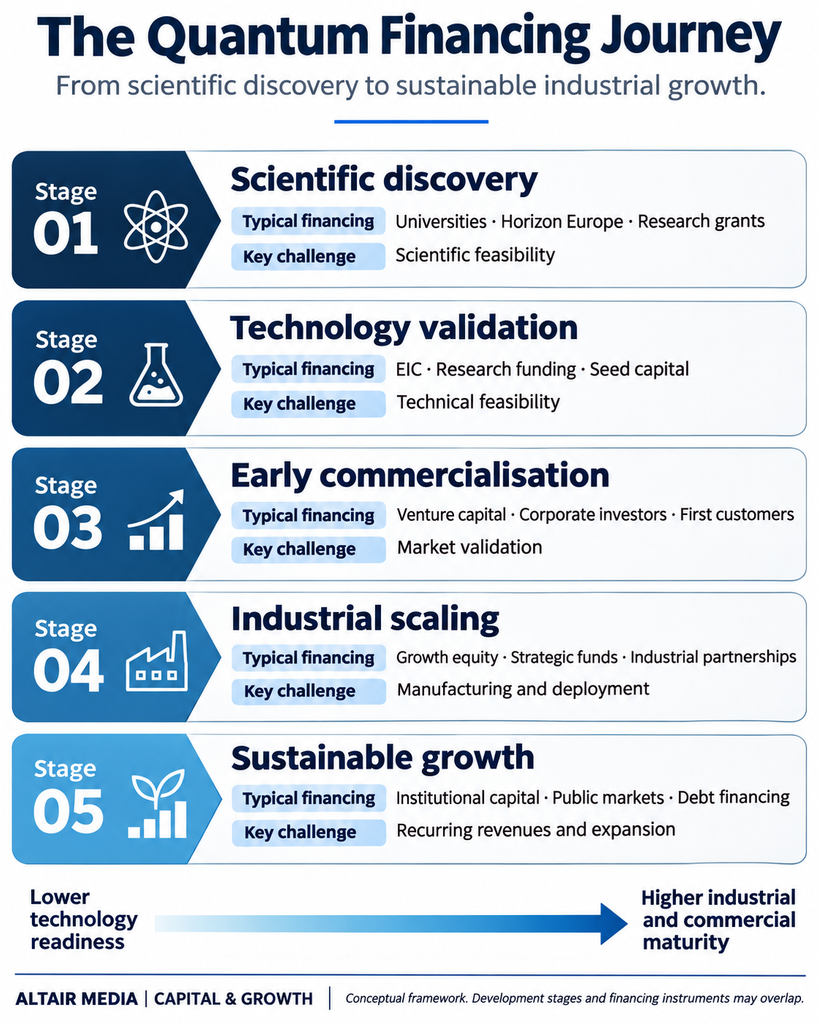
Source: Altair Media conceptual framework. Financing instruments and development stages may overlap.
🟦 2 | Can public capital mobilise private investment?
The proposed Sovereign Tech Equity Fund would complement existing European financing instruments, including the European Innovation Council Fund, InvestEU and European Investment Bank initiatives.
The ambition is to support larger, longer-term investments while attracting additional private capital.
But public and private investors do not necessarily pursue the same objectives.
Governments may prioritise technological sovereignty, economic security, employment and scientific leadership. Private investors must ultimately assess financial returns.
Public investment can reduce certain risks. It cannot eliminate commercial uncertainty.
The tension: what constitutes a successful strategic investment for Europe may not necessarily constitute a successful financial investment.
🟦 3 | Where are Europe’s institutional investors?
Europe’s pension funds, insurance companies and asset managers oversee substantial pools of long-term capital.
The question is whether part of that capital can be connected more effectively with emerging strategic industries.
The separate Scaleup Europe Fund, managed by EQT, brings together founding investors including ABP, through its asset manager APG, Allianz, Novo Holdings and Denmark’s EIFO.
This demonstrates how institutional capital can participate in European technology financing through a broader investment mandate.
However, patient capital is not automatically risk-tolerant capital. Pension funds and insurers have financial obligations to millions of European citizens. Their primary responsibility is not industrial policy.
The tension: Europe wants its accumulated wealth to finance its technological future, while institutional investors must protect the financial future of its citizens.
🟦 4 | Can investors finance technology without customers?
The European Commission identifies insufficient early industrial demand as one of the barriers to scaling quantum technologies.
A successful laboratory demonstration may validate the science. A successful industrial pilot may demonstrate technical feasibility. Neither necessarily guarantees a commercial contract.
Integration costs, procurement procedures, operational risks and uncertain business cases can all delay adoption.
Understanding where promising pilots stall could help distinguish technological immaturity from commercial and institutional barriers.
For investors, the conversion from successful pilots to recurring commercial revenues could become an important measure of industrial maturity.
Commercial customers are therefore not simply the final destination of innovation. They are part of its financing architecture.
The tension: investors want evidence of commercial demand before committing capital, while technology companies need capital to develop the products that could generate that demand.
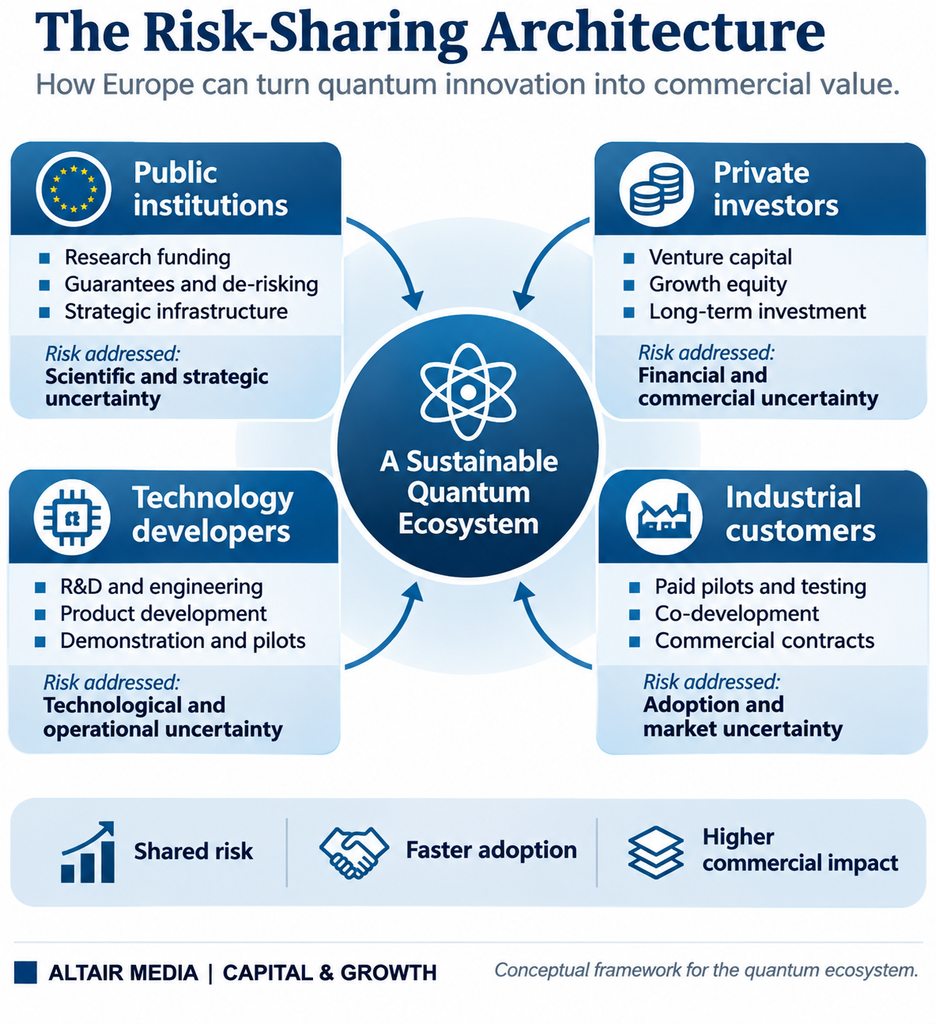
Source: Altair Media conceptual framework. Responsibilities and risks are shared rather than exclusive to individual stakeholders.
🟦 5 | Who will ultimately own Europe’s quantum industry?
International capital can help European technology companies expand, access global markets and accelerate industrial development.
But it also raises strategic questions about ownership, intellectual property, manufacturing capacity and the geographical distribution of future economic value.
Should European public investment come with commitments concerning domestic industrial development?
Can Europe remain attractive to international investors while retaining control over strategically important technologies?
Technological sovereignty does not necessarily require financial isolation. But it does require clarity about which capabilities Europe considers essential to retain.
The tension: Europe needs global capital to build internationally competitive companies, yet excessive external dependence could undermine the very sovereignty it seeks to achieve.
🟦 THE SIGNAL
Europe’s quantum revolution will require different forms of capital at different stages of development.
Research funding, venture capital, growth equity, institutional investment and commercial contracts must form a more coherent financing ecosystem.
Is Europe facing a shortage of capital, or a shortage of capital capable of carrying technological uncertainty?
Europe has already demonstrated its ability to finance scientific discovery.
The real test is whether its capital markets can sustain the industrial journey to commercial scale.
This article is part of Altair Media’s Quantum Series, exploring the scientific, industrial, economic and societal dimensions of Europe’s emerging quantum ecosystem.
Credit
Illustration: Altair Media / OpenAI (AI-generated editorial watercolour).
Caption
Financing the quantum revolution. An editorial watercolour illustrating the interconnected roles of scientific research, public institutions, private investors and industrial customers in transforming quantum innovation into sustainable commercial value.
Conceptual illustration of Europe’s emerging quantum financing ecosystem.
