Who Controls Europe’s Fruit?
Climate, consolidation and the future of an industry built on predictable harvests
PERSPECTIVE | Europe’s fruit industry has learned to make seasonal harvests available, functional and recognisable throughout the year. But as climate risk grows and industrial power consolidates, a deeper question emerges: who controls the fruit—and who carries the uncertainty on which the system is built?
An apple can be too small, unevenly coloured or slightly damaged and still be perfectly edible. Whether it reaches a supermarket shelf, becomes purée, enters a yoghurt preparation, disappears into concentrate or remains unharvested is decided by a system extending far beyond the orchard.
Power in the fruit industry belongs increasingly to those who can absorb variation.
The grower produces the fruit. Processors define technical specifications. Ingredient companies separate flavour, colour, acidity and texture. Brands translate those properties into consumer promises. Retailers control access to the shelf. So who actually controls Europe’s fruit?
From Orchard to Architecture
Over six Company Files, Europe’s hidden fruit industry has revealed itself not as a single sector, but as an architecture for managing biological uncertainty.
AGRANA showed how harvests from different regions become reliable industrial supply. Zentis revealed how fruit is engineered to remain visible and functional inside another product. Hero organised ingredients into brands and nutritional moments. MOM changed consumption through packaging. Döhler and SVZ separated fruit into functional components, while Andros made industrial scale feel like domestic familiarity.
Each performs a form of translation. The harvest becomes a specification, the specification an ingredient, and the ingredient a branded promise, portable snack or memory of a family kitchen.
Each layer removes uncertainty for the next—and creates a new dependency in return.
The modern fruit industry does not merely move fruit. It repeatedly changes what fruit means to the next part of the system.
Control Through Specification
A piece of fruit does not need to be rotten to lose value. Size, colour, sweetness, acidity and firmness determine whether it is sold fresh, processed, redirected or discarded. These requirements support machinery, product quality and the expectation of consistency across seasons.
But specifications also distribute power. Whoever defines usable fruit influences how growers cultivate, which varieties they plant and which imperfections the chain accepts. Whoever can blend origins, reformulate recipes or switch formats has more room to manoeuvre when a harvest changes.
The grower owns the crop, but its commercial identity emerges through the system around it.
The farmer owns the fruit. The chain decides what the fruit is worth.
When Predictability Meets Climate
This architecture assumes agricultural variation can be managed. Another origin compensates for a weak harvest; blending corrects acidity; processing adjusts texture and extends availability.
Climate change is making that task harder. European assessments identify water and heat stress as urgent threats to crop production, especially in southern Europe, alongside greater exposure to disruptive weather across the continent.
Fruit is constrained by time and place. Trees planted today may take years to reach full production and cannot move when rainfall patterns change. Frost, heat, drought, hail and excessive rain affect both harvest volumes and characteristics such as size, sugar, acidity and texture.
The European Commission expects climate change to affect the production and quality of apples, peaches and nectarines. Its agricultural outlook also cautions that steady projections cannot capture the full volatility of real markets.
Industry can standardise agricultural variation. It cannot manufacture a missing harvest.
Processors can smooth variation, ingredient companies find alternatives and brands modify recipes. But ingenuity reaches a physical limit.
Consolidation as Protection—and Dependency
Uncertainty makes scale attractive. Multiple sourcing regions and plants provide alternatives when one fails, while larger platforms can invest in laboratories, automation and crop knowledge.
Döhler’s acquisition of SVZ connected agricultural sourcing and primary processing to formulation technology. Bel’s acquisition of MOM joined packaging-led fruit consumption to a portfolio built around portioning and snacking.
Such combinations can strengthen supply chains while concentrating knowledge, purchasing power and access to customers. A processor may become more capable as growers and smaller manufacturers become more dependent on fewer routes to market.
Resilience may be strengthened through scale while dependency becomes concentrated in fewer hands.
The European Commission expects continuing structural change in agriculture and associates larger farm size with better income prospects. Scale is becoming both a defence against volatility and a condition for remaining in the system.
The Orchard Carries the First Risk
Not every participant can respond to disruption at the same speed.A retailer can change suppliers. A brand can adjust a recipe, portion or price. An ingredient company can blend batches or propose a substitute. A grower works with land, weather and trees whose lives extend beyond a commercial planning cycle.
The orchard therefore carries biological risk first, while downstream actors possess more instruments for redistributing commercial risk. When conditions deteriorate, the party least able to move may face the earliest and most permanent losses.
Farmers are not powerless. Producer organisations, long-term contracts, specialist varieties and technology can improve coordination and resilience. Yet none removes the question of how costs, margins and uncertainty are shared.
If the system depends on predictable fruit but does not preserve economically viable orchards, it gradually weakens its own foundation.
Capability Is More Than Supply
Europe can import more fruit, purée or concentrate when domestic production declines. But the presence of products on supermarket shelves is an incomplete measure of resilience.
The deeper capability includes nurseries, varieties, orchard knowledge, water management, labour, cold storage, processing plants, laboratories, packaging and distribution. Once parts disappear, rebuilding them takes more than purchasing another shipment.
Fruit should therefore be understood as industrial infrastructure. Agricultural policy begins with the farm, industrial policy with the factory, competition policy with the company and consumer policy with the label. Fruit passes through them all.
Food security is not only the presence of food. It is the continued ability to grow, transform and replace it.
Europe need not pursue self-sufficiency in every crop or protect every incumbent. It should retain enough diversity, productive capacity and knowledge to adapt without surrendering the chain to external supply or fewer internal decision-makers.
Learning to Live With Variation
No single company controls Europe’s fruit. Control is distributed across the interfaces: between grower and processor, ingredient and recipe, brand and retailer, packaging and consumer.
The companies in this series made fragile harvests transportable, seasonal abundance continuously available and agricultural variation almost invisible in the finished product.
Their success created a demanding standard: consistency even when nature does not provide it. Climate disruption now tests whether the architecture can protect its agricultural foundations as effectively as the uniformity of the final product.
The next phase will require more than efficient factories. It will require climate-resilient varieties, viable growers, water infrastructure, regional processing capacity and relationships capable of sharing uncertainty rather than merely transferring it upstream.
Europe built an industry that made seasonal fruit feel permanent. It must now ensure that the system does not become more durable than the orchards on which it depends.
The hidden fruit industry began by making harvests predictable. Its future depends on learning how to live with unpredictability again.
EUROPE’S HIDDEN FRUIT INDUSTRY
This concluding Perspective closes Europe’s Hidden Fruit Industry—a seven-part journey from orchard to ingredient, packaging and brand, revealing the industrial architecture behind some of Europe’s most familiar foods.
Image credit
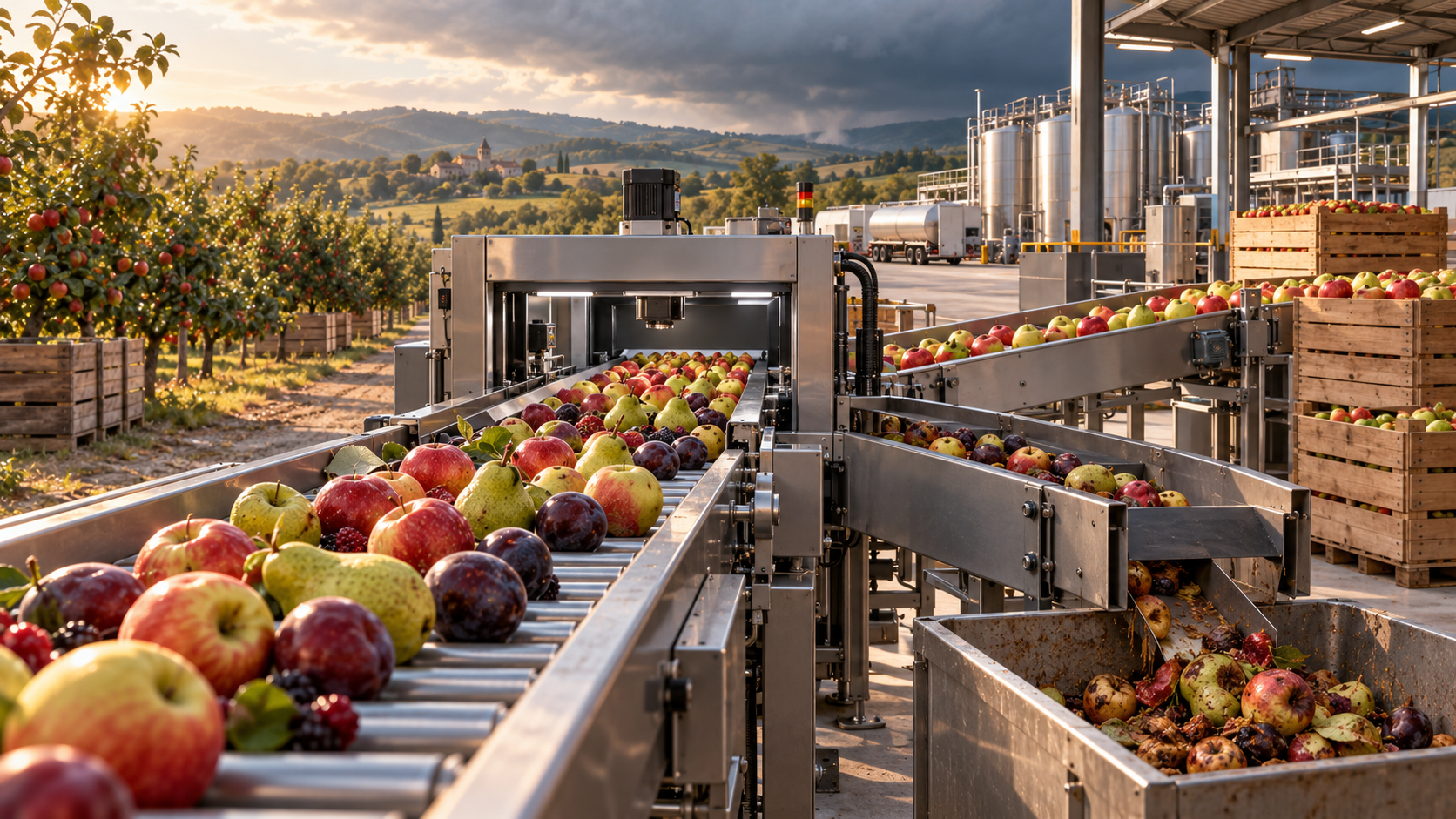
AI-generated image created for Altair Media. The orchard, sorting line and processing facility are conceptual representations and do not depict a specific company or industrial location.
Caption
Fruit moves from a European orchard through an automated sorting line towards fresh-market crates, industrial processing or rejection. Beneath an approaching weather front, the image captures the point where biological variation becomes a commercial specification—and where climate exposure meets industrial control.
