The Roads That Let Us Slow Down
What Europe’s old pilgrimage routes reveal about modern life
There is a particular kind of morning that begins with putting on walking shoes. A bag waits by the door. The weather matters. Ahead lies a village, a hill, perhaps a bed that has already been booked. For the next several hours, the principal task is simply to get there.
In a society organised around shortening distances and accelerating decisions, this is an unusual arrangement. We invest heavily in saving time, then set aside some of that time to travel at the speed of our feet. The apparent contradiction raises a cultural question: what becomes possible when movement stops being something to finish as quickly as possible?
We invest heavily in saving time, then set aside some of that time to travel at the speed of our feet.
Europe’s pilgrimage routes offer a setting in which to explore it. The Camino de Santiago and the Via Francigena carry religious histories, but they also make room for journeys whose meaning is still uncertain at departure. A person can follow a marked path without knowing exactly what they hope to find.
The religious inheritance remains essential. Churches, rituals and communities of faith give these journeys much of their character. Alongside devotion, however, people bring curiosity, grief, companionship and the desire for a different rhythm. The European Association of the Via Francigena Ways’ survey for 2024 records motivations ranging from shared experience and culture to spirituality and faith. These purposes can overlap.
That coexistence helps explain the cultural richness of a pilgrimage. A route can hold different convictions without requiring walkers to settle their differences before sharing a meal. Its common ground is practical: the next stretch of road, the approaching rain, the search for somewhere to sleep.
A route can hold different convictions without requiring walkers to settle their differences before sharing a meal.
Much of this depends on infrastructure so familiar that it disappears into the landscape. A bridge, a signpost, a hostel and a place to refill a bottle make an extended journey possible. The Council of Europe describes the Santiago routes’ heritage through places of worship, hospitals, accommodation and bridges, alongside legends and songs.
Preserving a path therefore involves more than preserving its surface. It means sustaining the arrangements that allow people to use it. Hospitality needs hosts. Affordable beds need buildings and maintenance. A continuous route depends on countless local decisions about access, upkeep and welcome.
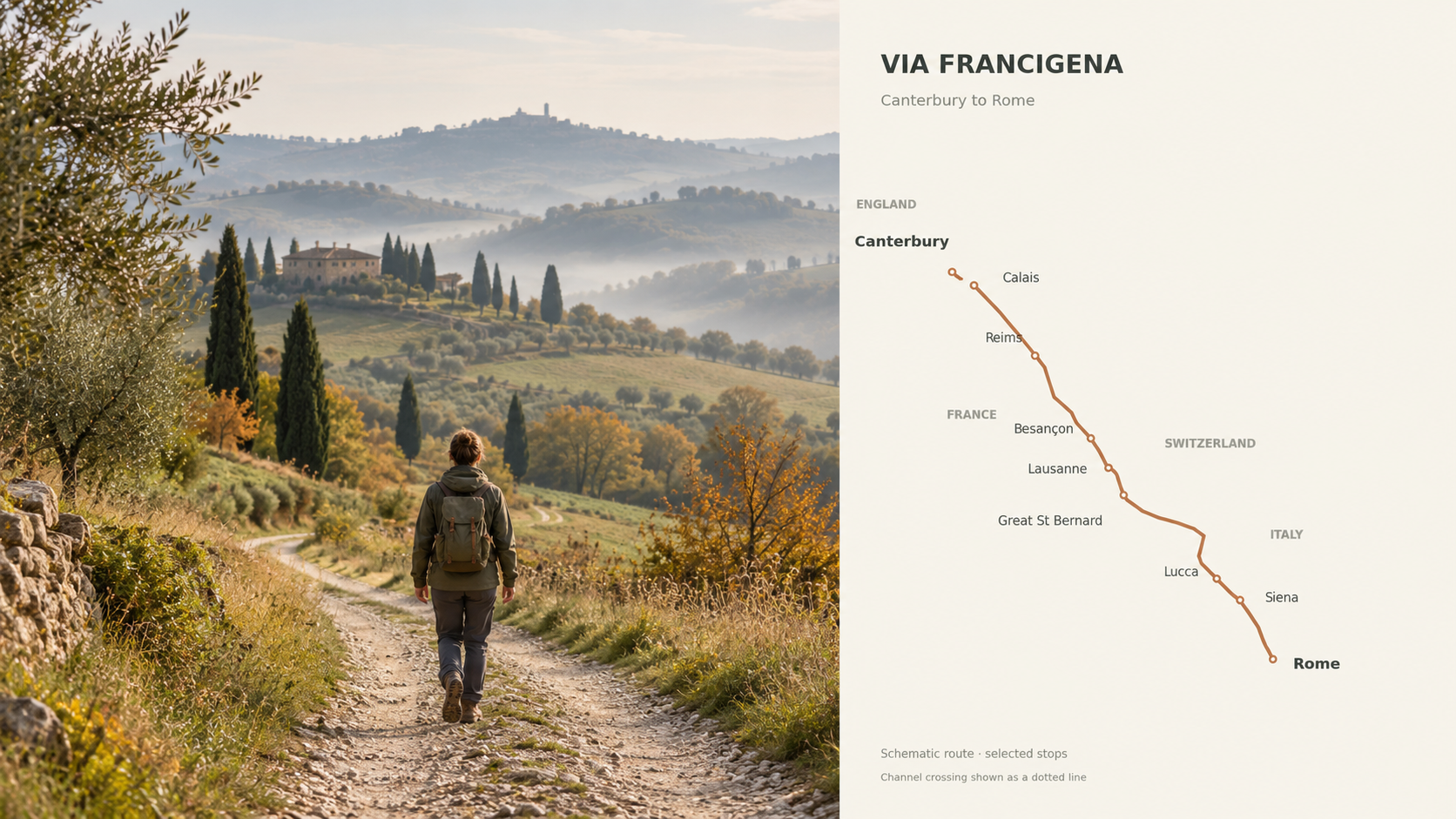
Seen this way, cultural heritage can remain an everyday service. The Via Francigena links Canterbury with continental Europe and Rome, continuing south through Italy. Its historical roles included trade and communication as well as pilgrimage. Today, walking it offers a way to experience connections that a map alone cannot convey.
Preserving a path therefore involves more than preserving its surface. It means sustaining the arrangements that allow people to use it.
At walking pace, geography acquires texture. A village becomes somewhere to arrive thirsty, buy bread and exchange a few words. A hill changes the conversation. Distance has weight because the body must carry itself across it.
Attention can change with that rhythm. The day presents immediate questions: where to turn, when to rest, whether the clouds will break. A phone may still provide directions, reservations and contact with home. Yet there is room to decide when to consult it, and when to keep walking with a thought unfinished.
The same openness can shape encounters. Someone walking nearby may become a companion for an hour. A shared table creates an opportunity to speak without the usual introduction through occupation, credentials or public profile. Nothing guarantees intimacy, but the circumstances give an unplanned conversation somewhere to begin.
There is a temptation to romanticise all this. Walking can be uncomfortable, lonely or disappointing. The time and physical capacity required are unevenly distributed. For someone balancing insecure work, care responsibilities or limited mobility, a long pilgrimage may remain inaccessible.
Those limits belong inside the story. An admiration for slowness should prompt questions about who can enjoy it. Shorter routes, accessible stretches, affordable accommodation and public transport connections matter because they widen the possibility of participation.
Even rest becomes something to optimise: the right itinerary, the transformative experience, the photographs that prove it happened.
There is also a commercial tension. Once a journey is offered as a personal reset, it can acquire a familiar pressure to deliver results. Even rest becomes something to optimise: the right itinerary, the transformative experience, the photographs that prove it happened.
A pilgrimage leaves room for a less predictable outcome. Some days may offer little beyond sore feet and ordinary conversation. Their value need not depend on becoming evidence of personal growth.
Perhaps this is what Europe’s old roads can contribute to modern life: places where another relationship with time remains available. Maintaining them is a cultural choice about the kinds of experience a society makes possible.
On a Sunday morning, that choice can seem modest. There is a path ahead, somewhere to pause, and enough time to notice what lies between.
Credit
AI-generated illustration / Altair Media Europe.
Caption
A solitary walker in an imagined Tuscan landscape, alongside a schematic overview of the Via Francigena from Canterbury to Rome — an old European route offering a different relationship with distance, attention and time.
