The Mall After E-Commerce
Why physical retail never disappeared
As online shopping became faster and more efficient, many predicted the gradual decline of physical retail. Yet across Europe, shopping centres are evolving into social environments where experience, presence and urban life increasingly matter as much as commerce itself.
For more than a decade, the dominant assumption seemed inevitable: e-commerce would gradually replace much of physical retail. Algorithms would recommend products more efficiently than storefronts. Warehouses would outperform shopping streets. Convenience would win. And in many ways, it did.
Products now arrive within hours. Entire shopping routines increasingly happen through smartphones. Price comparison became instant. The friction that once defined shopping largely disappeared behind platforms, logistics networks and recommendation engines.
Yet something unexpected happened along the way. Physical retail did not vanish.
Instead, many physical spaces began transforming into something larger than commerce alone.
Beyond the transactional space
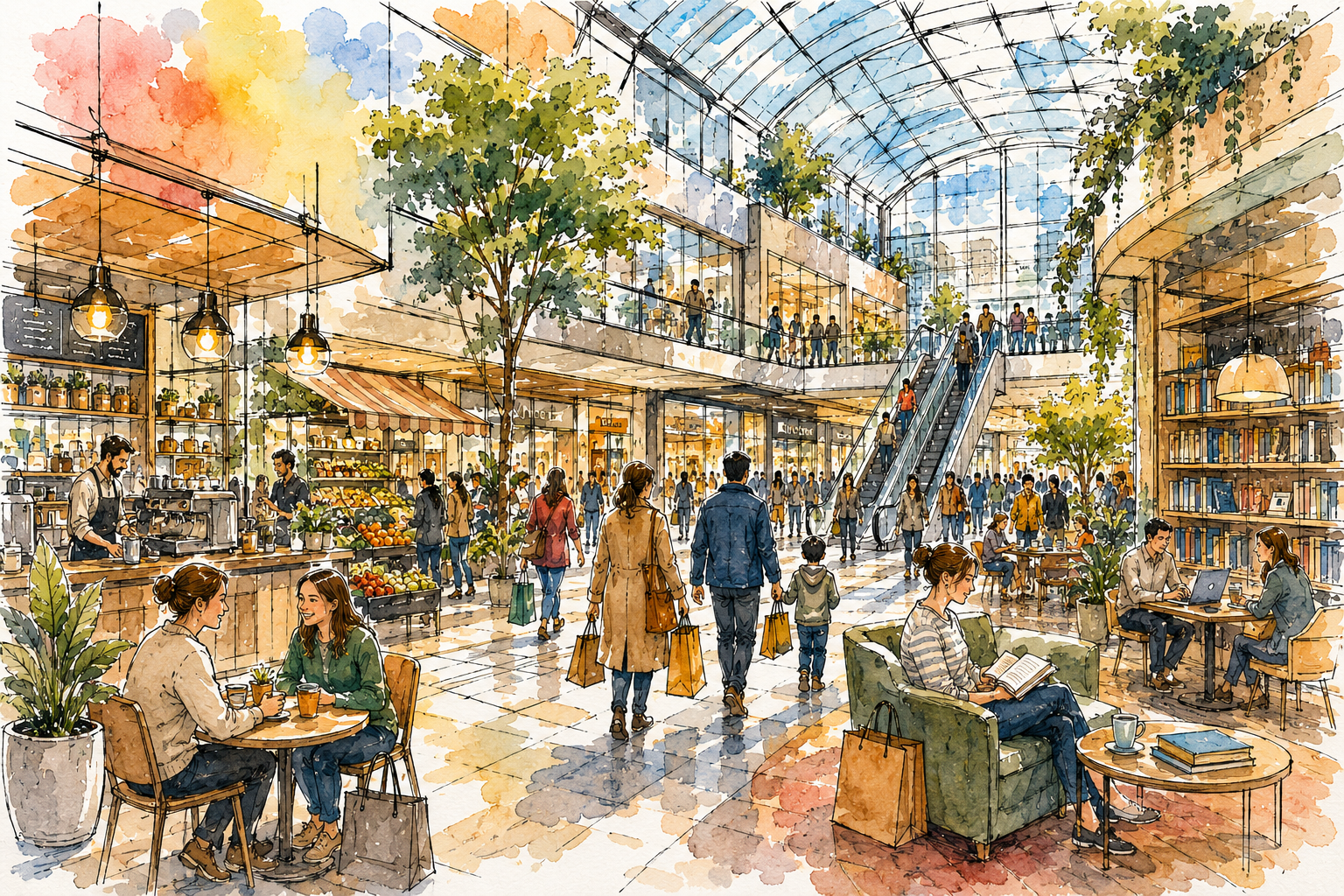
Across Europe, modern retail environments increasingly resemble miniature urban ecosystems rather than traditional shopping centres. Food halls replace empty corridors. Public seating areas expand. Greenery, cafés and open interiors become central design elements rather than decoration.
The underlying logic is changing. Physical retail no longer competes directly with online efficiency alone. It increasingly competes on atmosphere, human interaction and the quality of physical presence itself.
That transformation becomes visible inside places such as Westfield Mall of the Netherlands. The complex functions less like a conventional mall and more like a carefully designed urban interior where architecture, restaurants, flagship stores and public atmosphere merge into a single experience.
Visitors increasingly come not only to purchase products, but to spend time. The mall slowly evolves from transactional infrastructure into experiential infrastructure.
“The desire to gather physically did not disappear in the digital age. It simply changed form.”
That shift reflects a broader transformation inside modern consumer culture itself. Once online platforms absorbed much of retail’s functional efficiency, physical environments became freer to focus on something else entirely: experience, rhythm and presence.
The physical store increasingly functions as:
- showroom,
- meeting place,
- brand environment,
- hospitality space,
- and social setting at the same time.
In some cases, the purchase itself may even happen later online. The physical environment instead creates familiarity, trust and emotional connection around the brand or location.
The return of urban presence
The same transformation appears at a smaller and more local scale.
In Alphen aan den Rijn, redevelopment plans surrounding shopping centre De Aarhof reveal how retail increasingly merges with housing, hospitality and everyday urban infrastructure. The project combines commercial functions with residential towers, public accessibility and daily services, gradually transforming the area into a more integrated city environment rather than a standalone shopping zone.
At the same time, nearby public institutions such as modern libraries increasingly evolve into contemporary community spaces. Quiet study areas, cafés, flexible workspaces and educational meeting environments now coexist alongside traditional collections.
The distinction between retail, hospitality, public space and social infrastructure slowly begins to blur.
That may partly explain why long-term investment groups such as HAL Trust continue investing heavily in physical environments despite the continued growth of e-commerce. The long-term value increasingly lies not only in individual stores, but in the broader ecosystems forming around them.
Retail is gradually becoming intertwined with city-building itself.
The architecture of experience
This transformation also reveals something deeper about digital society.
Online systems optimize around:
- speed,
- efficiency,
- personalization,
- and frictionless consumption.
Physical environments optimize around something entirely different:
- atmosphere,
- spontaneity,
- sensory experience,
- social interaction,
- and psychological presence.
That difference matters more than many earlier predictions assumed.
Human beings may appreciate digital convenience, but they still seek physical environments where everyday life becomes visible and shared. Cafés remain full. Food markets continue attracting visitors. Public interiors still shape how cities feel socially and emotionally.
In many ways, the future of retail may depend less on competing directly with e-commerce and more on offering what digital systems struggle to reproduce entirely: the experience of inhabiting a place.
“In a platform economy, efficiency scales digitally. Human presence does not.”
Yet this transformation also introduces a quieter societal question. As shopping centres increasingly function like public gathering spaces, the boundary between public and private environments becomes less clear. Modern malls may feel open and communal, but they remain privately controlled spaces governed by commercial interests, surveillance systems and behavioural rules.
That tension may become increasingly important as cities continue searching for places where people can gather, study, meet and spend time together.
Why Europe may still understand this instinctively
Europe may hold a particular advantage in this transition.
Many European cities historically developed around walkable centres, mixed-use streets, cafés, markets and public gathering spaces. Long before the platform economy emerged, European urban environments already understood something digital systems are only now rediscovering: people rarely seek efficiency alone.
They also seek atmosphere, rhythm and social presence. The future of retail may therefore not simply be about selling products more efficiently. It may increasingly be about rebuilding places people still want to inhabit.
This article is part of The Future of Retail — an Altair Media Europe series exploring how shopping centres, libraries and public spaces are evolving into social infrastructure in an increasingly digital society.
Illustration credit
Illustration generated with AI by OpenAI for Altair Media Europe
Caption
Modern retail environments increasingly function as social and urban spaces where shopping, hospitality, public life and human interaction merge into a single experience.
