The European Veto: Protection or Paralysis?
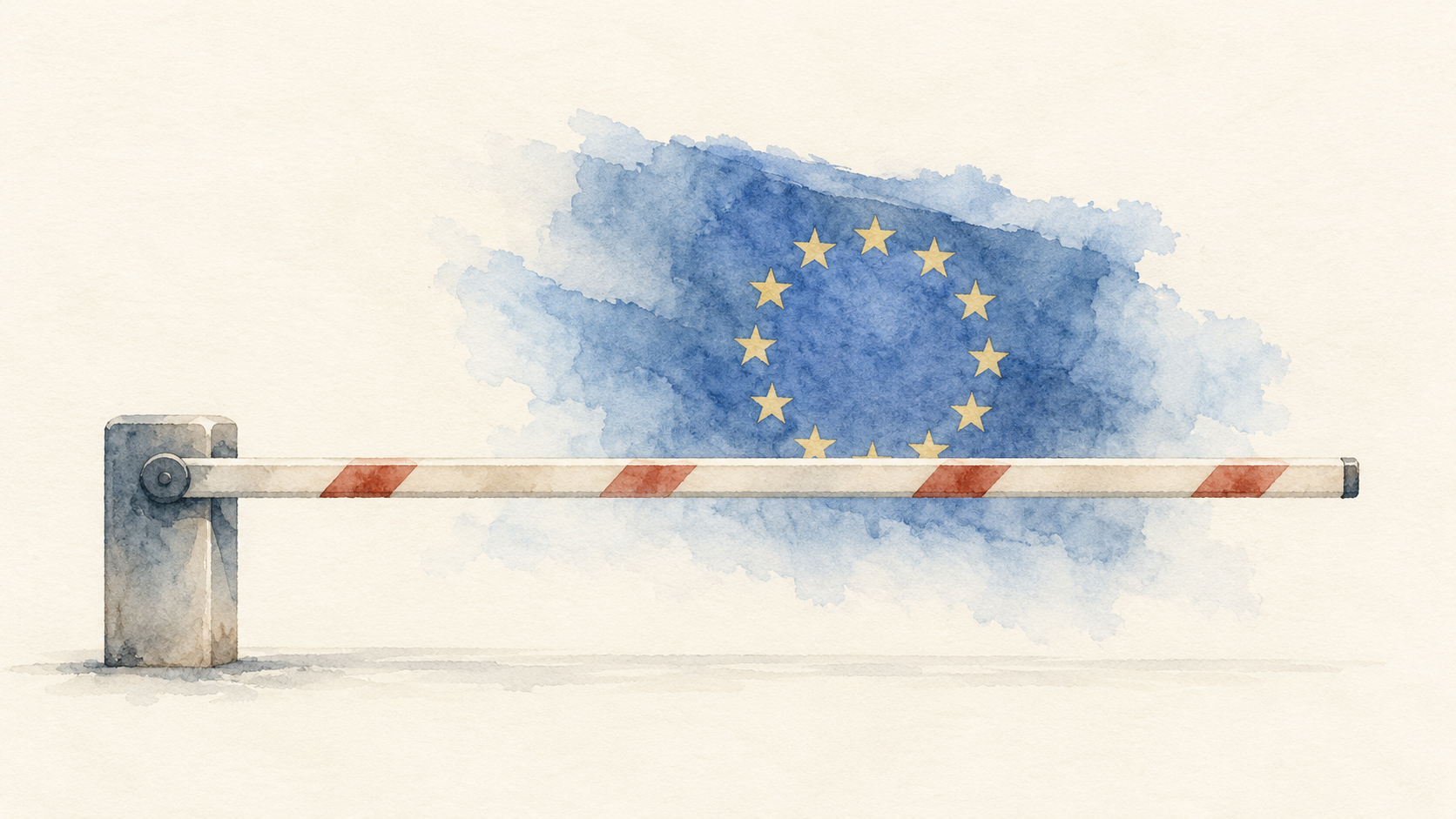
How national safeguards shape Europe’s capacity to act
In December 2023, Hungary blocked agreement on a revision of the European Union’s long-term budget that included €50 billion in support for Ukraine. On 1 February 2024, EU leaders reached an agreement, with Hungary joining the other member states. Europe eventually acted, but only after another summit and weeks of uncertainty.
The episode captures the tension behind Ursula von der Leyen’s call to extend qualified majority voting to certain policy areas. A national veto can force governments to negotiate and accommodate objections. It can also leave a collective commitment dependent on a single capital.
A national veto can force governments to negotiate and accommodate objections.
For Europe, the question is how much protection individual governments need, and what happens when that protection limits the security, resources or choices of everyone else.
The case for national protection
The veto has a defensible political purpose. European governments answer to national electorates, and European decisions can impose very different costs across member states. A country heavily dependent on a particular energy source may face a different adjustment burden from a neighbour with alternative supplies. A government committing public money must explain that commitment to its parliament and voters.
Unanimity gives such concerns institutional weight. It obliges partners to seek agreement with countries whose interests might otherwise be overlooked. For smaller states, the ability to withhold consent can offer reassurance that membership does not mean accepting decisions shaped primarily by larger economies.
The scope of this protection is often misunderstood. Qualified majority voting already applies to around 80% of the Council’s legislative work. Unanimity remains necessary in sensitive areas, including much of foreign and security policy, admission of new members, certain tax measures and the EU’s long-term budget.
Calls for reform therefore focus on selectively extending an established voting method. In her September 2025 State of the Union address, von der Leyen identified foreign policy as one such area.
Where every government’s consent is required, each can make its support conditional.
The democratic case for retaining unanimity deserves serious consideration. Decisions adopted more quickly still require implementation, public acceptance and lasting political support. A government that feels persistently overruled may become less willing to sustain the cooperation on which European policy depends.
When protection becomes bargaining power
Yet the same safeguard creates a powerful negotiating opportunity. Where every government’s consent is required, each can make its support conditional. The influence of the veto begins well before a formal vote: proposals can be delayed, narrowed or rewritten in anticipation of opposition.
There are several reasons for withholding consent. A government may seek changes to a measure that directly disadvantages its country. It may disagree with the policy’s objectives. Or it may use an unrelated decision to obtain concessions elsewhere.
These situations merit different assessments. Political disagreement is an ordinary part of democratic government. A minority position may identify risks that a majority has underestimated. Equally, linking one decision to another can help governments assemble a compromise that all can accept.
The capacity to stop a decision carries a responsibility towards those who bear the cost of waiting.
The difficulty arises when the connection between the objection and the blocked measure becomes weak, while the consequences for others become substantial. At that point, national protection can give one government disproportionate influence over a shared agenda.
A useful test is whether the objection identifies a specific harm, whether proposed concessions address that harm, and whether the conditions for agreement are clear. These questions make it possible to examine a veto without assuming that either the blocking government or its critics must be right.
The Ukraine dispute demonstrates both sides of the mechanism: one government could delay a widely supported commitment, while further negotiation eventually secured agreement. A fair assessment must consider both the protection achieved and the costs incurred.
The cost of waiting
Delay has consequences beyond the negotiating table. A recipient government needs dependable financing to plan expenditure. Institutions need clarity to organise delivery. International partners need confidence that European commitments can survive internal disagreements.
Additional negotiation may improve scrutiny and produce a more durable settlement. Its value must nevertheless be weighed against the uncertainty it creates. The capacity to stop a decision carries a responsibility towards those who bear the cost of waiting.
National interests must receive serious protection, and shared commitments must remain deliverable.
There is also a deeper question of sovereignty. A government may retain complete discretion to refuse a European decision while possessing limited ability to shape the external circumstances facing its country. Collective action can expand that practical influence. When Europe remains divided, individual members may preserve their formal freedom to object while losing opportunities to influence geopolitical and economic outcomes.
Reform should distinguish decisions requiring individual consent from those for which a broad majority can provide sufficient legitimacy. Clear safeguards, transparent reasoning and attention to exceptional national burdens would make that distinction more credible.
The treaties already contain passerelle clauses, allowing a switch to qualified majority voting in specified circumstances without formally amending the treaties. Activating these clauses itself requires unanimous agreement. Their existence provides a route towards reform, but agreement on using it remains a political hurdle.
On 6 October 2026, the Commission proposed qualified majority voting for opening negotiating clusters and other intermediate steps in accession talks. Final admission remains subject to unanimity under the current rules. The proposal brings the debate directly into preparations for enlargement.
A larger Union will need a convincing answer to the problem exposed by today’s veto disputes. National interests must receive serious protection, and shared commitments must remain deliverable. Europe’s task is to design decision-making rules that can sustain both.
This Perspective opens Europe’s Power to Decide, a four-part Altair Media Europe series examining vetoes, enlargement and the struggle to govern a larger Union.
Credit
Altair Media / OpenAI — AI-generated watercolour illustration.
Caption
A closed barrier against a softly painted European backdrop symbolises the dual role of the national veto: protecting individual interests while potentially obstructing collective action.
