The End of the Managed Message
Why Leadership Visibility Now Requires Friction
For years, executive visibility followed a predictable choreography. Questions were aligned in advance. Sensitive edges were softened. Strategy was presented as inevitability. Interviews became controlled environments — polished, careful and frictionless. The result was professional — and increasingly, forgettable.
That model belonged to a different decade. Today, artificial intelligence is no longer a software abstraction; it draws megawatts, occupies land and requires political consent. Energy grids are no longer background systems. Semiconductor supply chains are no longer neutral logistics. The infrastructures shaping Europe’s future operate under structural pressure — and structural pressure cannot be translated into promotional language.
Visibility is abundant. Authority is scarce.
“In a time of hyper-transparency, the classical PR machine is your greatest risk. Only those willing to confront their own friction build real strategic capital.”
— Dr. Elena Veenstra, Professor of Corporate Governance & Public Trust
The question for executive communication is no longer how success is presented. It is how legitimacy is constructed. When infrastructure, intelligence and public trust intersect, communication itself becomes infrastructural. What is said — and how it withstands examination — shapes an organisation’s licence to operate.
The Altair Executive Dialogues are built on this premise. They are not interviews in the traditional sense, but structured strategic conversations designed to test how leadership positions itself within systemic transformation.
The Architecture of an Executive Dialogue
Every Dialogue unfolds along four structural movements.
Structural Context
The conversation begins above the organisation. We examine the systemic forces reshaping the environment — geopolitical pressure, infrastructural constraint, technological acceleration — before narrowing the lens.
Organisational Position
Only once context is established do we examine exposure. Where does the organisation depend on systems it does not control? Where do strategic tensions surface?
Responsibility & Public Meaning
Infrastructure is never neutral. Leadership operates within a web of public expectation, regulatory oversight and societal consequence. This layer clarifies how responsibility is interpreted — and where blind spots may exist.
Forward Architecture
Rather than forecasting ambition, the Dialogue identifies friction. Which structural resistance must be overcome to legitimise future positioning?
Friction, in this sense, is not antagonism but diagnostic clarity.
“The most beautiful strategies fail because they lack public legitimacy. A dialogue that seeks friction is not an attack — it is a stress test of your licence to operate.”
— Marcus de Waal, Chief Strategy Officer, European Energy Collective
Infrastructural leadership in 2026 demands more than message discipline. It demands the capacity to articulate tension — between growth and grid capacity, between innovation and regulation, between sovereignty and interdependence. An executive who can only describe momentum appears fragile. An executive who can describe friction appears credible.
Such credibility requires independence. Not symbolic independence, but editorial authority that resists the gravitational pull of managed narrative. In the Executive Dialogues, Altair retains responsibility for framing, contextualisation and final composition. Participants are represented fairly, facts are verified and complexity is preserved. What is not granted is narrative control — because narrative control weakens the very authority leaders seek to strengthen.
“Leadership in complex infrastructure is not about having all the answers. It is about daring to name the blind spots within the system you are part of. That is where innovation begins.”
— Thomas van den Brink, Director of Foresight, Smart Cities NL
The final movement of each Dialogue is not a forecast, but a positioning exercise. The future is not an aspiration; it is an architectural problem within an evolving physical and political landscape.
Executives today do not struggle to be seen. They struggle to be believed.
“A CEO who admits the transition creates friction is infinitely more credible than one who claims everything proceeds according to plan. Vulnerability is the shortest path to trust in this decade.”
— Sarah Al-Hussaini, Partner, Strategic Advisory for Public Sector Transformation
The Altair Executive Dialogues are selective by design, engaging leaders who shape the physical and digital architecture of Europe and beyond. The outcome is not an article as a moment of publicity, but a Strategic Briefing — a durable positioning document that contributes to long-term legitimacy.
The Executive Dialogues form part of Altair’s broader strategic formats — alongside the Wake-Up Calls, Deep Reflection Reports and Strategic Framing Briefs — developed to examine leadership, infrastructure and systemic transition under editorial independence.
Marketing tells what one hopes will be believed.
Strategic dialogue tests what must endure.
In an age where systems are strained and authority is conditional, leadership visibility demands more than amplification. It demands intellectual courage.
The Executive Dialogue is not designed for comfort. It is designed for clarity — and clarity, under structural pressure, is the rarest strategic asset of all.
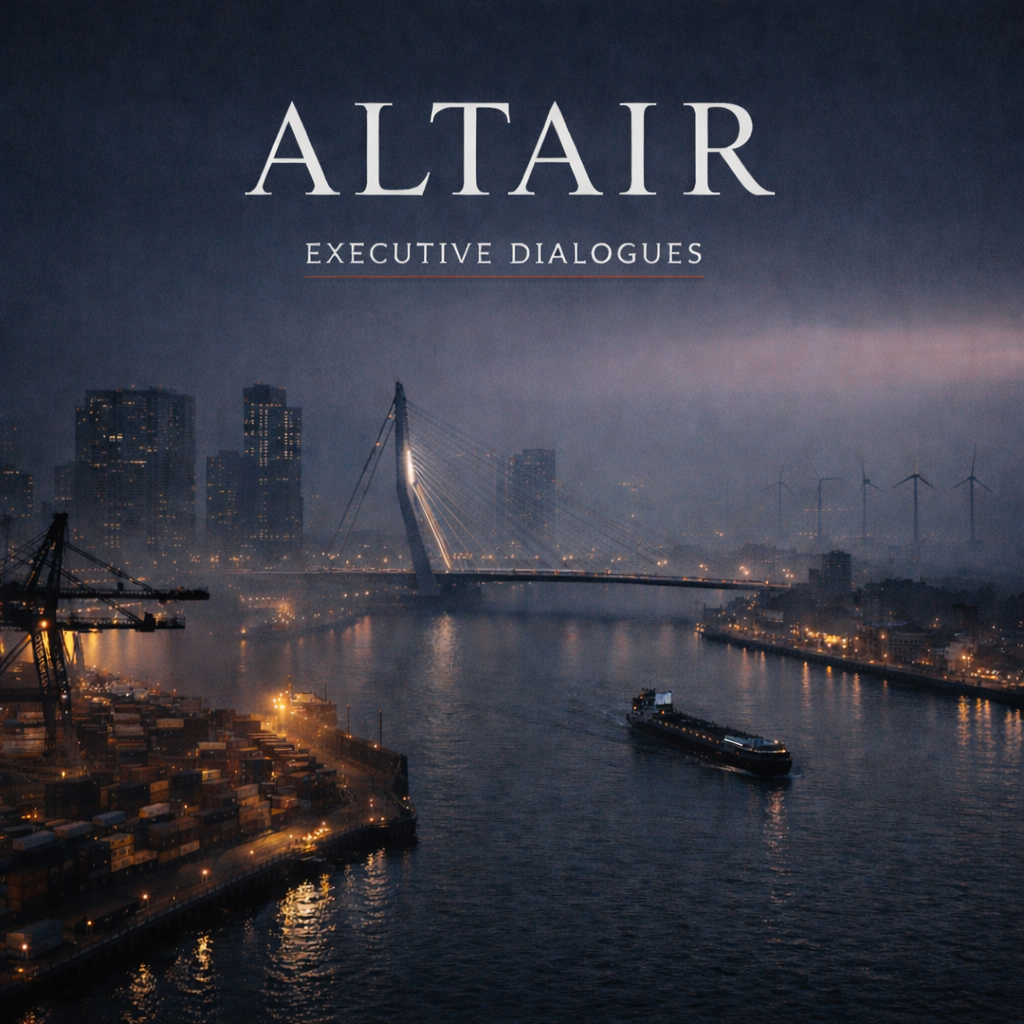
Photo credit: Altair Media / Generative visual composition
Caption: The Port of Rotterdam at twilight — where physical infrastructure, energy transition and digital systems converge under conditions of strategic uncertainty.
Institutional Engagement
The Executive Dialogue is part of Altair’s applied strategic formats.
Institutional engagement is facilitated through curated access.
More information:
connect.altairmedia.eu
member.altairmedia.eu
