The Digital Battlefield
Why Software Is Becoming Critical Military Infrastructure
Twenty years ago, military power was still largely imagined in physical terms: tanks, aircraft, ships, artillery and soldiers. Those capabilities remain essential, but modern warfare has added another layer of infrastructure around them.
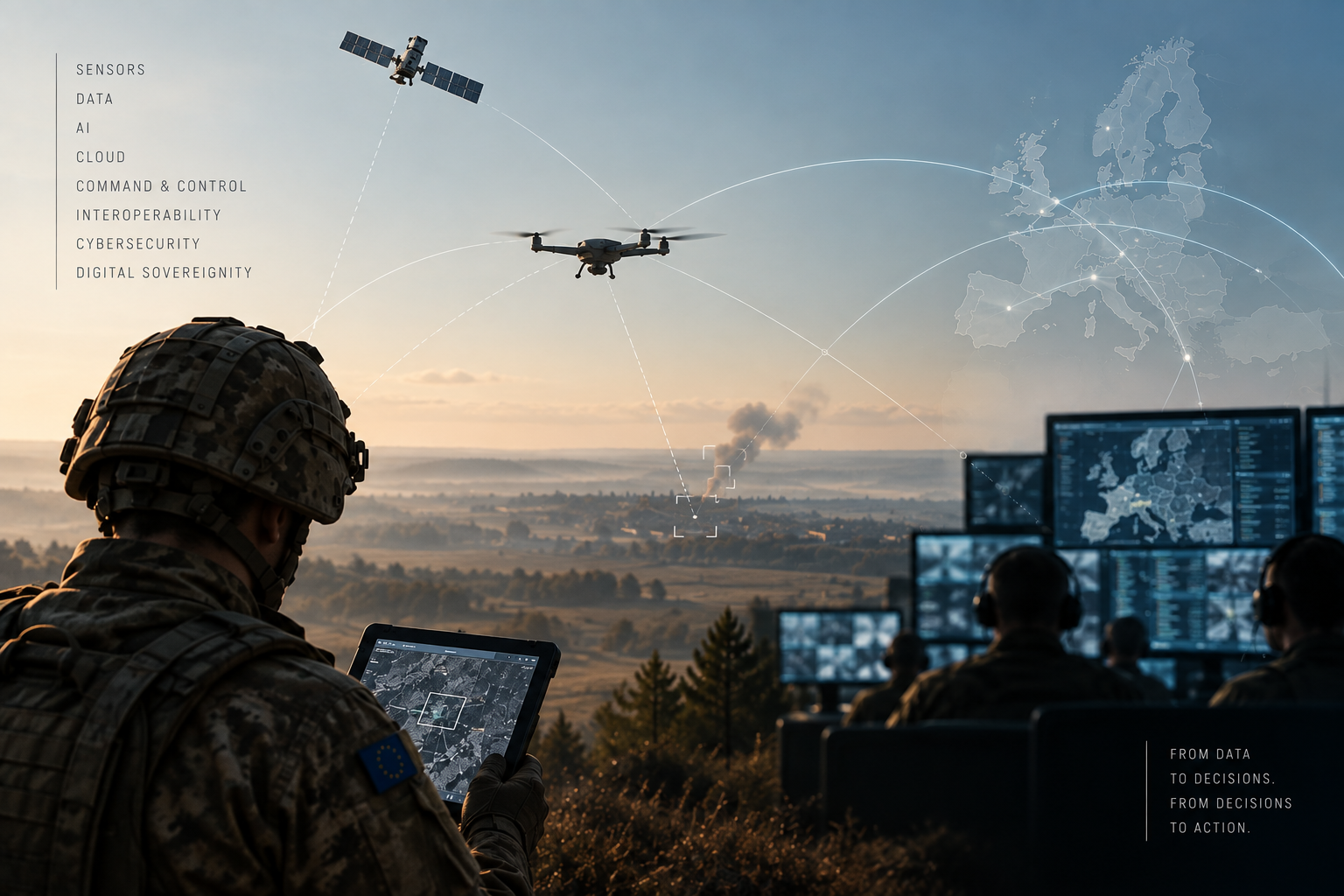
Drones collect imagery while satellites provide positioning and intelligence. Sensors detect movement, communications networks connect units and artificial intelligence helps analyse growing quantities of information. Behind them, cloud infrastructure provides computing capacity and battlefield software brings different streams of data together.
Increasingly, the effectiveness of physical military power depends upon the digital systems connecting it.
Digital infrastructure has become part of military infrastructure.
The question is therefore no longer simply who possesses the most advanced weapons. It is also who writes the software through which those weapons see, communicate and act. For Europe, that raises a strategic question extending far beyond defence procurement.
Can Europe fight without digital sovereignty?
The Invisible Layer of the Battlefield
A modern battlefield produces extraordinary quantities of information. Satellite imagery, drone footage, radar signals, intelligence reports, communications data and sensor readings continuously describe what is happening across an increasingly connected military environment. Collecting that information, however, is not the same as understanding it.
The strategic advantage increasingly lies in systems capable of combining different streams of information, interpreting them and distributing useful insights quickly enough for commanders and military units to act.
This creates an invisible layer between observation and action. Software increasingly occupies that space, determining how information moves, which systems can communicate, what commanders can see and how quickly decisions travel through a military organisation. Digital infrastructure has therefore become part of military infrastructure.
From Command and Control to Digital Ecosystems
Command and control has always been central to warfare. Generals have always needed to understand where their forces were, where an opponent might be and how orders should be distributed. What has changed is the technological environment in which those decisions are made.
A contemporary command structure may combine satellites, drones, radar, secure communications, cloud computing, artificial intelligence and battlefield-management software. Information generated by one system increasingly needs to become immediately usable by another.
A drone, for example, does more than collect an image. That image may need to be transmitted through a communications network, stored in a computing environment, compared with previous intelligence, analysed by software and delivered to the people or systems capable of acting upon it.
The value lies not simply in collecting more information, but in shortening the distance between observation, understanding and action.
The digital battlefield is still physical underneath.
A military that can complete that cycle in seconds may possess an advantage over one that requires minutes—even if both begin with similar physical equipment.
Software therefore changes not only what a military knows. It changes the speed at which knowledge can become action.
The Battlefield as a Data Environment
Modern warfare is becoming increasingly data-intensive. Every sensor adds another source of information, every connected vehicle another node and every drone or satellite another stream of imagery and intelligence. The battlefield begins to resemble a distributed digital network.
Artificial intelligence can help navigate this complexity by classifying images, identifying anomalies, comparing patterns and prioritising information for human analysts and commanders. Its military importance lies partly in making enormous quantities of data usable within increasingly compressed periods of time.
AI does not operate independently. It depends upon computing infrastructure, and computing infrastructure in turn depends upon data centres, semiconductors, electricity and communications networks.
This creates an important paradox. The more warfare becomes digital, the more dependent it becomes upon another layer of physical infrastructure. The digital battlefield is still physical underneath.
Cloud Becomes Military Infrastructure
This makes cloud infrastructure strategically important. Military organisations increasingly require computing environments capable of storing, processing and distributing information across multiple locations while remaining secure and available under extreme conditions. Cloud architectures can provide enormous computing capacity and flexibility, particularly when data from many different systems must be brought together. But scale also creates dependency.
Questions familiar from Europe’s wider debate about digital sovereignty suddenly acquire military significance. Who operates the infrastructure? Where is sensitive data processed? Who controls the underlying software? Which jurisdiction governs the provider? Who supplies critical updates? And can access to essential technologies still be guaranteed if political relations change? These are not theoretical questions about technological independence.
Software platforms can depend upon licensing agreements, export permissions, proprietary interfaces, remote updates and computing infrastructure operated by companies headquartered outside Europe. Any one of those dependencies may be manageable during normal circumstances. Their strategic significance changes when access to a system becomes essential to military operations.
The issue is therefore not whether foreign technology should be excluded. It is whether critical military capabilities can remain operational when political or commercial conditions change. A dependency that is commercially inconvenient during peacetime may become strategically critical during conflict.
Europe’s Dependency Question
Europe possesses sophisticated armed forces, advanced defence manufacturers and considerable technological capabilities. Yet important parts of its digital ecosystem remain dependent upon technologies developed or operated elsewhere, particularly in the United States.
Digital sovereignty is not autonomy from everyone. It is the ability to choose dependencies rather than simply inherit them.
Companies such as Palantir have demonstrated how powerful software platforms can become when data integration, artificial intelligence and operational decision-making are brought together. European initiatives involving companies such as ChapsVision, alongside wider efforts around sovereign defence cloud and artificial intelligence, reflect growing awareness that this digital layer itself has strategic significance. The issue, however, is larger than any individual company.
Replacing one American platform with one European platform would not automatically create digital sovereignty. What matters is the ecosystem around it: cloud and computing infrastructure, secure communications, semiconductors, software, AI models, cybersecurity, technical standards and the engineers capable of integrating them.
Digital sovereignty cannot be purchased as a single product. It has to be built as a system.
The European Paradox
Here Europe encounters a familiar problem. Its military forces remain predominantly national, while the digital systems supporting modern defence increasingly derive their value from scale, connectivity and interoperability.
A French sensor may need to exchange information with a German command system. Dutch communications infrastructure may support multinational operations. NATO systems must connect forces originating from countries with different procurement histories, technologies and security requirements.
Digital sovereignty therefore cannot simply mean national technological independence. Nor can it realistically mean technological isolation from Europe’s allies.
Europe needs systems sufficiently sovereign to remain under European control, yet sufficiently open to operate with others. That requires a more mature definition of sovereignty. Not autonomy from everyone. But the ability to choose dependencies rather than simply inherit them.
Interoperability as Infrastructure
This may ultimately be Europe’s most difficult digital defence challenge. Building another cloud platform is possible. Developing another AI model is possible. Creating another battlefield-management system is possible. Making dozens of national systems, defence companies, military branches and allied platforms exchange information reliably, securely and quickly is much harder. And speed increasingly matters.
The battlefield is becoming a system. Whoever controls its architecture controls an increasingly important layer of military power.
If one sensor detects a threat but another system cannot immediately interpret its data, technological sophistication alone offers limited advantage. The strategic value emerges when detection, analysis, decision-making and response can be connected into a continuous process.
Interoperability therefore affects more than technical compatibility. It influences how quickly information can become operational action. This is why some of the least visible elements of defence technology may become among the most consequential. Standards, interfaces and protocols rarely appear in photographs of military capability, yet they determine whether different systems can function together.
They form the digital roads along which military information travels. An alliance without interoperability possesses many capabilities. An interoperable alliance begins to possess a system.
From Industrial Capacity to Digital Capacity
The industrial battlefield described in the previous part of this series does not disappear when software enters the picture. It becomes connected to it.
Factories manufacture drones, vehicles, missiles and sensors. Energy systems power those factories, while logistics networks move equipment towards the battlefield. Digital infrastructure increasingly determines how those physical assets communicate, coordinate and respond once they arrive. The distinction between industrial and digital power is therefore becoming increasingly artificial.
A drone is simultaneously a manufactured object, a sensor, a communications device and a software platform. A modern military vehicle is both machinery and a node in a network. A command centre is simultaneously a physical facility and a computing environment. This creates a relationship of mutual dependence.
Software without physical capability cannot hold territory, manufacture ammunition or move supplies. Physical capability without information and coordination increasingly struggles to operate effectively in a battlefield shaped by sensors, drones and rapidly changing data. Military power emerges where these layers intersect.
Reflection
Europe’s defence debate often begins with numbers: how many tanks, how many aircraft, how many artillery shells and how much governments should spend. Those questions matter.
But another category of strategic assets is becoming increasingly important and much harder to count. Software, cloud infrastructure, data architectures, AI systems, communications networks and digital standards now determine how effectively physical military capabilities can function together.
The future balance of military power will therefore not be determined solely by who can manufacture the most sophisticated equipment. It will also depend upon who can connect that equipment, interpret the information it generates and maintain control over the digital infrastructure through which decisions travel.
The first layer of modern military power moves equipment. The second produces and replaces it. The third connects, interprets and coordinates it. None is sufficient alone.
Logistics without production eventually runs empty. Industry without logistics cannot reach the battlefield. Physical military capability without digital coordination increasingly risks becoming slow or blind. And digital intelligence without physical capability has little power to act.
Modern military resilience increasingly emerges from the convergence of these systems.
The battlefield is becoming a system.
And whoever controls the architecture of that system controls an increasingly important layer of military power.
Part of The Architecture of War — a Perspective series examining how logistics, industry, energy, communications and digital infrastructure have become the hidden architecture of modern military power.
Credit
Altair Media Europe | AI-generated editorial illustration
Caption
Modern military power increasingly depends on the digital infrastructure connecting observation with action. The Digital Battlefield examines how sensors, data, AI, cloud computing and interoperable command systems are reshaping warfare—and why control over that architecture is becoming a strategic question for Europe.
