Strategic Seven versus Magnificent Seven
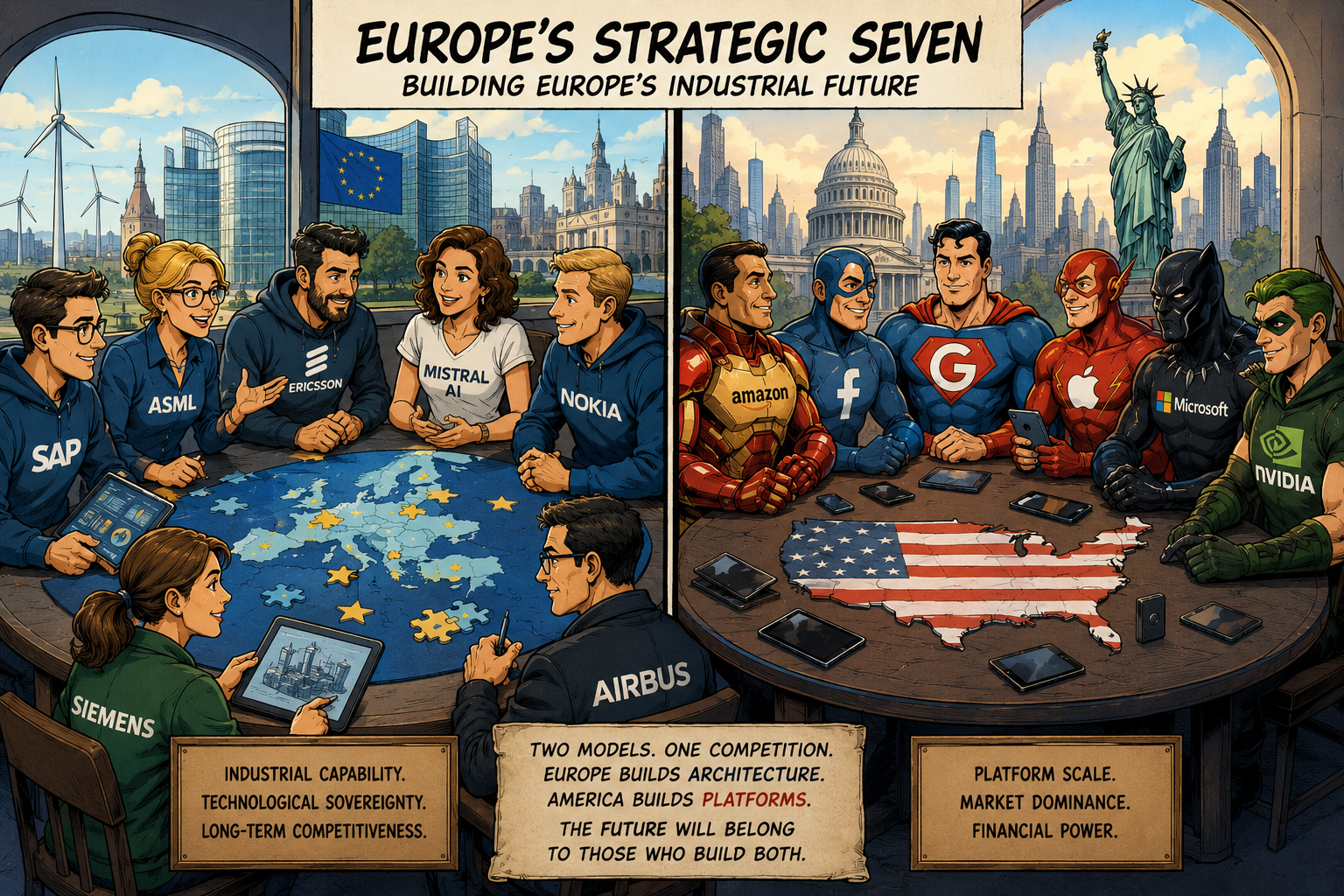
Why Europe’s strength may lie in coordination rather than concentration
The comparison is almost inevitable. America has its Magnificent Seven—technology giants that have come to dominate global markets through software, platforms, cloud computing and artificial intelligence. Europe appears to be developing something fundamentally different.
Rather than producing consumer platforms of unprecedented scale, Europe is increasingly identifying a small group of companies whose combined capabilities underpin its industrial future. Airbus, ASML, Ericsson, Mistral AI, Nokia, SAP and Siemens do not dominate the same markets. Together, however, they represent much of Europe’s strategic technology base.
The comparison therefore raises an important question. Perhaps Europe is not trying to build its own Magnificent Seven at all. Perhaps it is building a different model of competitiveness.
Platform versus Production
🟦 Why are the two groups fundamentally different?
America’s Magnificent Seven became global leaders by building platforms that connect billions of users. Their strength lies in software ecosystems, digital scale and access to capital.
Europe’s Strategic Seven operate according to another logic. They develop lithography systems, industrial software, telecommunications infrastructure, artificial intelligence, aerospace technologies and advanced manufacturing systems. Their products are often invisible to consumers, yet indispensable to entire industries.
Mistral AI illustrates this difference particularly well. Rather than primarily building a consumer platform, it represents Europe’s ambition to develop sovereign artificial intelligence that can be integrated across its wider industrial base.
One model creates platforms. The other enables production.
🟦 Why is coordination becoming Europe’s strategic advantage?
None of Europe’s Strategic Seven can transform Europe’s competitiveness alone.
ASML depends on advanced suppliers. Airbus relies on industrial software, semiconductors and telecommunications. Siemens connects manufacturing with automation. SAP provides the digital backbone of industrial processes. Ericsson and Nokia enable connectivity. Artificial intelligence increasingly depends on them all.
Their strength therefore lies not only in their individual technologies, but in the way those technologies reinforce one another.
Europe’s competitive advantage may ultimately emerge not from one dominant company, but from its ability to connect specialised capabilities into one coherent industrial ecosystem.
🟦 Is Europe building ecosystems rather than empires?
For decades, technological leadership has often been measured through the rise of individual corporate giants. Europe increasingly appears to be pursuing another path.
Rather than concentrating technological leadership inside one dominant platform, it is strengthening networks of specialised companies, research institutions, industrial partners and public institutions.
Its objective may not be to create a European equivalent of Google or Amazon. It may be to build an industrial ecosystem that is collectively difficult to replicate.
🟦 How does this differ from China?
The three major economic powers increasingly appear to follow three distinct models.
China coordinates vertically through the state, directing strategic industries towards long-term national objectives.
The United States coordinates primarily through capital markets, entrepreneurial ecosystems and private investment, supported where necessary by targeted industrial incentives.
Europe seems to be searching for a third path. One based on horizontal coordination between companies, research institutions, investors, standards, governments and public-private partnerships.
Rather than copying either model, Europe appears to be defining its own philosophy of industrial coordination.
🟦 Has coordination become a strategic capability?
For decades, economic strength was measured through labour, capital, technology and innovation.
In an increasingly interconnected industrial economy, another capability is becoming equally important.
Coordination.
The ability to connect specialised companies, universities, research institutes, investors, governments and industrial supply chains into one functioning ecosystem.
In that sense, coordination is no longer merely an organisational task. It is becoming a strategic capability in its own right.
🟦 Why does fragmentation matter?
Europe’s greatest weakness has rarely been technology. Nor has it been engineering talent. Its persistent challenge has been fragmentation.
Fragmented capital markets. Fragmented regulation. Fragmented innovation ecosystems. Fragmented deployment.
That is precisely why coordination matters. It is not simply another policy instrument. It is Europe’s answer to fragmentation itself.
If Europe succeeds in overcoming fragmentation by connecting its existing strengths more effectively, coordination may become its greatest competitive advantage.
Signify
The comparison between Europe’s Strategic Seven and America’s Magnificent Seven is ultimately not a comparison between companies. It is a comparison between two different philosophies of competitiveness.
One concentrates value inside a small number of global platforms.
The other distributes technological capability across interconnected industrial ecosystems.
Whether Europe’s emerging model succeeds will depend not only on innovation, but on its ability to coordinate knowledge, capital, institutions and industry around shared strategic objectives.
Europe’s greatest competitive advantage may not be any individual company. It may be the architecture that connects them.
Image Credit
Illustration: Altair Media (AI-generated editorial illustration)
Caption
Three models. Three philosophies of competitiveness. While the United States scales through platforms and China coordinates through the state, Europe is exploring a third path: strengthening interconnected industrial ecosystems through strategic coordination.
