Siemens’ Factory AI Reveals Europe’s Industrial Opportunity
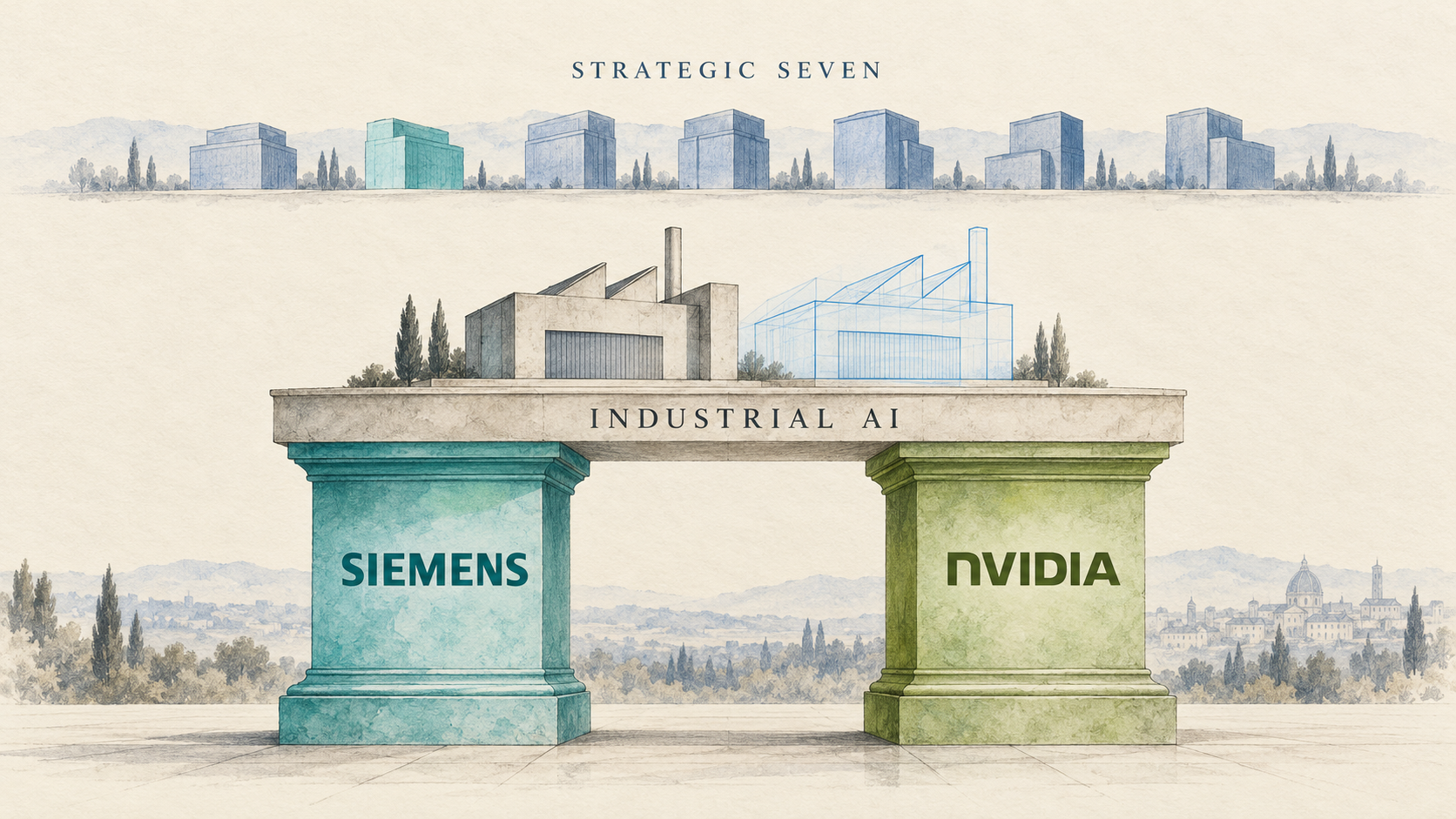
New applications with Nvidia give the Strategic Seven a concrete opening: turning domain engineering into industrial software that works beyond the first factory.
On 19 October, Siemens unveiled new industrial AI applications developed with Nvidia at its electronics factory in Erlangen. They connect production planning, quality inspection and digital twins. The announcement gives Europe’s Strategic Seven a concrete reference point: how established industrial capabilities could become practical AI solutions for customers across sectors and international markets.
For Altair Media’s industrial AI roadmap, the challenge is now sharper: repeatable delivery beyond a showcase factory.
🟦 What have Siemens and Nvidia actually demonstrated?
Siemens presented two applications developed and tested in live production:
- Earlier quality inspection: AI generates realistic images of circuit-board assemblies from digital twins, helping train inspection systems before physical prototypes are available.
- AI-supported production planning: An agent generates scenarios reflecting capacity, materials and delivery requirements. Planners assess their consequences, with proposals tested in a factory digital twin before implementation.
Siemens reports up to 85% less engineering effort for virtual production preparation and potential planning cost savings of up to 20%. These are company-reported figures for specific workflows.
The advance is connecting AI to physical operating constraints. The commercial hurdle is implementation cost and performance in factories with different equipment, data and working practices.
🟦 What does Erlangen establish about the Strategic Seven?
It demonstrates the value of combining industrial engineering with AI and computing technology. Siemens brings that capability to the group alongside ASML, Airbus, Ericsson, Mistral AI, Nokia and SAP.
In May, the seven reported €417 billion in combined revenue and more than €40 billion in annual R&D investment. That establishes corporate scale, not a shared investment fund.
Their capabilities span important parts of an industrial AI offering. Joint delivery requires additional suppliers, allocated capital and contractual responsibility for integration and performance.
Erlangen provides evidence of bilateral implementation. The next test is whether broader cooperation produces a competitive offering with shared commercial commitments.
🟦 Do customer relationships accelerate adoption or protect incumbents?
Established suppliers understand legacy equipment, maintenance requirements and purchasing processes. That knowledge reduces deployment uncertainty.
The same position creates commercial friction. Suppliers protect account ownership, service revenues and proprietary interfaces. Customers face the risk of deeper dependence on systems that become expensive to replace.
A joint offering must reduce integration costs while defining data access, support obligations and responsibility for failures. Customer relationships become a route to market when participants accept those boundaries.
Cooperation that merely adds suppliers and contractual complexity weakens the proposition.
🟦 Why would customers outside Europe buy the result?
Industrial buyers pay for measurable outcomes: fewer stoppages, faster engineering, better quality and more efficient use of equipment and energy.
International competitiveness rests on three conditions:
- Predictable total costs: licensing, computing, integration, training and ongoing support.
- Compatibility: deployment across mixed equipment and existing production systems.
- Customer control: clear data rights, manageable switching costs and defined upgrade obligations.
European engineering expertise supports credibility. Operating results justify the purchase.
The decisive test is a further customer buying the solution without financing a complete redesign. Normal configuration remains necessary; its cost must fit the business case.
🟦 What value can Europe retain on proprietary computing platforms?
The Siemens–Nvidia collaboration demonstrates a working combination of European industrial expertise and American computing technology. Its strategic value depends on the capabilities European participants retain and develop.
Engineering knowledge, application design and customer relationships support bargaining power. Dependence on a proprietary runtime or a single computing supplier limits alternatives.
The roadmap should identify critical dependencies, replacement options and switching costs across hardware, software and contracts. Claims of sovereignty must be assessed against those practical choices.
Public support can strengthen shared testing, interoperability and access for smaller companies. Commercial delivery remains the responsibility of participating suppliers.
🟦 Who will turn capability into a product customers can buy?
Each application needs a price, an implementation plan and an accountable delivery lead. Three commitments would advance the roadmap:
- Assign responsibility: specify who coordinates integration, maintains the system and responds when performance falls short.
- Deploy beyond participants’ own facilities: validate costs and results with an independent industrial customer.
- Define a repeatable commercial offer: make pricing, configuration requirements and support obligations clear.
The starting applications remain testing production changes and connecting diagnosis with maintenance. Each requires its own business case and appropriate participants.
The next milestone is a contracted deployment whose results justify a second sale.
Signal
Erlangen demonstrates how industrial expertise gives AI practical value. The Strategic Seven bring complementary capabilities and established routes to customers worldwide. Turning that potential into scale requires contractual commitments: clear integration responsibility, transparent costs and performance that survives deployment beyond the first factory.
Source notes
- Siemens’ Erlangen announcement, 19 October 2026. Performance figures are company-reported. (press.siemens.com)
- The seven companies’ joint appeal and reported corporate figures, May 2026. (www.nokia.com)
This article is part of Building Europe’s Industrial AI, an Altair Media series following the path from technological capability to commercial delivery. It examines how companies, researchers, investors and public institutions can help turn European industrial expertise into dependable solutions for customers worldwide.
Credit
AI-generated editorial illustration for Altair Media.
Caption
Siemens and Nvidia form the pillars supporting a factory and its digital twin. Seven building blocks in the background symbolise the wider potential of Europe’s Strategic Seven.
