Milan–Turin — Where Connectivity Becomes Production
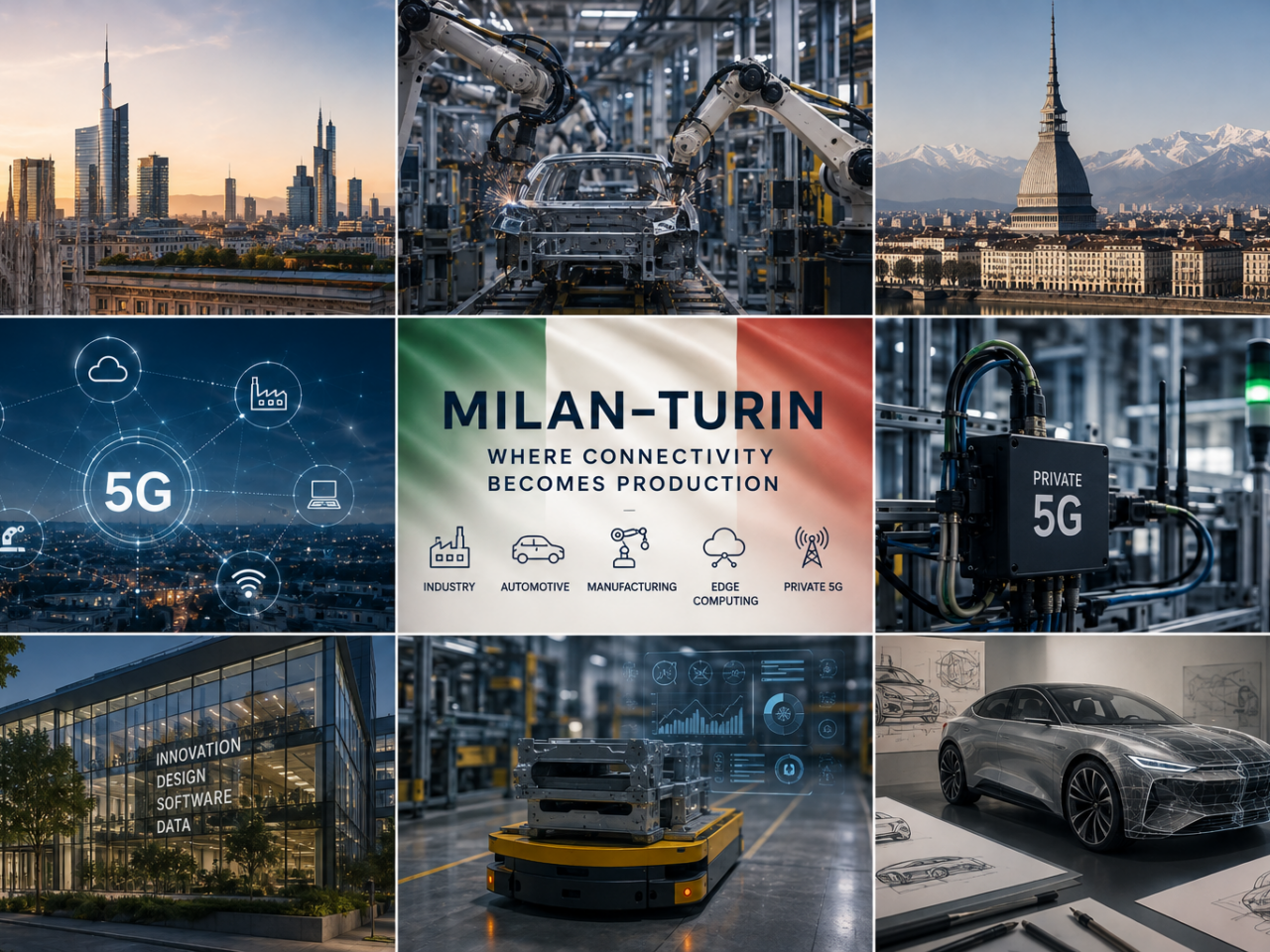
Why Europe’s manufacturing future depends on intelligent industrial networks
Regional Rising: Milan and Turin
Milan and Turin are often recognised for fashion, finance and automotive manufacturing. Less visible is another transformation taking place across northern Italy.
The region is quietly becoming one of Europe’s most important environments for integrating telecommunications directly into industrial production. Here, connectivity is no longer primarily about communication. It increasingly determines how factories operate, how machines cooperate and how production systems respond in real time.
Few European regions illustrate the convergence of manufacturing and digital infrastructure more clearly than the industrial corridor linking Milan and Turin.
Read MoreECB — Guardian of the System Beneath the Market

Can capital markets function independently of the monetary and financial system beneath them?
GUARDIAN FILE – Europe wants deeper capital markets to finance innovation, infrastructure and industrial scale. But markets do not operate in isolation. Beneath every share, bond and investment fund lies a monetary system that determines the price of capital, provides liquidity, settles transactions and absorbs financial stress. The European Central Bank guards that underlying system.
At first sight, the ECB appears distant from Europe’s scale-up debate. It does not select companies, operate stock exchanges or allocate growth capital. Yet every capital market depends on a stable monetary unit, a trusted settlement asset and financial institutions capable of providing liquidity. When those foundations weaken, market integration can disappear remarkably quickly.
The ECB therefore does not guard the market interface itself. It guards the stability on which that interface rests.
Read MoreWhy Feedzai Belongs in Europe’s Scale-Up Debate

Feedzai is not known to be a target of Europe’s new Scaleup Europe Fund. But it may be exactly the kind of company that explains why the fund had to be created.
SIGNAL | Feedzai has grown from a Portuguese fintech into a $2 billion-plus AI company operating deep inside global financial infrastructure. With major European customers, a growing US presence and a potential role around the digital euro, it raises a larger question: can Europe still finance its technology companies once they become genuinely valuable?
Feedzai is not the prediction. It is the test case.
🟦 Why would Feedzai need European scale-up capital at all?
Success changes the financing problem. Feedzai raised $75 million in its latest disclosed investment round. But a company worth more than $2 billion may eventually need very different amounts of capital.
If Feedzai grows towards $5 billion or $10 billion, tens of millions can quickly become hundreds of millions. That is where Europe has traditionally struggled.
Europe has become much better at creating technology companies. Financing them once they become genuinely large remains harder.
The European capital gap does not necessarily appear when a company is born. It appears when the company becomes valuable.
Read MoreSociety & Culture

Toddlers 1 – AI 0
Tuesday, January 20, 2026
While the world marvels at data centers and NVIDIA chips consuming electricity equivalent to small cities, a two-year-old sits on the floor of an ordinary daycare. Using no more than a dim household bulb’s worth of energy—20 watts—this child performs feats Silicon Valley can only dream of: learning a language, understanding sarcasm, recognizing a banana, whether drawn, plastic or half-eaten.
