Horizon Europe 2027: Why Europe Needs to Better Understand Its Own Societies
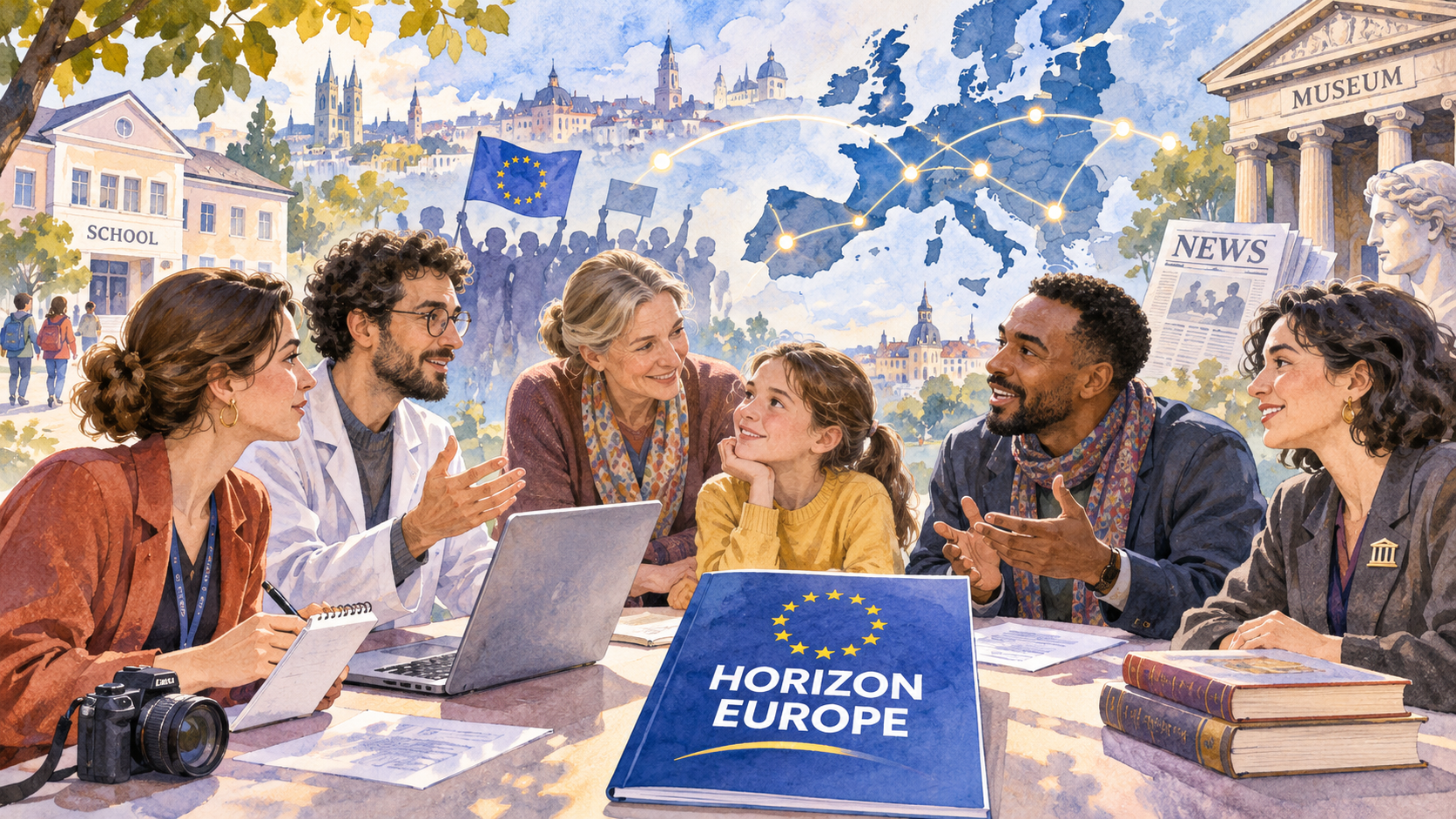
The social ambitions behind Europe’s research agenda
European integration has brought countries closer together through shared institutions, economic cooperation and common legislation. Yet living within the same European framework does not necessarily mean that citizens experience society, democracy or economic change in the same way.
Historical experiences, cultural traditions, educational systems and social structures continue to shape how people understand the world around them. Technological developments are adding another layer of complexity, influencing how citizens communicate, participate in society and relate to institutions.
Through Horizon Europe, the European Union is investing in a better understanding of these developments. Its 2027 research agenda under Cluster 2 — Culture, Creativity and Inclusive Society — offers an insight into the societal questions Europe considers important for its future.
The programme reflects a recognition that understanding society is not a secondary concern alongside economic and technological progress. It is an essential part of it.
🟦 1. What Makes People Feel Part of a Democracy?
Europe has established legal frameworks to protect democracy, fundamental rights and freedom of expression. However, the existence of democratic institutions does not automatically ensure that citizens trust them or feel represented by them.
Democracy also has a social dimension. People’s willingness to participate is shaped by their upbringing, education, economic circumstances, access to information and experiences with public institutions.
The 2027 research agenda explores several aspects of this relationship, including political polarisation, democratic participation among young people, the changing relationship between journalism and its audiences, and the influence of artificial intelligence on public life.
These developments raise questions about how people form opinions, establish trust and develop a sense of belonging within increasingly complex societies.
From a sociological perspective, the challenge is not only to understand why democratic institutions come under pressure, but also why different groups within the same society may experience democracy so differently.
Protecting democracy through legislation is one challenge. Understanding what makes people feel part of a democratic society is another.
🟦 2. Can Europe Grow Closer Without Losing Its Cultural Diversity?
Culture is often discussed in terms of heritage, artistic expression and economic activity. Yet it also plays a fundamental role in how people understand themselves, relate to others and develop a sense of belonging.
Europe’s cultural diversity reflects centuries of different historical and social experiences. Its significance extends beyond museums, monuments and creative industries into everyday life, shaping values, traditions and relationships between generations.
The research programme explores how cultural participation can contribute to health and well-being, how heritage can remain meaningful in changing societies and how creative activity can generate new social and economic opportunities.
Artificial intelligence introduces an additional dimension. As technology changes how cultural content is created, distributed and experienced, it may also influence how communities express and preserve their identities.
For Europe, the broader challenge is to develop greater connectedness without requiring cultural uniformity.
Research can help reveal how cultural differences influence social relationships, how shared experiences emerge and how cultural participation can contribute to more inclusive societies.
Europe’s cultural diversity is therefore not only something to preserve. It is also a source of knowledge about how societies develop and coexist.
🟦 3. Who Benefits When Society Changes?
Europe’s green and digital transitions are frequently discussed in terms of investment, productivity and competitiveness. Their consequences, however, are experienced by individuals, families, schools, employers and communities.
Technological progress can create new opportunities while reinforcing existing inequalities. Labour mobility can strengthen economies while changing family and community relationships. Educational innovation can benefit some children while leaving others behind.
The 2027 research agenda addresses several of these developments, including artificial intelligence in early education, declining educational skills, labour mobility, employment opportunities for people with disabilities and the role of the social economy.
What connects these topics is an interest in how broader transformations affect people’s opportunities and participation in society.
Economic growth and technological innovation can be measured through relatively familiar indicators. Changes in social relationships, independence, belonging and people’s sense of security are often more difficult to capture.
Research in the social sciences and humanities can help make these developments visible. It can reveal differences between social groups, identify unintended consequences and offer new perspectives on challenges that are sometimes understood primarily in economic terms.
The underlying question is whether societies are developing in ways that allow people to participate meaningfully in the changes taking place around them.
🟦 4. What Can European Societies Learn From One Another?
One of the defining characteristics of Horizon Europe is its emphasis on international research collaboration.
European countries face many similar challenges, but their responses are shaped by different institutional, historical and cultural circumstances. Education systems, welfare arrangements, media landscapes and relationships between citizens and public authorities have developed along different paths.
From a research perspective, these differences are particularly valuable. An educational approach that works in Denmark may produce different results in Spain or Greece. Understanding those differences can reveal how social environments, institutional arrangements and cultural expectations influence outcomes.
International research can therefore challenge assumptions that might otherwise remain unquestioned within a single national context.
There is also a wider social dimension to this collaboration. Researchers and practitioners develop relationships across borders, encounter different perspectives and gain a deeper understanding of the societies in which their European colleagues operate.
European connectedness, in this sense, can emerge not only through shared institutions and legislation, but also through the exchange of knowledge and experience.
The value of international research lies partly in its ability to develop shared understanding without assuming that every society requires the same solutions.
🟦 5. Can We Understand Society Without Involving Society Itself?
Universities and research institutions play a central role in Horizon Europe. Scientific expertise is essential to understanding complex social developments, examining assumptions and evaluating potential solutions.
Yet knowledge about society also exists outside academic institutions.
Teachers observe changes in children’s behaviour and learning. Journalists experience changing relationships between citizens and information. Social organisations encounter forms of exclusion that may remain largely invisible in national statistics. Cultural institutions see how different generations engage with identity and heritage.
These experiences represent different forms of knowledge. They can help researchers identify questions that might otherwise receive insufficient attention and develop a better understanding of how social developments are experienced in practice.
Depending on the research topic, collaboration between academic institutions and organisations working directly within society can bring these perspectives together.
Such cooperation should also work in both directions. Practitioners can benefit from scientific knowledge, while researchers can learn from the experiences of the people and organisations whose realities they seek to understand.
The challenge is not simply to communicate scientific findings to society, but to involve society meaningfully in the development of knowledge itself.
🟦 Can New Knowledge Change European Society?
Horizon Europe offers an insight into how the European Union approaches its own societal development.
Research can generate new knowledge, support policymaking and help institutions respond to emerging challenges. Equally important, however, is its ability to introduce alternative perspectives and challenge established assumptions.
This creates an important tension. Research programmes are developed within existing policy frameworks, yet some of their most valuable findings may reveal limitations in those very frameworks.
There is also a question of what happens after research has been completed. Scientific publications and policy recommendations are important, but their wider societal value depends partly on whether the knowledge reaches educators, communities, public institutions and other organisations capable of applying it.
The significance of Cluster 2 therefore extends beyond the individual projects it finances. It provides an opportunity to develop a more nuanced understanding of European societies, their differences and the experiences of the people who live within them.
European integration has created a framework for countries to work together. Developing a deeper understanding of one another remains an ongoing societal challenge.
Horizon Europe 2027 | At a Glance
Research area: Culture, Creativity and Inclusive Society (Cluster 2)
Call reference: HORIZON-CL2-2027-01
Indicative budget: €277 million
Research topics: 24
Scheduled opening: 13 May 2027
Scheduled deadline: 23 September 2027
Additional funding opportunities involving a two-stage application process are available separately.
Source: European Commission — Horizon Europe Work Programme 2026–2027, Cluster 2
🟦 Research & Collaboration
Altair Partnerships welcomes exchanges with universities, research institutions, businesses and civil society organisations interested in exploring European research and international collaboration.
Connect with Altair Partnerships
About European Programmes & Calls
Understanding not only what Europe funds, but why.
An Altair Partnerships initiative exploring the ambitions behind European funding programmes and their significance for research, society and international collaboration.
Image credit
Illustration: Altair Media | AI-generated editorial artwork.
Image caption
Understanding society requires more than scientific knowledge alone. Horizon Europe offers opportunities to connect researchers, practitioners and communities across national, cultural and institutional boundaries.
