Europe’s AI Sovereignty Runs on Nvidia
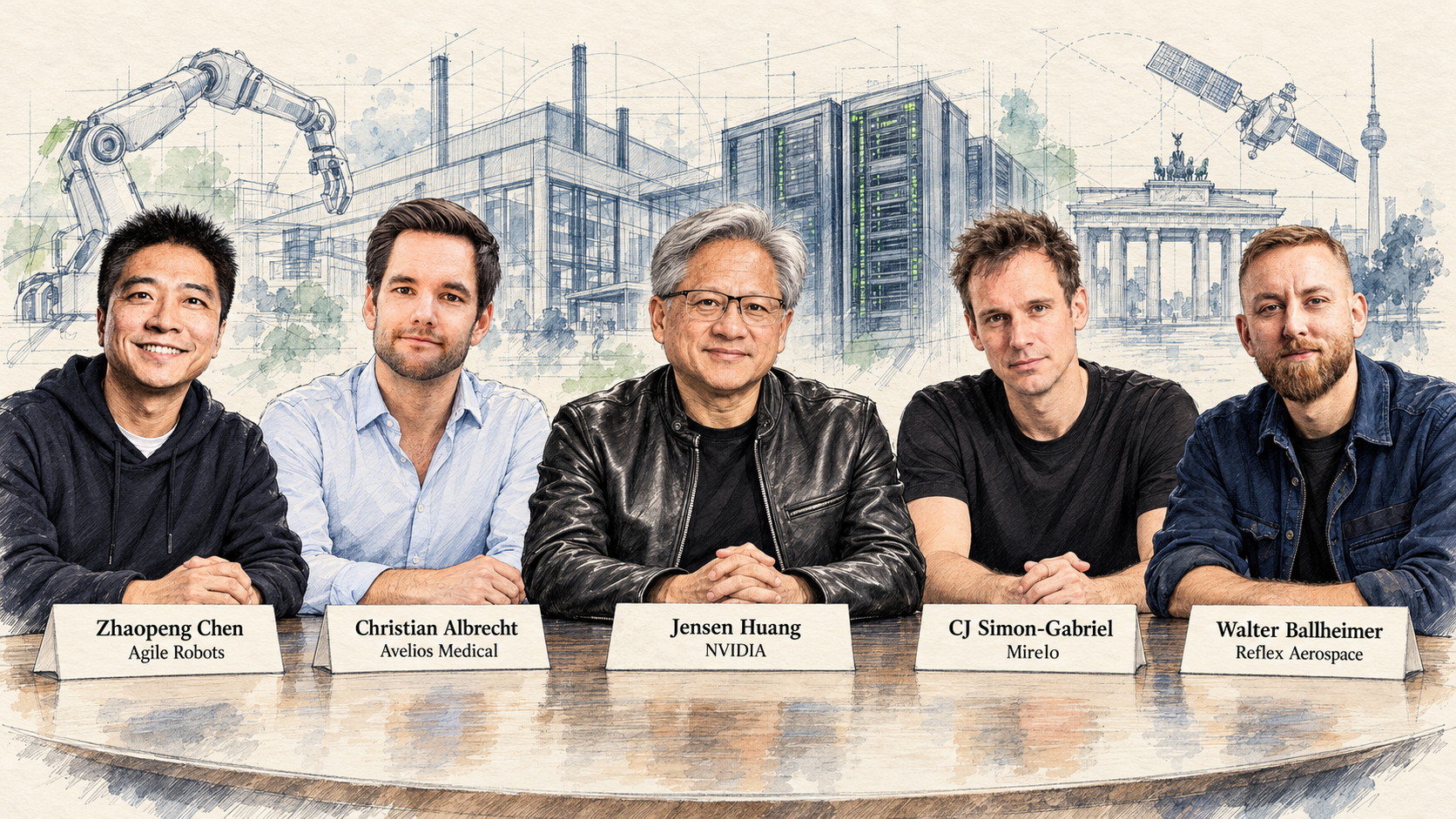
German startup investments sharpen the tension between industrial strength and technological dependence.
Nvidia’s planned investments in four German startups put a sharper question behind Europe’s industrial AI ambitions: who controls the foundations of future growth? Announced alongside a German government partnership on physical AI, the investments could strengthen European companies while deepening their reliance on an American supplier of computing infrastructure, development tools and models.
The strategic test extends beyond where companies are headquartered. It concerns their ability to develop, operate and change technology on their own terms.
🟦 Does a German headquarters guarantee European control?
A headquarters anchors employment, management and research. It does not establish control over the technology a company needs to compete.
Ownership of intellectual property, shareholder rights and freedom to change critical suppliers determine how much autonomy remains. A European business can retain its identity while its technical choices become increasingly constrained.
The announcements do not establish a transfer of control. Reflex Aerospace explicitly describes Nvidia’s proposed participation as a minority investment; financial terms remain undisclosed.
🟦 What connects robots, hospitals, audio and satellites?
The four investment targets span Agile Robots, Avelios Medical, Mirelo and Reflex Aerospace. Mirelo develops models that generate sound matched to video, extending the portfolio into audiovisual production alongside robotics, hospital systems and satellites.
The strategic reading is broader than physical AI: Nvidia is backing companies that embed AI into specialised workflows across different markets.
That creates a potential concentration of dependence. Separate European strengths could increasingly develop around the same supplier’s computing infrastructure and software ecosystem.
🟦 Can European capability grow alongside American dependence?
Yes. Reflex says the planned investment will support production expansion in Bavaria and further development of onboard processing capabilities. More European satellite manufacturing would add tangible industrial capacity.
Production, engineering and customer relationships can remain European while critical computing capabilities depend on external suppliers. Both developments can occur together.
Rejecting foreign investment carries costs too: slower expansion, weaker products and missed markets. The assessment must weigh the capabilities Europe gains against the dependencies it accepts—and the alternatives it can realistically build.
🟦 Do open models resolve the sovereignty problem?
Germany’s declaration supports specialised, open industrial models, including development based on Nvidia Nemotron and Cosmos. Its Industrie 4.0 platform remains open to other companies and international partners. The announcement does not establish exclusivity.
The harder question concerns the software beneath the model. CUDA provides Nvidia’s GPU programming environment and libraries; Omniverse combines open technologies such as OpenUSD with Nvidia-specific accelerated capabilities. Open data formats can support interoperability while execution still depends on particular hardware and software.
Where workflows rely heavily on those capabilities, migration may require code changes, renewed validation and performance tuning. Open models widen choice; practical portability must still be demonstrated.
🟦 What changes when investment meets industrial infrastructure?
Nvidia’s startup investments sit within established industrial relationships. Agile Robots announced in February that it would train its robotics foundation model on the Industrial AI Cloud built by Deutsche Telekom and Nvidia in Munich.
On 19 October, Siemens also presented factory AI applications in Erlangen using Nvidia Cosmos models and Omniverse simulation libraries. Nvidia’s reach therefore connects startup development, cloud infrastructure and established manufacturing systems.
Adding equity investment can strengthen these relationships further. It does not prove contractual lock-in. It makes independent supplier selection a governance test: can companies still choose competing technology when cost, performance or resilience justify it?
🟦 What should Berlin require beyond investment commitments?
Investment totals and deployment speed measure momentum. Sovereignty requires evidence of retained choice.
Can companies operate their models independently, move workloads at an acceptable cost and retain control over industrial data? Are competing suppliers practically accessible?
Where public support is involved, policymakers should require proportionate safeguards for interoperability, documented interfaces and data portability. Open interfaces alone are insufficient if migration remains technically or commercially prohibitive.
A successful partnership should leave European companies with stronger products, deeper expertise and credible alternatives as their operations grow.
Signal
Nvidia can accelerate Europe’s industrial AI ambitions while making itself harder to replace. The measure of sovereignty is the freedom European companies retain after they have scaled: to control their knowledge, negotiate their terms and choose a different technological path.
Credit
Altair Media / AI-generated illustration
Caption
An imagined editorial gathering of, from left, Zhaopeng Chen (Agile Robots), Christian Albrecht (Avelios Medical), Jensen Huang (Nvidia), CJ Simon-Gabriel (Mirelo) and Walter Ballheimer (Reflex Aerospace). The illustration explores the relationship between European industrial ambition and American AI infrastructure; it does not depict an actual meeting.
