Döhler and SVZ — Inside the Ingredient Machine
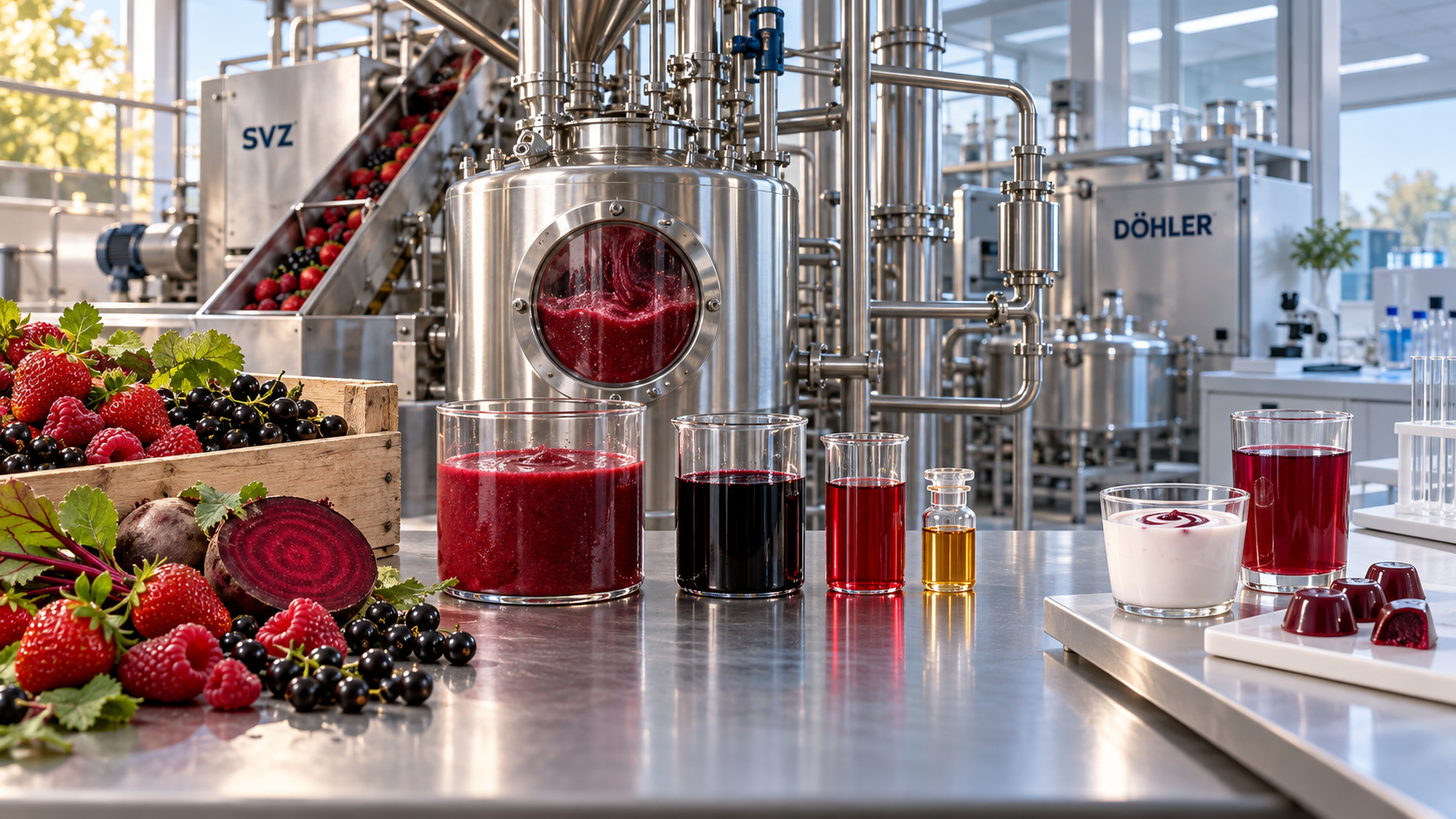
The concentrates, purées and natural systems behind modern food production
COMPANY FILE | The fruit shown on a yoghurt cup, beverage bottle or snack wrapper may no longer be visible inside the product. Behind its flavour, colour, sweetness and texture lies an industrial system that separates nature into functional components—and recombines them with precision.
A strawberry yoghurt may contain no recognisable piece of strawberry. A red drink may contain no visible berry. Yet both can offer a flavour and colour that remain almost identical across factories, seasons and markets.
The consumer experiences strawberry. The manufacturer sees concentrate, purée, colour, aroma, acidity, sweetness, mouthfeel and shelf life.
Modern food production does not always use fruit as a whole. It uses fruit as a system of functions.
Behind that consistency lies an ingredient machine that separates nature into functional components and recombines them with industrial precision. This is the system built by Döhler and strengthened through its acquisition of SVZ.
From Harvest to Specification
A strawberry is a fruit to the consumer. To an ingredient producer, it is also a combination of water, natural sugars, acids, colour, aroma, fibre and texture.
Those characteristics differ by variety, region, weather and harvest. A food manufacturer, however, cannot allow every harvest to produce a different yoghurt or drink. Colour, acidity and flavour must remain recognisable. Industrial processing translates that variation into specifications.
Removing water from juice makes fruit more efficient to store and transport. Blending origins or batches can create a consistent quality. Purée retains more body and mouthfeel, while specialised concentrates can perform in applications ranging from carbonated drinks to confectionery.
The transformation is physical. Fruit arriving from the field is pressed or puréed, water may be removed and the resulting ingredient is packed into aseptic containers, refrigerated or frozen. What entered the plant as a seasonal crop leaves as a standardised industrial input.
The ingredient is where agricultural variation becomes an industrial specification.
The original fruit is not simply preserved. Its individual properties become measurable, transportable and reproducible.
SVZ: The Agricultural Front End
SVZ occupies the first specialised layer of this system. The company built its position around fruit and vegetable purées, concentrates and ingredients, with particular strength in red berries and vegetables.
Its production footprint in the United States, Spain, Poland and Belgium connects growing regions to international manufacturers. Strawberries, raspberries, blackcurrants, carrots and beetroot each have their own harvest windows and exposure to weather.
Processing close to where crops are grown allows fragile produce to be stabilised soon after harvest. Perishable fruit becomes purée, juice or concentrate that can move through industrial supply chains and remain available beyond the local season.
SVZ stands where the harvest stops being produce and starts becoming infrastructure.
SVZ manages the point at which crops acquire an industrial identity. Colour, flavour and acidity are measured; qualities are separated or combined; agricultural variation becomes a product another factory can use.
Döhler: From Ingredients to Systems
Döhler operates further inside the formulation process. The German company supplies fruit and vegetable ingredients, natural colours, flavours, sweetening solutions, botanical extracts and functional components. These can be combined into integrated systems for a particular beverage, yoghurt, ice cream or confectionery product.
A customer may need more than raspberry flavour. It may need the right colour, stable sensory properties and sufficient mouthfeel after reducing sugar. The solution must also survive production and work inside the chosen packaging.
Döhler does not merely supply what enters the recipe. It helps determine what the finished product becomes.
This moves Döhler closer to the customer’s development function. It helps translate a desired consumer experience into an industrially reproducible formulation.
Connecting the Field to the Laboratory
Döhler acquired SVZ in 2023. The transaction brought SVZ’s processing sites, sourcing relationships and expertise in red fruits and vegetables into Döhler’s broader international ingredient platform.
The combination illustrates a deeper form of vertical integration. SVZ strengthens access to specialised crops and primary processing. Döhler adds application technology, sensory expertise and the ability to combine ingredients into market-ready systems. The field is thereby connected more tightly to the formulation laboratory.
The acquisition connected agricultural depth with formulation breadth.
The value lies in controlling more of the translation between agriculture and the consumer product through shared knowledge, standards and technical capabilities. A broader raw-material base also provides alternative origins, qualities and combinations.
The Clean-Label Paradox
Consumers increasingly want shorter ingredient lists, natural colours and fewer artificial additives. This appears to be a movement away from industrial complexity. In practice, it can require more knowledge behind the label.
A colour derived from black carrot, beetroot or berries must remain attractive under exposure to light, oxygen, heat and changing acidity. Reducing sugar affects more than sweetness: it can alter texture, body and the balance of flavour. Replacing a familiar additive may therefore require several natural components to reproduce the function it once performed.
Clean labels do not eliminate formulation. They move more of its complexity behind the label.
Döhler sells natural ingredients, but also the knowledge needed to make nature perform industrial functions. The simpler the declaration becomes, the more carefully those interactions may need to be designed.
The Hidden Development Department
The brand on the package owns the visible relationship with the consumer. But some of the knowledge that makes the product possible may sit with the ingredient supplier.
Döhler contributes sensory data, application testing, stability knowledge and alternatives when a raw material becomes expensive or scarce. It can also help translate emerging consumer preferences into products that can be manufactured at scale.
The food brand brings distribution and consumer recognition. The ingredient company brings specialised technologies and an understanding of how the desired experience can be reproduced across factories, seasons and markets.
Precision also creates a less visible trade-off. Standardisation protects quality and recognisability, but it can narrow the sensory variation associated with different harvests, regions and varieties. The flavour expected by the market may gradually become more important than the fruit’s original diversity.
This does not make industrial ingredients inherently inferior or ultra-processed. That depends on the complete formulation and production process. It does show that consistency is never neutral: it reflects choices about which qualities should be preserved and which variations may disappear. Its influence is substantial precisely because it remains mostly invisible.
The brand owns the shelf. The ingredient company may own part of the knowledge that makes the product possible.
The consumer tastes strawberry. The manufacturer sees acidity, colour, sweetness, aroma, viscosity and shelf stability. Döhler and SVZ operate between those two realities.
Across this series, AGRANA showed how harvests become predictable. Zentis revealed how visible fruit is engineered to perform. Hero organised ingredients into brands, while MOM transformed consumption through packaging. Döhler and SVZ expose another layer: the machinery that converts nature into functional, transportable and reproducible components.
The fruit has not disappeared. It has been separated into properties, translated into specifications and reconstructed inside products whose consistency appears effortless.
The ingredient machine does not remove nature from food. It disassembles nature so that industry can use it again.
EUROPE’S HIDDEN FRUIT INDUSTRY
This article opens an Altair Media series examining the companies, technologies and supply chains behind Europe’s everyday fruit products. The articles that follow will explore the largely invisible businesses that transform seasonal harvests into industrial ingredients, consumer brands and year-round availability. Together, they reveal how the orchard became part of a sophisticated European food system.
Image credit
AI-generated image created for Altair Media. Döhler and SVZ corporate wordmarks are reproduced for editorial identification.
Caption
Fresh berries and vegetables enter SVZ’s agricultural processing layer before being separated into purées, concentrates, colours and aromatic components. Döhler combines these functional ingredients into reproducible systems for beverages, yoghurt and confectionery.
