Google Cloud — The Intelligence Infrastructure
From Search Engine to Compute Platform
Strategic Briefing
For decades, Google organised information. Increasingly, it appears to be organising intelligence itself. Search transformed access to knowledge. Advertising transformed digital markets. Artificial intelligence may now be transforming the cloud.
Google Cloud occupies a distinctive position within the cloud landscape. It does not dominate enterprise software in the way Microsoft does. Nor does it possess the broad infrastructure footprint of AWS. Its strategic advantage increasingly resides elsewhere. Intelligence.
The question is no longer whether Google is a search company. It may be whether Google has become an artificial intelligence company that also happens to sell cloud services.
Engineering Intelligence
Google’s influence on contemporary computing extends well beyond cloud market share. Many foundational technologies shaping the AI era originated within Google itself.
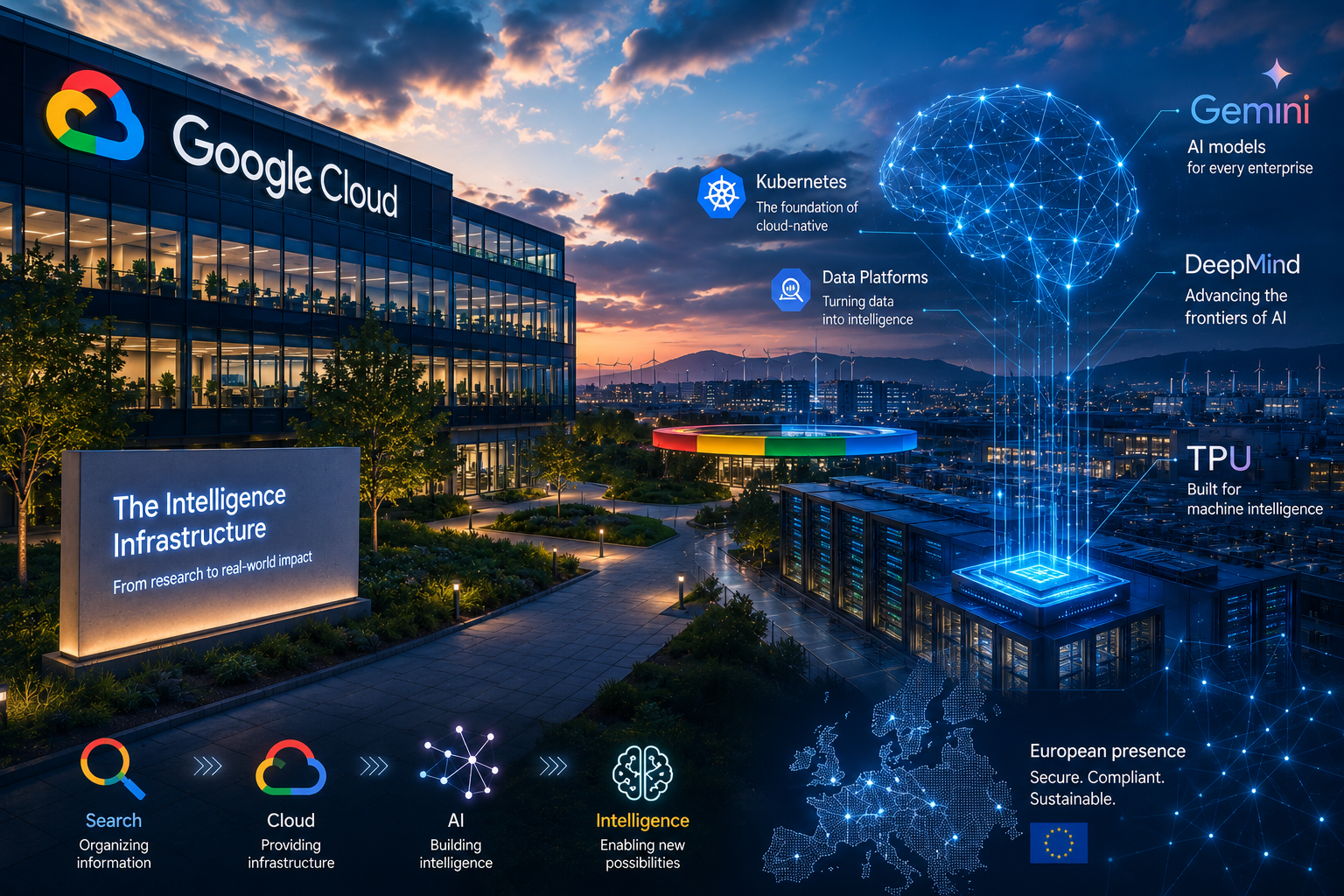
Kubernetes transformed cloud-native architecture and became an industry standard for container orchestration. Tensor Processing Units introduced specialised hardware designed specifically for machine learning workloads. DeepMind helped redefine the frontiers of artificial intelligence research.
Gemini increasingly represents Google’s effort to integrate advanced reasoning capabilities directly into cloud environments. For developers, researchers and data-intensive organisations, Google Cloud increasingly offers access not merely to infrastructure. But to intelligence infrastructure.
The Research Layer
Few cloud providers possess research capabilities comparable to Google. DeepMind remains one of the world’s leading AI laboratories. Google Research continues to shape developments in machine learning, scientific discovery, language models and data analysis.
This creates a distinct proposition. Where AWS represents scale and Microsoft organisational integration, Google increasingly positions itself at the intersection of research, computation and cognition.
Cloud therefore becomes more than compute. It becomes an environment for experimentation, optimisation and discovery.
The Developer Ecosystem
Google’s influence extends far beyond its direct customer base. Open-source technologies, machine-learning frameworks and cloud-native architectures increasingly reflect Google’s engineering culture.
Kubernetes is perhaps the clearest example. Originally developed within Google, it evolved into a universal language for modern applications.
Many organisations may never become Google Cloud customers. Yet they increasingly operate within ecosystems shaped by Google’s intellectual infrastructure.
Influence therefore extends beyond market share. It increasingly resides in standards, frameworks and technical paradigms.
The Capacity Constraint
Artificial intelligence is changing the economics of cloud infrastructure. Demand for compute capacity is expanding faster than providers can build new datacentres, deploy accelerators or secure sufficient energy supplies.
Google illustrates this transition. Its rapid growth in cloud services and AI offerings suggests that intelligence itself is becoming a scarce resource.
Cloud providers increasingly compete not merely through software capabilities, but through access to megawatts, semiconductors and compute clusters.
The era of abundant compute may be ending. Intelligence is becoming physical infrastructure.
Cognitive Infrastructure
Google Cloud increasingly represents something distinct. AWS established cloud as a global utility. Microsoft embedded cloud within organisational life.
Google appears to be constructing a new layer altogether. A platform for cognition. Not simply storage. Not merely compute. But an environment through which organisations access models, reasoning capabilities and new forms of knowledge production.
Google may therefore represent an emerging category of infrastructure. Infrastructure designed not primarily to move information. But to generate intelligence.
Sovereignty Assessment
Global Scale Competitiveness ★★★★★
AI Capability ★★★★★
Research Leadership ★★★★★
Developer Ecosystem ★★★★★
European Datacentre Footprint ★★★★☆
European Jurisdiction ★★☆☆☆
Strategic Autonomy Alignment ★★☆☆☆
Series Note
Building Europe’s Cloud Architecture explores the infrastructures, organisations and governance models shaping Europe’s computing future.
Phase II — The Hyperscalers examines the companies that established the cloud paradigm itself, including AWS, Microsoft Azure, Google Cloud and Oracle Cloud, and asks how Europe positions itself within an increasingly strategic computing landscape.
Credit
Artwork: Altair Media / AI-generated visualisation inspired by Google Cloud’s artificial intelligence ecosystem and emerging intelligence infrastructure.
Caption
A contemporary interpretation of Google Cloud as intelligence infrastructure, where research laboratories, machine learning, specialised compute, developer ecosystems and cloud platforms converge into a new layer of cognitive capacity for the AI era.
