Europe Finally Has the Capital. But Are Its Scaleups Still European?
The Scaleup Europe Fund is exposing a structural weakness in Europe’s innovation economy
Europe is mobilising billions of euros to help its most promising technology companies compete globally, only to discover that some of its potential investment targets have already established corporate structures in the United States. The challenge is no longer simply financing European innovation, but ensuring that its economic benefits remain anchored in Europe.
The fund’s early experiences raise five fundamental questions about the relationship between capital, entrepreneurship and European prosperity.
🟦 Is European capital arriving too late?
Managed by Swedish investment group EQT, the Scaleup Europe Fund had secured more than €3 billion in capital commitments by mid-October, against a target of €5 billion.
By late October, the fund had announced eight investments, spanning artificial intelligence, satellite technology, semiconductors, healthcare and enterprise software.
Yet reporting by Brussels-based Rapporteur on 27 November, citing an internal European Commission document, suggests that more potential investment candidates than anticipated have established holding companies in the United States.
Europe is encountering the consequences of its own historical financing gap.
🟦 What makes a technology company European?
Research by the European Investment Bank found that 82% of EU scaleup financing deals involved a foreign lead or sole investor, compared with just 14% in San Francisco.
The European Commission’s impact assessment accompanying the EU Inc. proposal further indicates that around one in four European high-growth companies with more than €10 million in cumulative funding had established a parent or holding company outside the EU.
For entrepreneurs, establishing a US holding company can be a rational decision, facilitating access to capital and international markets.
Swedish-founded AI company Lovable, itself backed by the Scaleup Europe Fund and reportedly incorporated in the United States, illustrates the growing distinction between entrepreneurial origins, operational activities and legal incorporation.
🟦 Can commercial returns and strategic autonomy coexist?
The Scaleup Europe Fund brings together European public institutions, pension funds, insurers and international investors, including Singapore’s Temasek.
EQT makes investment decisions independently on commercial grounds within the fund’s mandate. Its investment guidelines permit limited investment in companies incorporated outside its principal geographical area.
This creates a delicate balance between financial performance and European industrial ambitions.
An excellent investment for the fund may not necessarily deliver the greatest strategic benefit for Europe.
🟦 Who ultimately benefits from European innovation?
The founders of Finnish satellite company ICEYE met during an Erasmus exchange and received their initial funding through Horizon 2020. In August 2026, ICEYE became the Scaleup Europe Fund’s first investment.
Its journey illustrates how European education, research funding, entrepreneurship and growth capital can reinforce one another.
When companies relocate key corporate functions abroad, however, Europe risks losing part of that cumulative economic benefit.
Tax revenues, highly skilled employment and the reinvestment of entrepreneurial wealth into new startups can all contribute to the prosperity of future generations.
The challenge extends well beyond the financial returns of individual investments.
🟦 Can Europe change the incentives rather than the rules?
The proposed EU Inc. corporate framework, part of the EU Startup and Scaleup Strategy, represents an attempt to make Europe more attractive to entrepreneurs and international investors.
But legal simplification alone will not close the gap. Deeper capital markets, institutional investment, credible exit opportunities and stronger entrepreneurial ecosystems remain essential.
Europe should not merely make it harder for companies to leave. It should make it more attractive for them to stay.
The ultimate measure of the Scaleup Europe Fund will not simply be how much capital it raises or how many companies it finances, but how much lasting economic value it helps Europe create and retain.
Caption
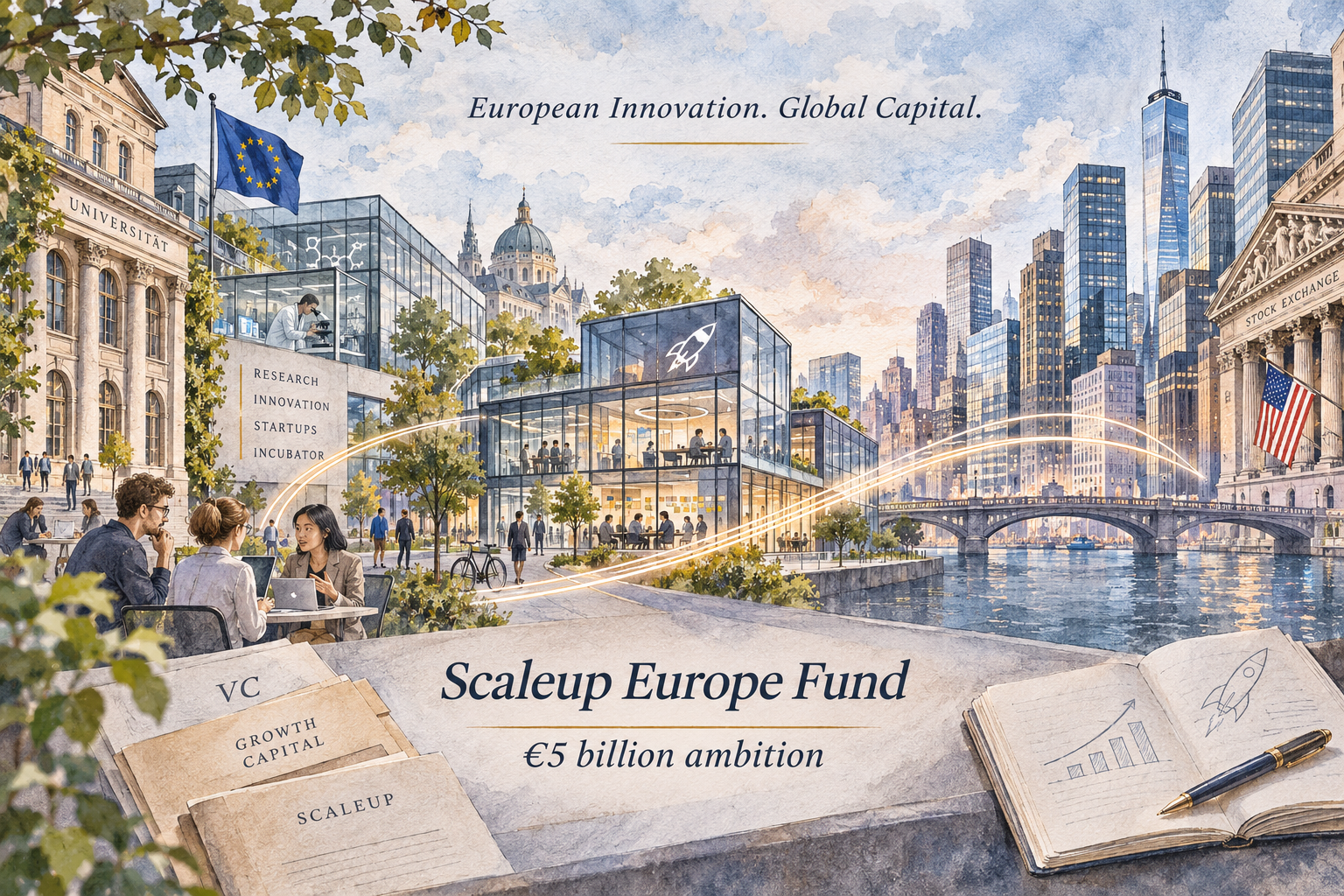
European Innovation. Global Capital. The €5 billion ambition of the Scaleup Europe Fund highlights the complex relationship between European research, entrepreneurship, international capital and long-term economic prosperity.
Image credit
Altair Media | AI-generated editorial watercolour illustration.
