Europe Can Build AI Chip Companies. Can It Finance Their Entire Journey?
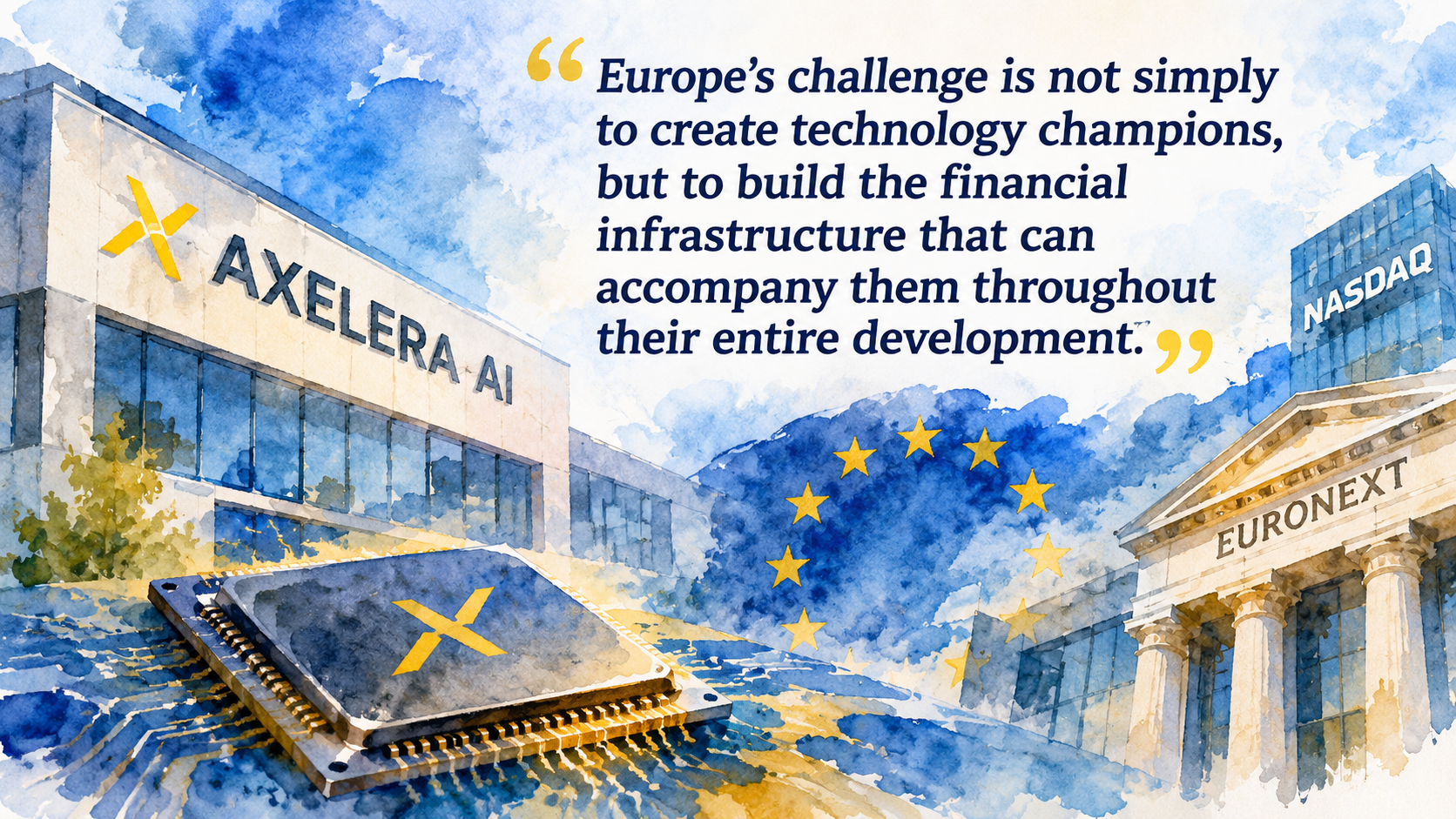
Axelera AI and the limits of Europe’s financial infrastructure.
Dutch AI chipmaker Axelera AI is in talks to raise another $400 million alongside substantial European public funding, Bloomberg reported today. Just nine months after securing more than $250 million, the Eindhoven-based company is exposing a structural question: can Europe finance its strategic technology companies from early innovation to industrial scale and public markets?
Axelera’s development brings together European industrial policy, venture capital, institutional investment and international capital markets. Its trajectory raises five questions that extend well beyond the semiconductor industry.
🟦 Can public funding create commercially independent technology companies?
Axelera has already secured up to €61.6 million through EuroHPC for the development of its Titania architecture. The company is now reportedly seeking further public funding through the Important Projects of Common European Interest (IPCEI) framework.
Such instruments can absorb technological risks that private investors may be reluctant to accept. Commercial independence, however, ultimately depends on sustainable revenues and the ability to attract capital on market terms.
The tension: public capital can accelerate technological sovereignty, but it cannot guarantee commercial viability.
🟦 Can Europe’s venture capital market finance industrial scale?
Axelera’s February funding round was led by Dutch investor Innovation Industries, with participation from the European Innovation Council Fund, Invest-NL and Belgium’s SFPIM, alongside international investors including BlackRock and Samsung Catalyst Fund.
This combination demonstrates Europe’s ability to mobilise public and private capital. Yet the transition from edge computing towards data centres and supercomputers introduces substantially greater financing requirements, from chip manufacturing to software development and commercial deployment.
The tension: Europe can finance technological breakthroughs, but industrial scale demands capital on an entirely different level.
🟦 Can technological progress translate into commercial power?
Axelera reported more than 600 customers in September. Its expanding product portfolio, from Metis and Europa to Titania, positions the company across increasingly demanding AI inference markets.
Customer numbers, however, do not necessarily translate into recurring revenues, substantial order volumes or sustainable margins. Competing with Nvidia requires not only competitive hardware but also reliable supply, mature software and the ability to persuade customers to adopt an alternative technological ecosystem.
The tension: technological competitiveness does not automatically create market power.
🟦 Who captures the value created by European public investment?
European public funding helps reduce the risks associated with developing strategic technologies. As commercial opportunities mature, international capital can accelerate their industrial deployment.
For Europe, the return on these investments extends beyond financial performance. It includes intellectual property, skilled employment, industrial capabilities and access to critical technologies. Public equity investments may also generate direct financial returns.
The central question is not the nationality of investors, but where economic value, strategic capabilities and decision-making power ultimately accumulate.
The tension: the geographical distribution of technological risk does not necessarily mirror the distribution of economic returns.
🟦 Can European stock exchanges compete for their own technology champions?
In October, Axelera CEO Fabrizio Del Maffeo indicated that a North American IPO could be achievable within three to five years.
Euronext Amsterdam remains a conceivable alternative. ASML demonstrates that a European primary listing can coexist with a Nasdaq presence. North American markets, however, offer deeper pools of specialist capital, established semiconductor peers and extensive technology analyst coverage.
A North American listing would not necessarily mean the departure of Axelera’s European operations. It would, nevertheless, raise questions about the international competitiveness of Europe’s public capital markets.
The tension: Europe may succeed in building its next semiconductor champion while another capital market becomes the preferred platform for its future growth.
The Signal
Axelera’s financing ambitions expose the interdependence of European industrial policy and capital market development. Supporting strategic technologies without developing equally competitive growth and public equity markets risks leaving that financial architecture incomplete.
Europe’s challenge is not simply to create technology champions, but to ensure that its financial infrastructure can accompany them throughout their entire development.
Image credit
Altair Media | AI-generated editorial watercolour illustration.
Caption
From publicly funded innovation to industrial scale and international stock markets, Axelera AI’s development raises a fundamental question about Europe’s ability to finance its own strategic technology companies.
