Europe Is Raising Billions. But Who Gets to Grow?
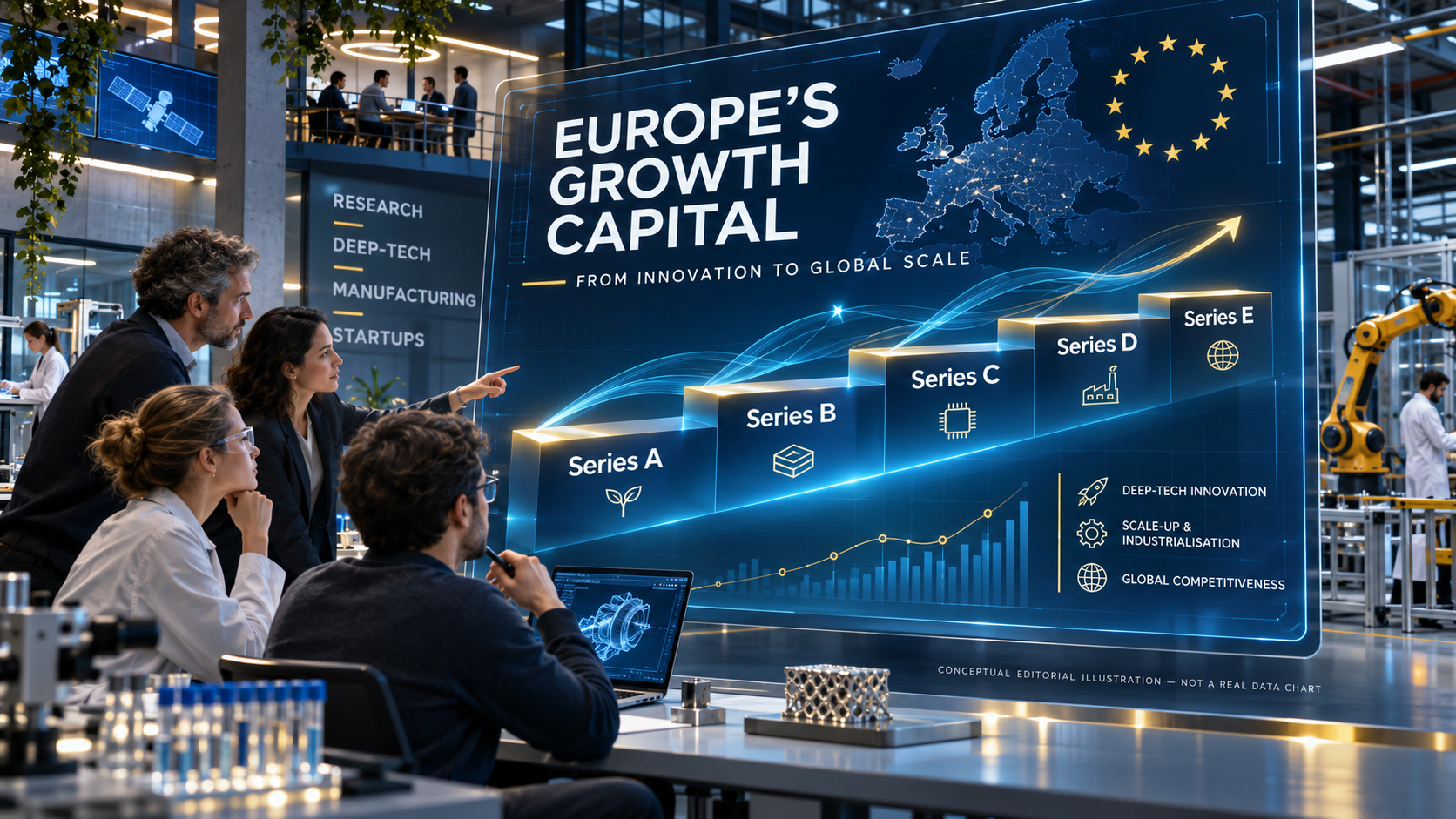
From Series A to late-stage financing, Europe’s venture capital boom raises a fundamental question: can the continent turn more of its startups into global companies?
Europe’s technology investment market appears to be entering a new period of expansion. According to Atomico’s State of European Tech 2026, investment in European technology companies is expected to reach $81 billion this year, compared with approximately $50 billion in 2025. An estimated 40,000 people have founded new technology companies across Europe, while some of the continent’s most promising businesses are attracting financing rounds worth hundreds of millions or even billions of dollars. Yet behind these impressive figures lies a less encouraging development.
Early-stage investment activity has weakened, the number of smaller financing rounds has declined and many companies face increasingly difficult transitions between successive stages of growth.
Europe appears capable of financing some of the world’s most ambitious technology companies. But that does not necessarily mean its broader financing system can support enough businesses throughout their development.
Europe’s challenge is no longer simply to create more startups. It is to finance enough of them to become global companies.
The distinction matters because creating a successful startup is only the beginning of a much longer financial journey.
A company must repeatedly secure capital, demonstrate commercial progress, expand its operations and convince investors that the next phase of growth justifies additional financial commitments.
Each stage brings new opportunities, but also new pressures on valuations, ownership and strategic independence.
Five questions reveal how Europe’s venture capital system works — and where its most consequential weaknesses may lie.
🟦 1. What does it take to move from Series A to Series E?
The financing of a technology company usually begins long before it becomes profitable or reaches public markets.
Founders may initially rely on their own resources, research grants, business angels or early-stage investment funds. These initial investments support the development of prototypes, products and the first commercial activities.
As the business develops, subsequent financing rounds are commonly identified as Series A, B, C, D and E.
The letters are not formal legal categories. They provide a convenient way to describe successive investment rounds, each typically associated with increasing business maturity and larger financing requirements.
A Series A investment often helps a company demonstrate that its business model can support sustainable growth. Investors want evidence that customers value the product and that the company can expand beyond its initial market.
Series B financing is generally associated with scaling operations, strengthening management structures and entering new markets.
By Series C, companies may be seeking substantial capital for international expansion, industrial investment, acquisitions or the development of additional products.
Later Series D and E rounds can support further expansion, finance particularly capital-intensive business models or allow companies to remain privately held while postponing an IPO.
Not every company follows this sequence. Some achieve profitability without additional rounds, while others raise financing under different structures.
The fundamental mechanism, however, remains similar: investors provide capital in exchange for an ownership interest or another form of financial claim.
Consider a company valued at €80 million before a new investment. If an investor contributes €20 million in exchange for newly issued ordinary shares at that valuation, the company has a post-money valuation of €100 million and the investor receives a 20% ownership stake.
The company now has additional resources to finance growth, while existing shareholders have been diluted.
But a €100 million valuation does not mean the company has €100 million in cash, nor does it guarantee that the business could be sold for that amount.
Private valuations reflect negotiated transactions and can depend on investor protections, share classes and contractual rights. A future financing round may establish a substantially different valuation.
Understanding this distinction is essential because the ability to raise money at one stage does not guarantee access to financing at the next.
🟦 2. Is Europe’s venture capital boom reaching enough companies?
The European investment recovery is impressive, but much of the increase is concentrated in exceptionally large transactions.
According to Atomico, thirteen financing rounds worth at least $1 billion took place during the first nine months of 2026, raising approximately $22 billion.
These transactions illustrate Europe’s growing ability to develop companies capable of attracting international investors at substantial scale.
AI infrastructure, robotics, defence technology and other capital-intensive sectors have emerged as particularly important destinations for investment.
Yet the growth of these large transactions creates a statistical problem.
A small number of extraordinary investments can substantially increase the total amount of capital raised without producing a comparable improvement in financing conditions for the wider startup ecosystem.
Atomico’s research points to a decline of almost 30% in first-money-in financing rounds before Series A between 2021 and 2025. Its latest findings also highlight reduced activity in Series A and B deals.
This does not necessarily mean that Europe has become less innovative.
The continent continues to generate new founders, research-based technologies and entrepreneurial activity. However, an expanding population of startups does not automatically translate into a corresponding increase in companies successfully obtaining growth capital.
The distinction between total investment and the distribution of investment is therefore essential.
A healthy venture capital ecosystem requires both the capacity to finance exceptional companies with enormous capital requirements and a sufficiently broad market that allows emerging businesses to demonstrate their potential.
If capital becomes increasingly concentrated, the overall investment figures may improve while the financing opportunities available to many companies become more limited.
The central question is not simply how much venture capital Europe attracts, but how widely the opportunities to obtain that capital are distributed.
🟦 3. Where does Europe’s financing ladder become most difficult to climb?
The transition from one financing round to the next is rarely automatic.
A company that raises Series A financing may have demonstrated early commercial demand, but investors considering Series B will often expect stronger revenues, more predictable performance and convincing evidence that additional investment can generate substantial growth.
The requirements generally become more demanding as financing rounds increase in size.
This creates a challenge for companies operating in capital-intensive industries.
A software business may be able to expand by hiring developers and sales teams, while a semiconductor company, robotics manufacturer or advanced materials business may require expensive equipment, specialised facilities and lengthy industrial qualification processes.
Their capital requirements can be substantial long before revenues become predictable.
Europe’s financing environment does not always accommodate these different development trajectories equally well.
Atomico reports that the median time required for European startups to progress from Series A to Series B has reached 29 months, compared with approximately 20 months in the United States.
The difference does not prove that European companies are inherently less successful. Business models, market conditions, sector composition and investor expectations can all influence financing timelines.
Nevertheless, longer periods between funding rounds increase the importance of cash management and access to follow-on capital.
Companies may need to reduce expenditure, slow expansion or seek alternative financing while waiting for another investment round.
Some will become more financially disciplined and ultimately stronger. Others may lose valuable opportunities, particularly in markets where technological leadership depends on speed and industrial scale.
The financing ladder therefore acts as more than a mechanism for distributing capital. It influences which technologies reach commercial maturity, which companies remain competitive and which innovations can be transformed into significant industrial businesses.
🟦 4. Who finances European companies when investment rounds reach hundreds of millions?
As companies mature, their financing requirements increasingly exceed the capacity of traditional early-stage venture capital funds.
This is where Europe’s structural disadvantage becomes particularly visible.
In its 2026 analysis of venture capital financing, the European Central Bank estimates that venture capital funds located in the European Union collectively account for approximately €150 billion in fund size, compared with around €930 billion in the United States.
The difference reflects more than the number of investment firms.
American venture capital markets benefit from larger institutional investors, deeper financial ecosystems and substantial participation from pension funds, endowments and other long-term capital providers.
Europe possesses considerable financial wealth, but its institutional capital is less extensively connected to venture capital and scale-up financing.
Public institutions, including the European Investment Fund, consequently play an important role in supporting European investment funds and encouraging private participation.
Their involvement can address market gaps, but it does not fully replace the financial capacity of a large and diversified private investment ecosystem.
As financing requirements increase, European companies therefore often turn to American venture capital funds, international growth investors or sovereign wealth funds.
Such investment can be enormously valuable.
Foreign investors provide not only capital, but also experience, international networks and access to new markets. Their participation may allow European companies to expand more rapidly than would otherwise be possible.
However, dependence on foreign capital can also influence long-term corporate decisions.
Investors may encourage businesses to establish operations in other markets, recruit internationally, pursue overseas acquisitions or eventually list on foreign stock exchanges.
These outcomes are not inevitable, nor are they necessarily detrimental to the company itself.
But they raise an important question for Europe.
If European institutions support the early development of promising technologies, while international investors provide much of the capital required for subsequent expansion, where will the resulting economic value ultimately accumulate?
The challenge is not to exclude foreign investment. It is to ensure that European investors can participate meaningfully throughout the entire financing cycle.
🟦 5. Can Europe build a complete financing system, from startup to IPO?
Europe’s growth-capital problem cannot be separated from the structure of its public markets.
Venture capital funds invest with the expectation that successful businesses will eventually generate financial returns. These returns may arise through acquisitions, secondary share sales or public listings.
The availability of credible exit opportunities therefore influences investment decisions long before a company reaches maturity.
If investors believe successful European startups will struggle to obtain attractive public valuations or find suitable buyers, they may become less willing to provide growth capital in the earlier stages.
This creates a connection between two problems that are often discussed separately: the shortage of late-stage investment and the difficulty of bringing European growth companies to public markets.
A weak exit environment can discourage investment, while insufficient scale-up financing reduces the number of companies capable of reaching the stage at which an IPO becomes realistic.
The relationship can become self-reinforcing.
The European Commission’s Savings and Investments Union aims to improve the connection between European savings and productive investment. A more integrated capital market could help companies access financing across national borders and attract a broader range of institutional investors.
The Scaleup Europe Fund represents another attempt to strengthen this financing architecture.
With a target size of approximately €5 billion, including a €1 billion commitment from the European Commission, the initiative is designed to support larger investments in strategically important European technology businesses.
Its ambition is not simply to provide public funding, but to mobilise additional private capital and strengthen the market for large financing rounds.
However, improving one part of the financing system will not automatically resolve constraints elsewhere.
More seed financing is of limited benefit if companies cannot subsequently raise Series B capital. Larger growth funds cannot compensate entirely for weak exit markets, while successful IPOs do not automatically ensure that companies receive new capital for expansion.
Europe needs continuity across the entire financing cycle.
That means connecting early-stage investment, institutional capital, growth financing and public equity markets into an environment where promising companies can access appropriate financing as their needs evolve.
It also requires an understanding of how capital flows, how risk is distributed and which investors ultimately benefit from successful innovation.
The question is no longer simply whether Europe can produce world-class technology companies. It is whether its financial system can support enough of those companies from their earliest stages through international expansion and eventual public ownership.
The missing infrastructure of European growth
Europe has developed an increasingly sophisticated innovation ecosystem. Its universities, research institutes, technology entrepreneurs and industrial companies continue to generate important technological capabilities. Recent large financing rounds demonstrate that European businesses can attract substantial international investment.
But successful innovation and sustained economic growth depend on more than scientific discovery or entrepreneurial ambition. They require a financing infrastructure capable of supporting companies throughout their development.
The current European venture capital market provides important elements of that infrastructure, but the system remains uneven. Investment is increasingly concentrated, large growth rounds depend heavily on international capital and public market opportunities remain fragmented. The consequences extend beyond individual companies.
When promising businesses cannot obtain sufficient financing, their technological development may slow, their international expansion may be constrained or their ownership and activities may gradually shift elsewhere.
The challenge is not to guarantee financing for every company. Venture capital necessarily involves selection, risk and failure. It is to ensure that capable businesses are not prevented from growing simply because the financial system cannot accommodate their next stage of development.
Europe’s challenge is no longer simply to create more startups. It is to build the financial infrastructure that allows more of them to become global companies.
Sources & References
1. Atomico — State of European Tech 2026 (November 2026)
Annual research on Europe’s technology ecosystem, including venture capital investment, funding concentration, startup formation, financing rounds and the progression of companies from early-stage to growth financing.
https://www.stateofeuropeantech.com
2. European Central Bank — Exploring the Investor Landscape for Venture Capital (2026)
Analysis published in Financial Integration and Structure in the Euro Area 2026, examining European venture capital fund sizes, institutional investors, public-sector participation and structural differences between EU and US venture capital markets.
https://www.ecb.europa.eu/press/fie/box/html/ecb.fiebox202605_04.en.html
3. European Commission — Scaleup Europe Fund (2026)
Official information on the European initiative to strengthen late-stage financing, including its targeted fund size, investor structure, strategic objectives and management arrangements.
https://eic.ec.europa.eu/eic-fund/scaleup-europe-fund_en
Editorial note: This article combines published research, institutional data and independent analysis by Altair Media. Investment figures for the full year 2026 include projections. European technology market data and EU institutional statistics refer to different geographical scopes and should not be interpreted as directly interchangeable.
Image credit
Illustration: Altair Media / AI-generated visual.
Image caption
From Series A to Series E, European technology companies navigate successive financing rounds to turn innovation into industrial scale. The challenge is not simply attracting more investment, but ensuring sufficient growth capital is available throughout their development.
