Europe’s IPO Pipeline Is Growing. But Who Will Make the Leap?
From defence and software to fintech, Europe’s next generation of listed companies faces a difficult choice between timing, valuation and access to capital
Europe continues to produce companies capable of competing internationally. From defence manufacturing and enterprise software to digital banking and healthcare, several major businesses have reached the scale at which a public listing would appear a natural next step.
Yet Europe’s ability to build successful companies does not necessarily translate into an equally strong capacity to finance their future growth through public markets.
Some of the continent’s most prominent businesses have postponed their initial public offerings, while others are considering American stock exchanges or extending their reliance on private capital. Even when companies successfully list, much of the money raised may flow to existing shareholders rather than finance new investment.
The Franco-German defence manufacturer KNDS illustrates the dilemma. Despite a €33.1 billion order backlog at the end of 2025 and growing European demand for military equipment, the company postponed its planned stock market debut in July 2026. Its management continues to favour a listing, but only when market conditions allow.
“Europe’s challenge is not simply to turn private success into public listings. It is to turn public capital into future growth.”
– Altair Media Europe
KNDS is not alone. Norwegian software group Visma has also delayed its IPO ambitions, while British fintech giant Revolut continues to evaluate whether London or New York would provide the better environment for a future listing.
These developments come against an apparently encouraging backdrop. According to PwC’s latest IPO market analysis, European IPO proceeds increased by more than 25% during the first nine months of 2026 compared with the same period last year.
The recovery is real, but uneven. While some companies have successfully entered public markets, several of Europe’s most anticipated listings remain unresolved.
This raises a broader question about the continent’s financial architecture. Can European capital markets provide both attractive opportunities for existing investors to realise their returns and sufficient new capital for the next phase of industrial and technological growth?
Five questions reveal what is at stake as Europe’s IPO market approaches 2027.
🟦 1. Is Europe’s IPO market really recovering?
The recovery in European initial public offerings has been significant, but it has not been uniform.
The first nine months of 2026 brought renewed issuance across several European exchanges. Improved investor confidence and demand for selected industries helped reopen opportunities that had remained limited during previous years.
One of the most prominent successes came in January, when Czech defence group Czechoslovak Group (CSG) completed a €3.8 billion IPO on Euronext Amsterdam, including the over-allotment option.
The transaction demonstrated that European capital markets can accommodate large international offerings when investor demand, sector prospects and valuations align. It also reinforced Amsterdam’s position as an important European listing venue for companies operating beyond the Netherlands.
However, the broader picture remains considerably more selective.
According to S&P Global Market Intelligence, the third quarter saw more European companies enter public markets than a year earlier, but the aggregate value of their listings declined. Many transactions were relatively small, indicating that increased IPO activity does not necessarily translate into a sustained reopening of the market for Europe’s largest companies.
This distinction matters because the success of capital markets cannot be measured solely by the number of new listings.
Large IPOs can attract international institutional investors, establish valuation benchmarks for privately held businesses and create opportunities for shareholders to recycle capital into new investments. They may also encourage companies to consider remaining independent rather than seeking an industrial buyer.
But their contribution to economic growth depends partly on how much new capital companies actually receive and whether public markets remain accessible after the initial offering.
Europe’s challenge is therefore not simply to increase IPO activity. It is to develop capital markets capable of supporting ambitious businesses throughout their development, from private investment to public ownership and subsequent expansion.
🟦 2. Why are major companies still postponing their listings?
Two of Europe’s most anticipated IPO candidates illustrate how fundamentally different industries can encounter the same financial obstacle.
KNDS operates in a sector benefiting from powerful structural demand. European governments are increasing defence expenditure, rebuilding military capabilities and seeking greater industrial autonomy.
The company’s planned dual listing in Paris and Frankfurt would have provided public investors with access to one of Europe’s most strategically important defence manufacturers.
Yet even this combination of strong demand, political support and a substantial order backlog was insufficient to guarantee a successful flotation.
KNDS postponed its July IPO amid volatile market conditions and uncertainty surrounding defence-sector valuations. In October, chief executive Jean-Paul Alary reiterated his preference for proceeding as soon as conditions permit, ideally before the French presidential elections beginning in April 2027.
The difficulty was not primarily a shortage of industrial opportunities. It was whether public investors and existing shareholders could agree on an acceptable valuation.
Visma represents almost the opposite end of Europe’s corporate landscape.
Where KNDS manufactures physical equipment for governments and defence organisations, the Norwegian software group provides accounting, payroll and business management systems through recurring subscription-based services.
Backed by private equity investor Hg, Visma has developed into one of Europe’s largest enterprise software companies. Its business model historically offered precisely the characteristics investors valued highly: predictable revenues, strong customer retention and opportunities for international expansion.
However, the emergence of increasingly capable artificial intelligence systems has introduced new uncertainty about the long-term economics of established software businesses.
Investors are questioning whether AI could automate functions currently performed by subscription software, intensify competition or weaken the pricing power of incumbent providers.
Visma’s prospective London IPO has consequently shifted towards 2027, although its eventual timing remains uncertain.
The comparison is revealing.
KNDS represents Europe’s physical industrial economy, supported by government spending, manufacturing capacity and long-term procurement programmes. Visma represents its digital services economy, built around recurring revenues and scalable software platforms.
One benefits from powerful political and industrial tailwinds, while the other faces questions about technological disruption. Yet both encounter the same bottleneck: public investors must be willing to accept the valuation expectations of existing shareholders.
Their experiences demonstrate that operational success and financial market readiness are not interchangeable.
A company may possess an attractive business model and strong long-term prospects without being able to secure an IPO valuation acceptable to its owners.
For Europe’s largest private companies, the decision is therefore not simply whether they are ready to list. It is whether the market is ready to value them on terms they consider reasonable.
🟦 3. Which European companies are waiting for their opportunity?
Beyond KNDS and Visma, several major privately held European businesses remain potential candidates for public markets. Their circumstances differ considerably, however, and none should be treated as having a guaranteed IPO date.
Revolut — fintech and digital banking
The British financial technology group remains one of Europe’s most valuable privately owned companies. A share sale completed in November 2026 established a valuation of approximately $115 billion.
Chief executive Nik Storonsky has indicated that a public listing is unlikely before 2028, while the company continues evaluating potential listing venues.
Revolut therefore represents a longer-term candidate rather than a confirmed 2027 IPO.
Monzo — digital banking
Another prominent British fintech, Monzo, continues expanding while considering alternative financing options.
In November, reports indicated that the company was discussing a new private funding round potentially worth £300 million to £500 million following earlier discussions about a possible acquisition or private-equity investment.
A stock market listing remains a potential future step, but access to private capital offers an alternative to entering public markets immediately.
IVC Evidensia — veterinary healthcare
The European veterinary group, backed by private equity investor EQT, has been exploring a possible multibillion-pound IPO, with 2027 discussed as a potential window.
Unlike technology companies, IVC Evidensia would test investor appetite for a large privately owned healthcare services business with an extensive operating network.
KNDS and Visma — the nearer-term tests
Among these candidates, KNDS and Visma remain particularly relevant because both have undertaken substantial preparations and subsequently encountered market resistance.
Their eventual decisions could provide important signals about investor confidence in European industrial and technology businesses.
Together, these companies demonstrate the diversity of Europe’s potential IPO pipeline. Defence, software, banking and healthcare involve different business models, growth expectations and investment risks.
But they also share an important characteristic: the availability of private financing, shareholders’ valuation expectations and potential alternative transactions can all influence whether a public listing ultimately takes place.
An IPO pipeline is therefore not a calendar of inevitable transactions. It is a collection of strategic options whose outcomes depend on changing financial and corporate circumstances.
🟦 4. Will Europe’s next generation of companies choose European stock exchanges?
The location of a public listing is becoming an increasingly important strategic consideration.
Europe possesses established financial centres, sophisticated institutional investors and internationally recognised stock exchanges.
Euronext Amsterdam has demonstrated its ability to attract major international issuers, most notably through the successful CSG flotation. Frankfurt remains closely connected to Europe’s industrial economy, while Paris offers access to investors familiar with multinational and strategically important businesses.
London continues to compete for international listings despite the challenges facing the British IPO market.
Yet these exchanges face a powerful competitor: the United States.
American equity markets offer deep liquidity, extensive analyst coverage and substantial pools of institutional capital. For internationally expanding technology companies, these characteristics can influence both initial valuations and the ability to raise additional funding after listing.
Revolut illustrates the dilemma.
In September, its founder discussed the possibility of a dual listing in London and New York, while expressing a preference for the United States because of the depth of its investor market.
Italian technology company Bending Spoons provides a more concrete example. The business completed its IPO on Nasdaq in July 2026, demonstrating that European companies can choose American exchanges while maintaining their operational roots in Europe.
Such decisions do not automatically imply that companies will relocate their activities or abandon European investment. A listing venue does not determine where employees, technologies or customers are located.
Nevertheless, the location matters for financial markets.
A European company listed in New York contributes to the depth, liquidity and sector representation of American equity markets rather than European exchanges. Its performance also becomes part of the valuation landscape that other businesses use when considering where to list.
Over time, these dynamics can reinforce the attractiveness of markets that already host large concentrations of globally recognised technology companies.
The challenge for Europe is therefore not to prevent businesses from accessing international capital, but to make European exchanges sufficiently competitive that listing closer to home becomes an attractive strategic choice.
That requires more than regulatory adjustments. It depends on investor participation, market liquidity, research coverage and confidence that public markets can support companies after their initial listing.
🟦 5. Does a successful IPO actually finance European growth?
One of the most important questions surrounding Europe’s IPO revival receives surprisingly little attention.
When a company announces that it has raised billions through a public offering, the implication is often that substantial new capital has become available for investment and expansion.
That is not always the case.
An IPO can combine two fundamentally different transactions. In a primary offering, a company issues new shares and receives the proceeds, which can be used to finance investment, acquisitions, research, infrastructure or debt reduction. In a secondary offering, existing shareholders sell shares they already own, and the proceeds go to those shareholders rather than to the company.
Both mechanisms serve legitimate purposes, but their immediate economic consequences differ.
The January 2026 IPO of Czechoslovak Group provides a revealing example.
According to the company’s official listing announcement, the approximately €3.8 billion offering comprised €750 million of newly issued shares and approximately €3.05 billion of existing shares, including the over-allotment component.
In other words, only about one-fifth of the total offering represented new equity capital for the company. The remaining proceeds went to the selling shareholder.
The transaction was unquestionably important for the development of Europe’s defence capital markets. It provided CSG with additional capital, established a public valuation and broadened access to institutional investors.
Nevertheless, most of the money committed by investors in the offering did not directly finance additional production capacity or industrial expansion.
The planned KNDS IPO presented an even clearer example.
According to its June 2026 IPO announcement, the offering was designed around the sale of up to approximately 20% of existing shares held by the French state and the company’s German family shareholders.
No new shares were planned.
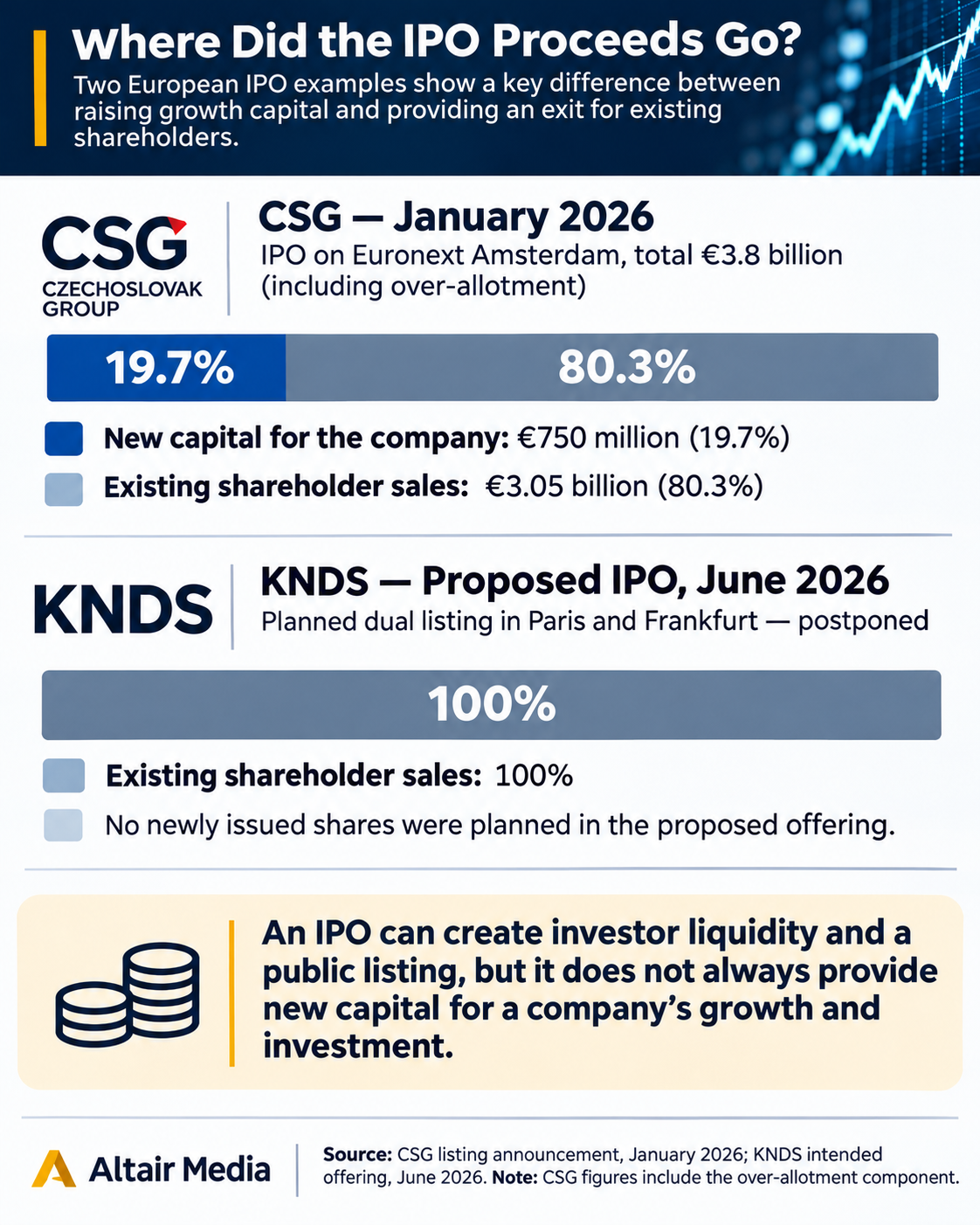
Had the transaction proceeded in that form, KNDS would have gained a public listing and a broader investor base, but the IPO itself would not have generated new equity capital for the company.
A secondary offering does not remove money from a company’s balance sheet. Rather, it transfers ownership between investors without directly increasing the company’s financial resources.
That distinction is particularly important for private-equity-backed businesses.
Investment funds eventually need to realise returns and distribute capital to their own investors. An IPO provides a mechanism for doing so, potentially allowing successful companies to remain independent while their ownership becomes more widely distributed.
These exits also play a constructive role in the wider investment ecosystem. Capital returned to shareholders can be reinvested in new businesses, venture capital funds or other productive assets.
However, such reinvestment is not automatic, and it does not necessarily take place in the same country, sector or even continent.
This creates a fundamental distinction between improving investor liquidity and financing new corporate growth.
Europe needs both.
The European Commission’s Savings and Investments Union seeks to mobilise savings more effectively and channel additional capital towards the European economy. But an increase in investment flowing through public markets does not necessarily translate into an equivalent increase in newly issued corporate equity.
If additional demand is directed predominantly towards existing shares, it may support valuations and liquidity without immediately providing businesses with more capital for investment.
That does not make secondary transactions undesirable. Strong secondary markets can lower future financing costs, improve investor confidence and make subsequent primary offerings more attractive.
But it means that the success of Europe’s capital market reforms cannot be judged solely by IPO proceeds, trading volumes or market capitalisation.
The more important question is whether these reforms also increase the amount of capital available for productive investment.
For Europe’s industrial and technological ambitions, that distinction could prove decisive.
The real test for Europe’s capital markets
Europe’s next IPO cycle will provide more than an indication of investor confidence. It will test whether European financial markets can support the transition from privately financed growth companies to publicly listed international businesses.
The challenge extends across several dimensions: acceptable valuations, adequate liquidity, access to institutional investors and the ability to raise additional capital after listing.
The experiences of KNDS and Visma reveal how different companies can encounter similar valuation constraints, while Revolut demonstrates the continuing appeal of American capital markets. CSG, meanwhile, shows that successful European listings are possible but also illustrates why the composition of IPO proceeds matters.
The European Commission’s Savings and Investments Union represents an important attempt to strengthen the financial foundations of European competitiveness.
Yet deeper capital markets cannot be created through regulatory reform alone.
Companies must have confidence that public markets will recognise their economic prospects. Investors must be willing to provide long-term capital, while market structures must support both new equity issuance and shareholder liquidity.
Europe’s challenge is not simply to create more opportunities for investors to sell their holdings. It is also to ensure that successful businesses can obtain the capital required to expand, innovate and compete internationally.
As 2027 approaches, the most important question is therefore not which company will be the next to ring the opening bell.
It is whether European public markets can become attractive enough to finance the continent’s next generation of industrial and technological leaders — and sufficiently deep to retain their listings and support their subsequent growth.
Europe’s IPO challenge is not merely to bring more companies to market. It is to ensure that those markets can finance the growth that comes next.
Image credit
Illustration: Altair Media / AI-generated visual.
Image Caption
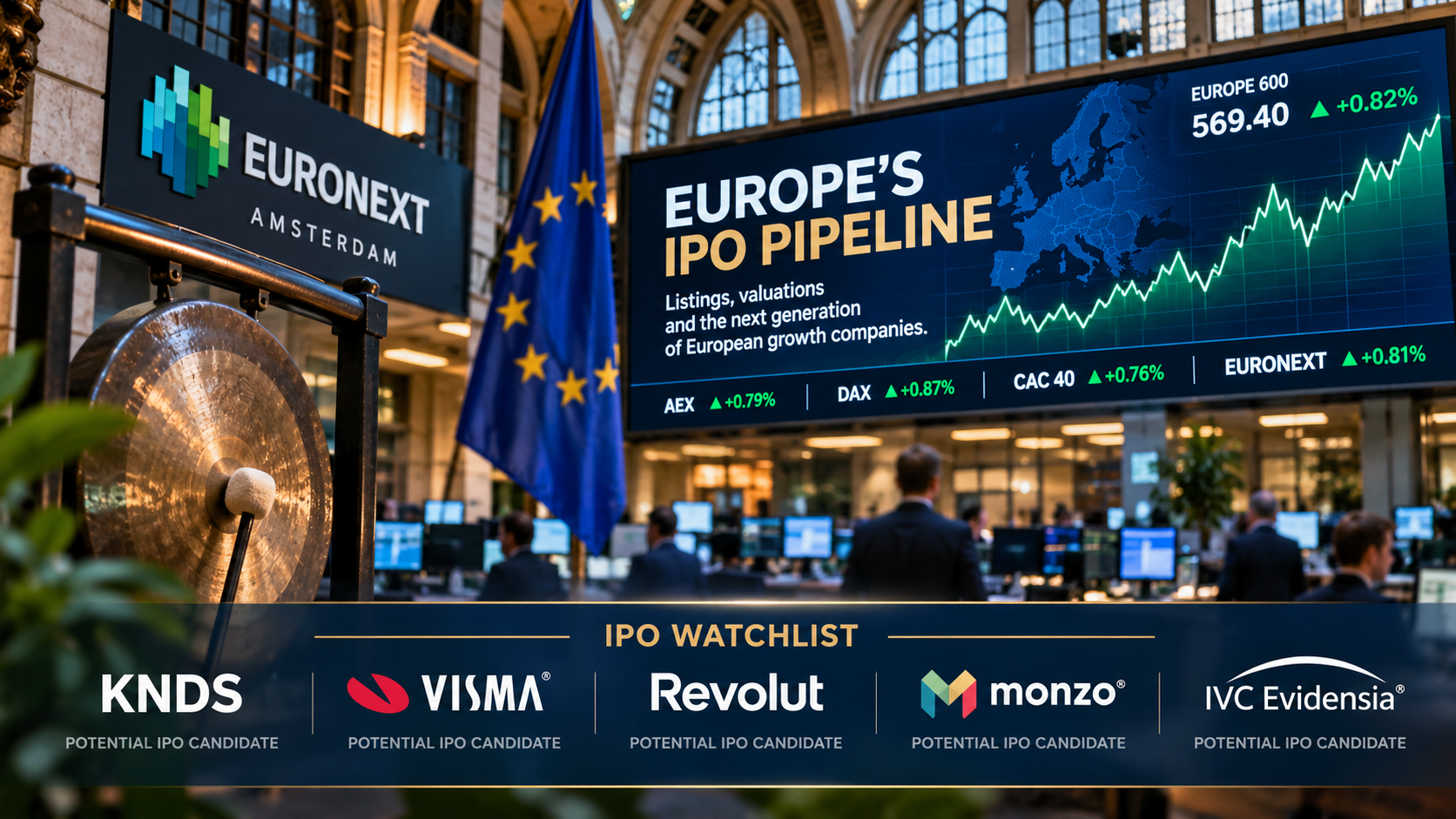
Europe’s IPO pipeline includes major companies such as KNDS, Visma, Revolut, Monzo and IVC Evidensia. Their potential listings highlight the challenges of market valuations, investor liquidity and access to growth capital across European financial markets.
