Europe Has an Investment Pact. But Where Is the Money?
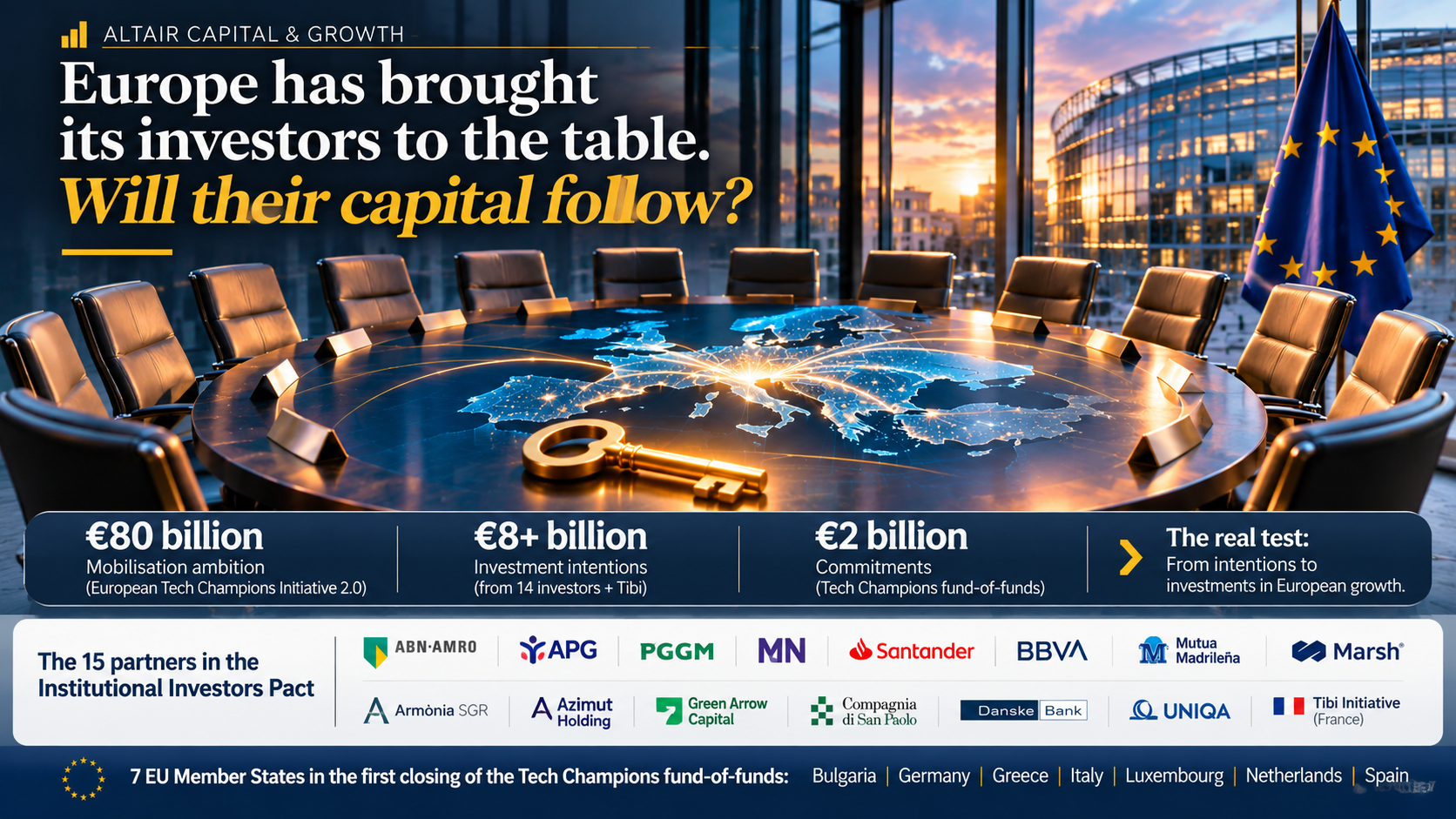
Fifteen investment partners have joined Europe’s new financing alliance. The real test is whether their intentions become investments in European growth.
On 9 November 2026, the European Investment Bank Group announced a new milestone in Europe’s effort to finance its technology companies. Fifteen investment partners, including Dutch pension managers APG and PGGM, had come together in an alliance intended to help mobilise up to €80 billion for European scale-ups.
The announcement highlighted more than €10 billion in investment intentions and commitments. Yet behind that headline lie different financial realities. Expressing an intention to invest is not the same as signing a binding commitment, and committing money to a fund does not mean it has already reached a technology company.
Understanding those differences is essential to assessing whether Europe’s latest investment initiative can deliver meaningful results.
After examining venture capital through Atomico, public markets through Euronext and pension investments through APG and PGGM, Capital & Growth now turns to the mechanism intended to connect Europe’s financial resources with the businesses that need them.
Five questions reveal what the new Institutional Investors Pact could achieve — and what remains unresolved.
🔑 1. Why does Europe need another investment agreement?
Europe’s difficulty in financing technology companies is no longer simply a question of identifying promising businesses. The greater challenge often comes when those companies need substantial capital to expand production, enter international markets or compete with established global players.
Institutional investors such as pension funds, insurers and asset managers control enormous financial resources, but many approach venture capital and growth equity cautiously. These investments can be difficult to evaluate, require long holding periods and offer fewer opportunities to sell than publicly traded shares.
The European Institutional Investors Pact, launched on 22 September 2026 by the European Commission and the EIB Group, seeks to address some of these obstacles. Rather than establishing another conventional investment fund, it provides a voluntary framework through which investors can identify opportunities, share information and discuss the conditions affecting long-term investment.
The underlying assumption is that Europe does not necessarily lack potential investors. It lacks some of the connections, investment structures and market conditions needed to bring their capital into European growth companies.
Whether a new agreement can overcome those barriers is another question. Institutional cooperation may improve access to opportunities, but it cannot remove commercial risks or guarantee attractive returns.
- The tension: Europe has institutions capable of mobilising capital, but bringing them together does not guarantee that their investment decisions will change.
🔑 2. How much money is actually on the table?
The EIB Group’s announcement on 9 November highlighted more than €10 billion in combined intentions and commitments — a headline figure that blends two very different financial realities.
Fourteen institutional investors, alongside France’s Tibi Initiative, expressed intentions to channel more than €8 billion into Europe’s innovation and scale-up ecosystem. The participants include APG, PGGM, ABN AMRO, Santander, BBVA and several other European financial institutions.
Separately, seven EU Member States joined the EIB Group in the first closing of the Tech Champions fund-of-funds, with approximately €2 billion in commitments. These represented a more advanced stage of financing, with the first investment approvals expected in the following weeks.
The distinction becomes even more important when considering the alliance’s broader ambition to mobilise up to €80 billion. That figure represents potential investment across the expanded European Tech Champions initiative and its surrounding investment ecosystem. It is not an existing fund containing €80 billion, nor evidence that this amount has already reached European companies.
To understand the financial reality, three stages must be distinguished:
INTENTIONS → COMMITMENTS → DEPLOYMENT
- Intentions: What investors say they intend to invest.
- Commitments: Capital formally pledged to investment vehicles.
- Deployment: Money actually invested in funds, businesses or projects.
Even deployment requires careful interpretation. Money invested in a venture capital fund may not reach an individual company immediately, while capital commitments can be drawn down over several years.
This distinction matters because the success of European financing initiatives is frequently communicated through their potential to mobilise large sums. For growing companies, the more immediate question is how much financing becomes available, under what conditions and within what timeframe.
- The tension: Europe has announced a substantial investment pipeline, but the distance between intentions, commitments and deployed capital remains crucial.
🔑 3. What makes this pact different from Europe’s existing investment funds?
The Institutional Investors Pact introduces two complementary mechanisms intended to make European growth investment more accessible to large financial institutions.
The first is an Investment Platform led by the EIB Group. It provides a common entry point through which institutional investors can explore investment opportunities, access information about fund managers and gain a clearer understanding of Europe’s venture capital and growth equity market.
The second is a Policy Dialogue Forum led by the European Commission, allowing participating investors to discuss regulatory developments and obstacles that may discourage long-term investment.
The European Investment Fund plays an important role in this arrangement. Through its established relationships with venture capital and private equity funds, the EIF can help connect institutional investors with specialist managers and investment opportunities that might otherwise be difficult to identify or evaluate.
However, the pact should not be confused with the investment vehicles it seeks to support.
The European Tech Champions Initiative 2.0 is designed to mobilise public and institutional capital through large investment funds. The separately managed Scaleup Europe Fund, targeting €5 billion in commitments, focuses on direct growth investments in European companies developing strategic technologies.
The pact provides a framework for connecting investors with these and other opportunities. It does not replace the commercial assessment of individual investments, nor does it guarantee that participating institutions will allocate capital.
The significance of the initiative therefore lies less in creating another layer of European financing than in attempting to improve the connections between existing investors, fund managers and investment instruments.
- The tension: Europe is lowering barriers to participation, but easier access does not automatically translate into stronger returns.
🔑 4. Will pension investors behave differently because of the pact?
The participation of APG and PGGM provides an especially revealing test of the initiative.
Both institutions already invest internationally across public and private markets, and both have supported European digital infrastructure. Their involvement in the new alliance therefore does not represent the beginning of their exposure to European technology or growth-related investments.
What could change is the range and scale of opportunities available to them.
Large institutional investors generally require experienced fund managers, diversified portfolios and investment structures that allow risks to be assessed and managed effectively. A deeper European market for growth funds could make it easier to allocate capital without requiring pension investors to evaluate individual technology companies themselves.
This matters particularly for businesses that have moved beyond the startup phase but still need substantial financing to expand. Such companies may have established products, customers and revenues, yet remain too risky or difficult to finance through conventional lending or public equity markets.
Specialist growth funds can provide a bridge between these companies and institutional capital, particularly when supported by investors with the experience and financial resources to manage large portfolios.
Nevertheless, participation in the pact does not oblige APG or PGGM to redirect pension savings towards European businesses. Their responsibilities to pension participants remain unchanged, and any investment must compete with opportunities elsewhere in the world.
The meaningful test is therefore not whether pension investors have joined the initiative, but whether it produces investments they would not otherwise have made — on terms consistent with their financial responsibilities.
- The tension: Europe’s pension investors are joining the financing initiative, but their willingness to participate commercially remains the decisive test.
🔑 5. How will Europe know whether the pact works?
The first measure of progress will be whether the announced investment intentions become formal commitments. The next will be whether those commitments translate into investments in European funds and, ultimately, financing for companies that might otherwise have struggled to raise capital.
But measuring success requires more than following the aggregate figures.
An important question is how transparently the EIB Group and participating institutions will report their progress. Will individual investment commitments be disclosed, or will the public mainly see consolidated figures? Can investors and policymakers distinguish between genuinely additional private capital and money that would have been invested anyway?
The EIB Group’s November announcement indicated that the first investment approvals under the Tech Champions fund-of-funds were expected within weeks. That provides an early opportunity to assess whether the initiative is moving from institutional agreement towards operational investment activity.
A broader assessment over the following twelve to eighteen months could examine how much of the announced investment interest has become binding commitments, how much has been drawn down and which European businesses have ultimately benefited. Such a period would provide a useful editorial benchmark, rather than an official deadline established by the pact.
The longer-term test is more demanding. Europe needs to determine whether institutional participation becomes a recurring feature of its investment market instead of a temporary response to public initiatives.
That requires credible financial returns, functioning exit markets and fund managers capable of attracting institutional capital across successive investment cycles. It also means assessing whether public participation genuinely encourages additional private investment or primarily supports activity that would have occurred anyway.
The pact could become an important step towards a more integrated European growth-capital market. Equally, its implementation may reveal how much Europe still depends on public institutions to organise investment flows that deeper private markets might otherwise generate.
Ultimately, success will depend not on the number of participating institutions or the size of their announced ambitions, but on whether the initiative helps establish a durable market for financing European growth.
- The tension: The pact will succeed not when investors sign another agreement, but when European growth capital becomes a market they repeatedly choose to enter.
The Altair Signal
Europe is beginning to connect its financial resources more deliberately. Whether those connections become lasting capital flows is still an open question.
The Institutional Investors Pact brings pension investors, financial institutions, the European Commission and the EIB Group into a common framework. Its investment platform and policy dialogue could reduce some of the barriers that have historically kept institutional capital at a distance from Europe’s growing technology companies.
But the difference between announced ambitions and financial results remains fundamental. Investment intentions must become commitments, commitments must translate into deployed capital, and successful investments must generate the confidence needed for investors to return.
Europe has already created many of the institutions required to finance its technological future. The next challenge is to make their cooperation produce a self-sustaining investment market.
Europe has brought its investors to the table. Will their capital follow?
This article is part of Altair Capital & Growth, an Altair Insights series exploring how capital is raised, invested and distributed across Europe’s economy. Following Atomico, Euronext and APG/PGGM, this fourth Signal examines whether Europe’s new Institutional Investors Pact can turn institutional interest into lasting growth investment.
Image credit
AI-generated editorial illustration for Altair Media. Institutional and financial information based on European Investment Bank Group announcements, September–November 2026. Logos are used for editorial identification.
Image caption
Europe has brought its investors to the table. Will their capital follow? The Institutional Investors Pact brings together 15 investment partners, including APG, PGGM and major European banks, with the ambition of mobilising substantial growth capital. The challenge is turning investment intentions into commitments and ultimately into financing for European companies.
