The Geography of Europe’s Returns
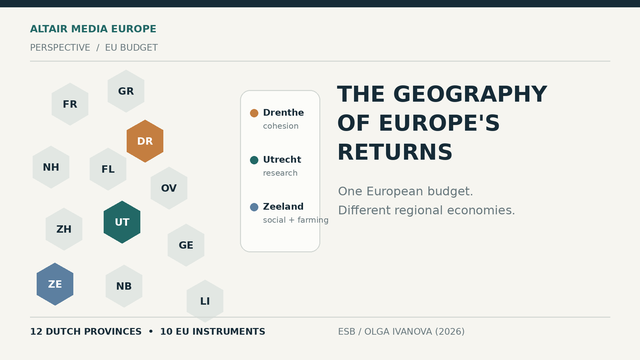
What a Dutch study of EU funds reveals about the places Europe chooses to strengthen
The Netherlands is a net contributor to the European Union. In budget negotiations, that fact often becomes the beginning and end of the argument. Money goes to Brussels; the question is how much comes back.
But money does not return to a country as a single sum with a single effect. It enters research institutions, farms, transport networks and regional economies. Its impact depends on what those places already do, what they lack and how they are connected to the rest of Europe.
A recent study by Olga Ivanova for Economisch Statistische Berichten makes that geography visible. Using the Dutch Environmental Assessment Agency’s EU-EMS model, she estimates the economic effects of ten EU funding instruments on the Netherlands’ twelve provinces. For every euro of Dutch contribution used as a benchmark, the estimated increase in provincial GDP ranges from €0.84 in North Holland and North Brabant to €2.00 in Drenthe. Seven provinces exceed one euro; the average is approximately €0.99.
“Money does not return to a country as a single sum with a single effect.”
Altair Media Europe
These are modelled economic effects, not cash repayments to provincial governments. Nor does the study calculate a return for every region in Europe. Its value lies elsewhere: it shows how misleading a national balance sheet can be when the benefits of European investment have a regional shape.
One budget, different economies
The mix of funds matters as much as the total.
In knowledge-intensive regions, research funding plays a larger role. Ivanova finds that Horizon accounts for a substantial share of the estimated gains in Utrecht and Groningen. In Drenthe and Zeeland, social and regional development funds, together with agricultural support, are more significant. The same European budget reaches these places through different parts of their economies.
That is neither surprising nor trivial. Research grants tend to flow towards institutions with the people, facilities and partnerships to compete for them. Agricultural funding reaches places where farming remains economically important. Regional funds address needs that cannot be met simply by concentrating more research money in established centres.
The result is a European investment system with several purposes at once. It can strengthen centres of scientific excellence, support employment and skills, improve connections, and help regions develop from their own starting points. Judging all of those instruments by one national figure conceals the choices they make.
“Judging all of those instruments by one national figure conceals the choices they make.”
Altair Media Europe
Ivanova’s model also captures effects beyond the place where a grant is awarded. Investment in another member state can increase demand for Dutch goods and services through trade. A stronger European region may therefore benefit a Dutch province without that province receiving the original funding. This is one reason the question of what a country “gets back” is harder than a comparison of payments and receipts suggests.
Growth has a geography
Europe’s next budget will face competing demands. It must support research and industrial capacity while also addressing differences between regions. The European Commission’s proposal for 2028–2034 seeks to bring several funding streams together in one national and regional partnership plan per member state, alongside stronger support for competitiveness and Horizon Europe.
The proposed structure has brought the role of regions into the budget debate. The European Committee of the Regions worries that decisions made through national plans could weaken regional programmes and reduce the influence of local and regional authorities. The Commission presents the plans as a way to tailor investment to local needs. Which of those ambitions prevails will depend on the final rules and how the plans are made.
Ivanova’s findings do not resolve that institutional dispute. They explain why it matters. Even within one country, EU funding works through markedly different regional economies. A plan drawn at national level must still be capable of seeing those differences.
A budget that favours competitive research can produce valuable discoveries. It may also send more funding to places that already have strong universities and established networks. A budget focused only on distributing money geographically may miss opportunities to build capabilities at European scale. Neither observation settles the allocation question. Together, they make it more precise.
“Every region benefits in its own way.”
Olga Ivanova, PBL — translated from her own commentary on the ESB article. (nl.linkedin.com)
What does a region need in order to take part in Europe’s next phase of growth? In one place, the answer may be a research facility. Elsewhere it may be technical training, a reliable energy connection, better transport or the capacity of local organisations to join cross-border projects. Those investments cannot always be assessed in isolation. A laboratory depends on skilled workers; a company depends on infrastructure; a region’s opportunities depend partly on its connections to other regions.
This is where the debate over competitiveness meets the debate over cohesion. Europe needs places capable of developing and scaling new technologies. It also needs more places able to participate in the economy those technologies create.
What the numbers can and cannot say
The ESB study estimates that EU funding modestly reduces inequality in GDP per head between Dutch provinces. In the model, the largest reduction in its measure of regional inequality is 0.61 percent, reached in 2025. The effect then diminishes over time.
That finding deserves a careful reading. It does not mean regional inequality has been solved, or that every fund delivers the same return. The estimates depend on assumptions about how investments affect productivity over time.
Research is particularly difficult to capture in a provincial GDP figure. A discovery may take years to become an economic application, and the resulting activity may emerge beyond the region where the research was funded. Ivanova notes the long and varied path from R&D spending to GDP, as well as the difficulty of assigning the effects of research by multinational companies to one province. A lower estimated return in a particular region therefore does not establish that its research funding has less value.
“When Europe decides where to invest, what kind of economic map does it hope to create?”
Altair Media Europe
The variation between provinces is still informative. Drenthe’s estimated gain is not a template that can simply be applied elsewhere, just as North Holland’s figure says little on its own about the value of its research base. Each result reflects an economic structure, a particular combination of European instruments and the limits of what a model can measure.
The wider lesson is less about finding a winning province than about asking better questions of the budget. Where does funding increase an existing strength? Where does it remove a barrier to participation? Where might an investment in one region create gains across borders? And where are capabilities needed before a region can make use of the opportunities Europe intends to finance?
A European budget is often presented as an agreement between governments over contributions and allocations. On the ground, it is also an arrangement between places with different capacities and futures. The Dutch study gives us one detailed view of that arrangement. It does not map the whole continent.
But it points towards a question that belongs at the centre of Europe’s budget debate: when Europe decides where to invest, what kind of economic map does it hope to create?
Sources: Olga Ivanova, “EU-fondsen leveren meeste Nederlandse provincies geld op”, ESB, 24 September 2026; European Commission proposal for the 2028–2034 EU budget; European Committee of the Regions on the role of regions in the proposed budget.
Image credit
Illustration: Altair Media Europe. Based on research by Olga Ivanova published in ESB (2026). (esb.nu)
Caption
A schematic view of the Netherlands’ twelve provinces. EU investment reaches regions through different parts of their economies, from research to cohesion and agriculture.
