Europe’s €10 Trillion Energy Test
Europe has the technology, the savings and the targets. What it lacks may be the financial architecture capable of connecting them.
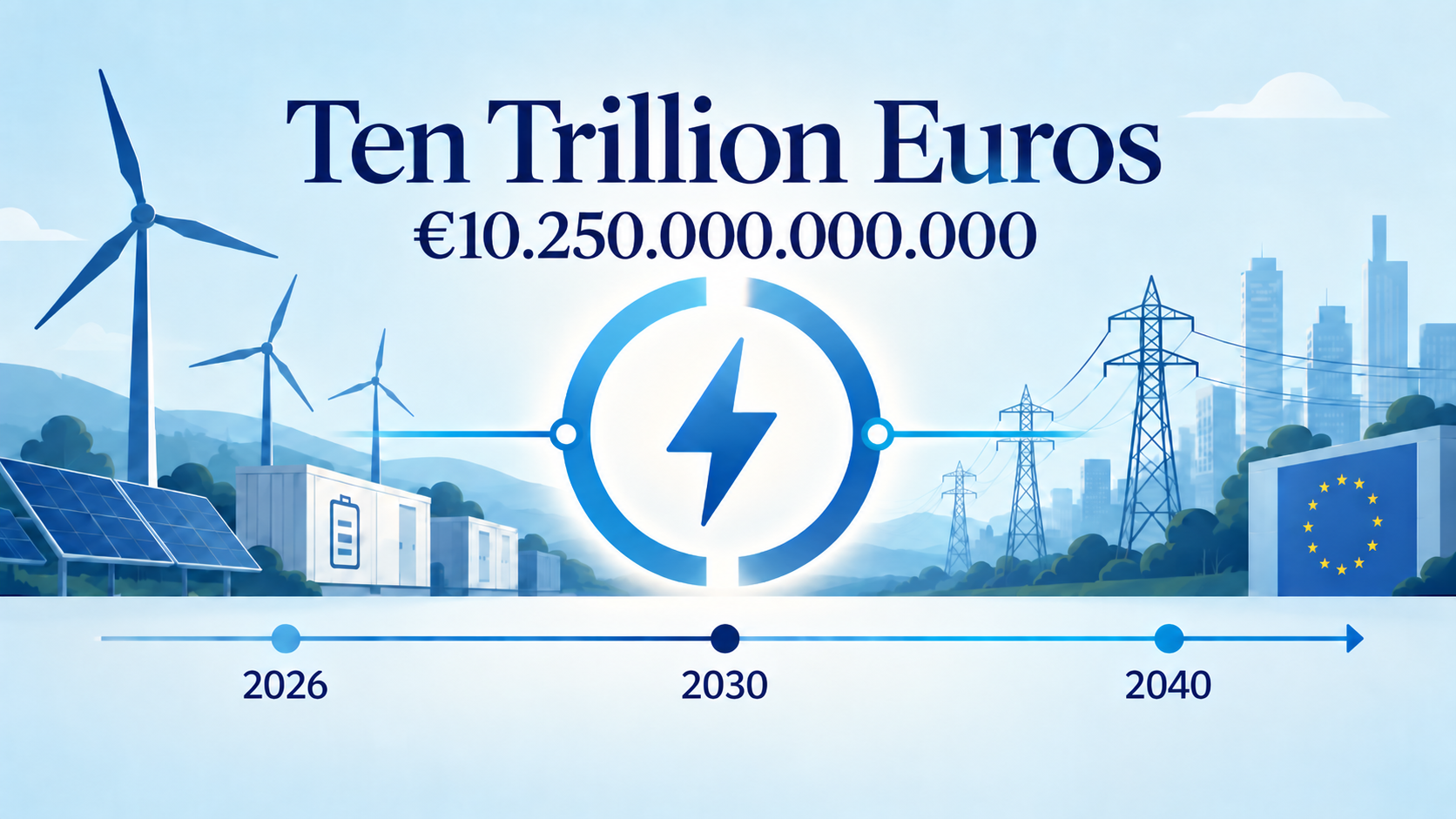
Europe’s energy transition is becoming a capital test. The European Commission estimates that energy-related investment must reach around €660 billion a year between 2026 and 2030, rising to approximately €695 billion annually between 2031 and 2040. Over fifteen years, that adds up to more than €10 trillion.
Europe largely knows what needs to be built. The harder question is whether it can finance it.
Can a fragmented European financial system turn more than €10 trillion into physical energy infrastructure by 2040?
🟦 Can Europe really triple its investment rate?
Between 2011 and 2021, European energy investment averaged roughly €240 billion a year. The level now required approaches €700 billion — almost three times as much, sustained for more than a decade.
Energy is not competing for capital in isolation. Europe is simultaneously trying to finance defence, digital infrastructure, semiconductors, housing and industrial renewal. Public budgets can support that effort, but they cannot carry a €10 trillion transformation.
Most of the capital will have to come from elsewhere.
🟦 If Europe has the money, why is investment still the constraint?
Europe is not short of financial wealth. Households hold vast savings, pension funds and insurers manage long-term capital, and European banks have balance sheets measured in trillions. But savings do not automatically become infrastructure.
A pension fund can buy global equities instantly. Financing a transmission network with long permitting cycles, construction risk and uncertain revenues is fundamentally different.
Europe’s problem is therefore not simply a shortage of capital. It is a shortage of capital willing to go where strategic investment is needed. The continent can be wealthy and still fail to build.
🟦 Why would capital accept European complexity?
The required investment does not enter one European market. It enters national permitting systems, different tariff regimes, regulatory frameworks and political environments. That fragmentation matters at this scale.
Capital prefers standardisation, predictability and repeatable structures. Europe often offers the opposite: individually viable projects embedded in nationally organised systems.
Policymakers regularly speak of “mobilising private capital” as though that capital has nowhere else to go. It does.
🟦 Who carries the risk before infrastructure becomes attractive?
Long-term investors often like infrastructure once it is operational. Stable, regulated assets can fit their portfolios extremely well. The problem lies earlier.
Europe needs capital during permitting, development and construction — precisely when uncertainty, delays and cost overruns are greatest. That creates the central financing contradiction of the transition: Europe needs private capital most when private capital has the strongest reason to hesitate.
The EIB, national institutions, banks and public guarantees can absorb parts of that risk. But at €10 trillion, individual interventions are not enough. They have to form a financing system.
🟦 What if strategic value does not produce the highest return?
Some of the infrastructure Europe needs most may not be the infrastructure markets value most highly.
Additional grid capacity can be necessary before demand arrives. Interconnectors can increase resilience without capturing all the economic benefits they create. Storage can strengthen the system while revenue models remain uncertain. Redundancy may look inefficient precisely because its value appears only when something goes wrong.
Financial markets price expected returns. Energy security also values resilience, optionality and strategic capacity. Those calculations will not always produce the same result.
And that is where Europe’s €10 trillion investment requirement becomes more than an energy transition. It becomes a test of what Europe expects its financial system to do.
The technologies can exist. The savings can exist. The projects can exist. Europe can still fail to connect them.
By 2040, the decisive question will not be how much capital Europe possessed, but whether its institutions managed to turn that capital into grids, generation, storage, interconnection and resilience.
That is Europe’s €10 trillion energy test.
Credit
Altair Media / OpenAI
Caption
Europe’s energy transition may require more than €10 trillion in investment by 2040 — turning the next phase of the transition into a test of Europe’s ability to convert capital into physical infrastructure.
